EG "make me a 120 minute Star Trek / Star Wars crossover". It should be more or less comparable to a big-budget studio film, although it doesn't have to pass a full Turing Test as long as it's pretty good. The AI doesn't have to be available to the public, as long as it's confirmed to exist.
 1,000
1,000People are also trading
Notice that no one believes anymore that a video model is going to generate a movie from a prompt, which is what people were predicting before. They think that an agentic AI is basically going to create its own internal movie company and organize a huge number of moving parts to create a movie.
This won't happen either, but it is far more plausible than what people were imagining before.
@DavidBolin I feel like creating 'movie subagents' would still resolve YES if the source was just 1 prompt.
@DavidBolin This comment from 7 months ago is what led me to take a large yes position:
https://manifold.markets/ScottAlexander/in-2028-will-an-ai-be-able-to-gener#xtapi2z2bio
I expect people smarter than me could have found this angle without having an example handed to them. Unclear to what degree this was priced in.
@Hakari https://artificialanalysis.ai/video/models
Best I could find. It looks like they only analyze API generation time over time (and even that, only fairly recently).
@inaimathi thanks for looking it up. sounds like a gap in the market.
I'm sure I'm not alone in being interested in efficiency.
@skibidist idk if there has been progress at the underlying architecture level, but there's been a lot of progress at the harness level.



Let's look at this, not like generating a movie, but coding it... I think Claude could totally do it with enough compute.
https://m.youtube.com/watch?v=8j-hR4fJywU&list=RD8j-hR4fJywU&start_radio=1

@Velaris that is around what I thought when i was making my initial bet. Recently I also looked at opus 5.5's ability to generate stories and it is nowhere near as bad as was for littler/older models (though since then the market also grew), I would say it is almost "acceptable" (considering that very much big budget studio films are quite bad in many senses), so it seems plausible that 1-1.5 years from now closed models at some kind of "mega agent management" (that is, a swarm of literally a million of agents) will be able to orchestrate coding/videogen of a film. Basically, make it more like humans make big films. Not one shot. But with scenarists, actors, operators, special effect experts and software, gluing together, multiple tries of each scene etc. But around as faster as current coding is faster than human coding.
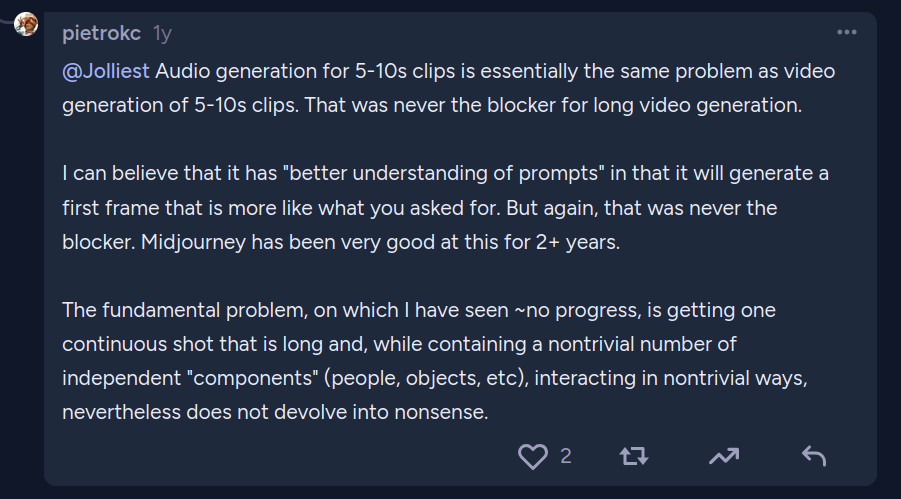
Among the myriad naysayers, @pietrokc does have consistently good takes
https://manifold.markets/ScottAlexander/in-2028-will-an-ai-be-able-to-gener#iesopni8rs
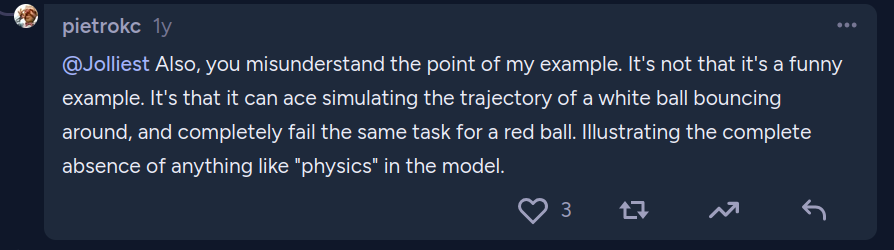
The reasoning makes sense, I just think it's the wrong framing in the context of this question. Video gen AI doesn't need to have an "accurate internal model of physics" in order to make a movie people would pay to watch
It's the same mistake the symbolic AI crowd made, believing that you first had to solve AI at the symbolic level before propagating that upwards towards more sophisticated forms of cognition. Turns out you can just smoosh everything together with neural nets and it will learn a passable generative modelling of continuous domains early on; and then hard symbolic reasoning will emerge at later stages as you throw more compute and data at it
https://manifold.markets/ScottAlexander/in-2028-will-an-ai-be-able-to-gener#vg9mpmoz6r
@MachiNi if you scroll down in this market there's so many confident predictions from a year ago. And now they've gone all so very quiet 🤣
@MachiNi all right then. I'll bet 100 mana YES if you bet 2000 mana NO
seems fair given differences in net worth


@0xseraphim If you need a loan, I would be willing to work something out with you. You seem consistently profitable, so if you need leverage to get more returns faster, hit me up.
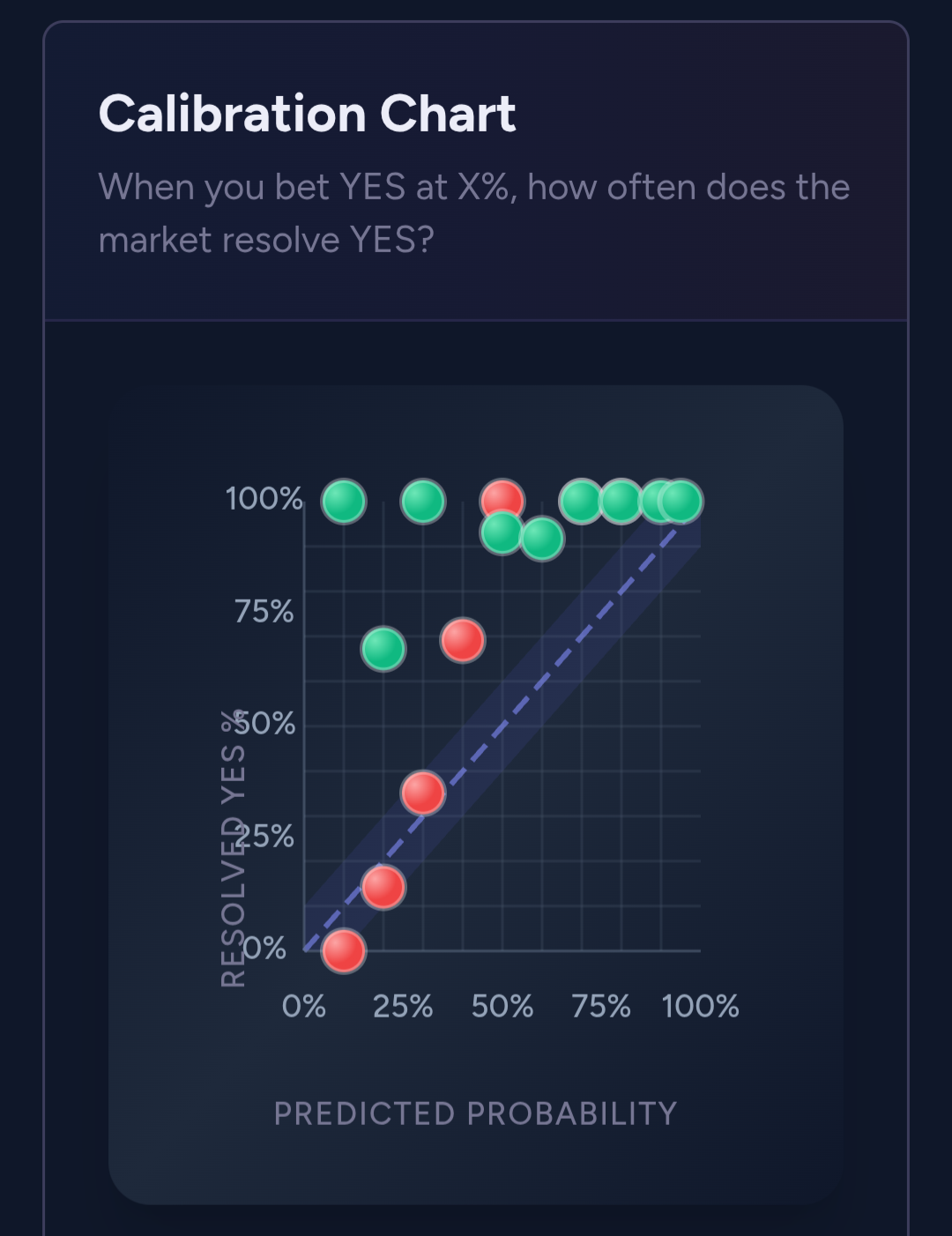
@Quroe dunno, never really looked at that. I'm mainly on manifold because the comments section is fire. Mana is just a secondary thing

@0xseraphim I mean, if you blow up somebody's notifications with @ tags to disparagingly goad them, what did you expect?
A little goading is fine (and can be great discourse), but the result in this instance is not surprising.
To paint a picture, you overdrafted on your "charisma bank account", and your "bank account" with them got closed. It might have turned out better if you had some reserves to draw on first before... whatever happened there.
@0xseraphim I believe this is true. But this is not an argument of kind, it's an argument of intensity. You did come on strong.
@0xseraphim There's a reason "be excellent to one another" is the motto of the Community Guidelines.
@0xseraphim Like, I have tried to goad you in the past. But if you had decided to not back up your beliefs with a trade, I wouldn't have kicked you while you were down. The trades speak for themselves.
@0xseraphim And I expressed gratitude when you played along in the song and dance we do here on Manifold: putting our money where our mouths are.
I implore you to meditate on these things. You've got this. 😊
@Quroe everyone on manifold can indeed be pure of heart and devoid of ego. The free market brings all together in the pursuit of truth. Hail Reason!
@0xseraphim
> Video gen AI doesn't need to have an "accurate internal model
> of physics" in order to make a movie people would pay to watch
I think you're probably right if the bar is "can make at least one movie that at least some people want to watch". But this market is much more stringent: it has to make a GOOD movie for ANY prompt (or, charitably, any reasonable prompt that could be the synopsis of a real movie).
I think it's clear that there are many reasonable prompts that would require the output movie to contain a lot of objects interacting in physically complicated ways for fairly long stretches. I have already given the example of a drama about jugglers. You can multiply the examples in your head. Current Sora-style videogen still can't do this. The Claude javascript generations are interesting and different, but at the end of the day they're good for schematic/undetailed video with simple movement with few "independent components" and if I ask for a live action movie it's not really going to work. Disney employs an army of PhDs just to animate the hair on their characters.
> hard symbolic reasoning will emerge at later stages as you throw
> more compute and data at it
I think this turned out to be correct, in some sense, for math and coding where you can do RLVR. I freely admit I was surprised by this. But I don't want to overcorrect. We have to understand the mechanism which led to success in math/code, and that seems to be a lot of RL in very restricted domains. What is the analogue for video? We have a lot of data, that's for sure, but we don't have any verifiable rewards. We could envision verifiable rewards if the model, instead of creating footage directly, created specs for a physics simulator. But then all the insane amount of data we have (10^10 hours of regular video?) doesn't help since it's not of that form.
@pietrokc I'm not sure that the video gen model has to support movies about jugglers in order for this to resolve YES
@0xseraphim "I'm mana-poor" --> well I would love to loan ya some mana at veeeery amenable interest rates
@pietrokc
> Disney employs an army of PhDs just to animate the hair on their characters.
Claude swarm can do this too (both the PhD and the hair parts).