Please add questions for what will happen in 2026 related to AI! I've added some clarifications below. If there is ambiguity I will resolve to my best judgement.
Clarifications
"SSI will release a product": It should be generally available in 2026; i.e. no waitlist. Should be an AI product; I’m not counting hats, clothing, etc.
"X will outperform the S&P": As measured at the end of the year. It's not sufficient for X to outperform at some point in the year.
"An LLM will beat me at chess": See this market:
“Epoch AI will estimate that there has been a training run using more than 5e27 FLOP” : according to this source or some other official announcement by the org.
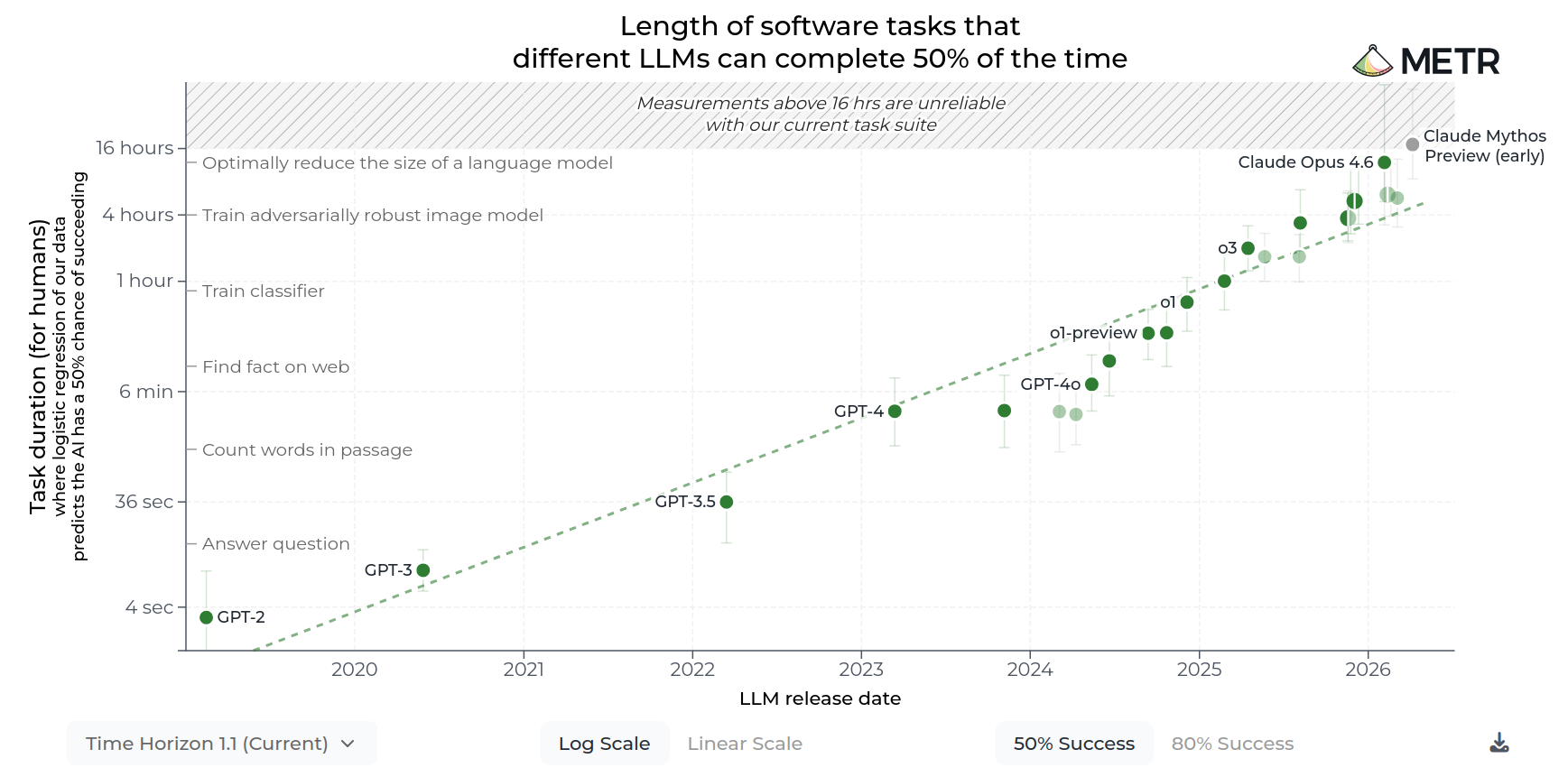
"The METR time horizon will exceed X hours": At 50% success rate, acoording to this source.
“Frontier Math Tier X >= Y%” refers to the top score on this leaderboard. The current top scores as of 2025-12-21 is 40.7% for Tier 1-3 and 18.8% for Tier 4.
“An open millennium prize problem is solved, involving some AI assistance”: refers to these famously difficult mathematics problems.
“Epoch Capabilities Index >= X” refers to this metric. The current leader as of 2025-12-18 is 154.
"Yudkowsky will publish a new book": It should be avalible to (pre)order some time in 2026. Resolves no if they announce it but you can't (pre)order it somewhere.
"Metaculus will predict AGI before 2030" means that at some point in 2026, this market has an estimate before 2030. The current estimate as of 2025-12-24 is May 2033.
"There will be an AI capabilities pause lasting at least a month involving frontier companies": This means that there is an agreement between frontier companies not to advance capabilities. Frontier companies not releasing new models for a month does not resolve this market.
"My median ASI timelines will shorten": My current estimate as of 2025-12-27 is March 2033.
"My P(doom) at EOY (resolves to %)" : Resolves to a %, rather at the end of year, except in the unlikely case that it's 0 or 100%, in which case I'll resolve NO or YES. My current estimate as of 2025-12-27 is 25%.
"An open source model will top Chatbot Arena in the 'text' category": This refers to this source.
"US unemployment rate reaches 10% due in part to AI": Based on this source, according to my judgment.
"Schmidhuber will continue to complain about people not citing his work properly", e.g. here.
“Thinking Machines will train and release their own model”: from scratch, not a finetune of another model
AI Summaries below:
Update 2025-12-19 (PST) (AI summary of creator comment): "Open source model" is defined as a model where the weights are publicly available.
Update 2025-12-20 (PST) (AI summary of creator comment): "I will think that a Chinese model is the best coding model for a period of at least a week": Cost and speed will not be considered unless they make the model difficult to use. Resolution will be based on how well the model performs on difficult coding tasks encountered by the creator.
Update 2025-12-21 (PST) (AI summary of creator comment): "An LLM will beat me at chess": The creator is rated approximately 1900 FIDE.
Update 2025-12-25 (PST) (AI summary of creator comment): "A significant advance in continual learning": The model should be able to remember facts or skills learned over a long period of time like a human. It should not make egregious errors related to memory that current bots in the AI village regularly commit.
Update 2025-12-30 (PST) (AI summary of creator comment): "There will be an international treaty/agreement centered on AI": Must be signed by 3+ countries and be legally binding. Non-binding declarations (like the Bletchley Declaration or Seoul Declaration) do not count. Examples that would count: Montreal Protocol or Non-Proliferation Treaty.
Update 2026-05-22 (PST) (AI summary of creator comment): xAI IPO: If SpaceX and xAI merge, this will resolve YES if SpaceX IPOs.
Update 2026-06-05 (PST) (AI summary of creator comment): "Epoch AI will estimate that there has been a training run using more than 5e27 FLOP": The creator plans to resolve all questions around January 1st, 2027 (end of year).
Update 2026-06-12 (PST) (AI summary of creator comment): "At least 3 people will do an anti-AI hunger strike": All 3 people must be part of one single strike, not across multiple separate strikes.
Update 2026-07-14 (PST) (AI summary of creator comment): "Thinking Machines will train and release their own model": The model must be publicly accessible (via website or API) to count as "released". Being trained but not yet accessible does not qualify.
 1,000
1,000People are also trading
(deleted)
@0xseraphim They say "Measurements above 16 hrs are unreliable with our current task suite" and haven't updated thier charts in a while.
https://metr.org/time-horizons/
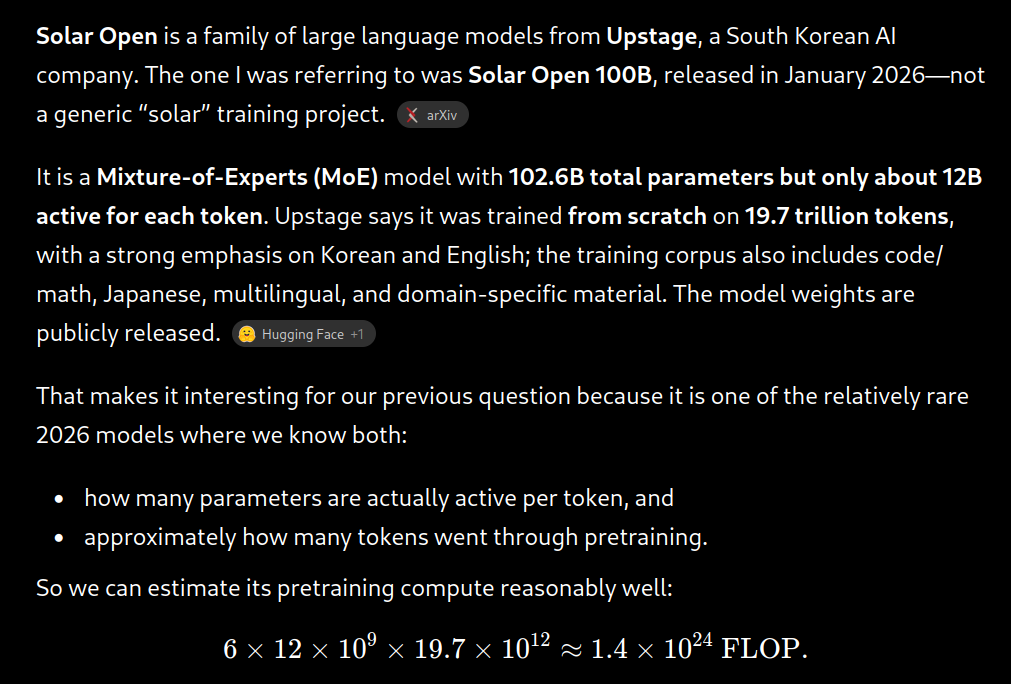

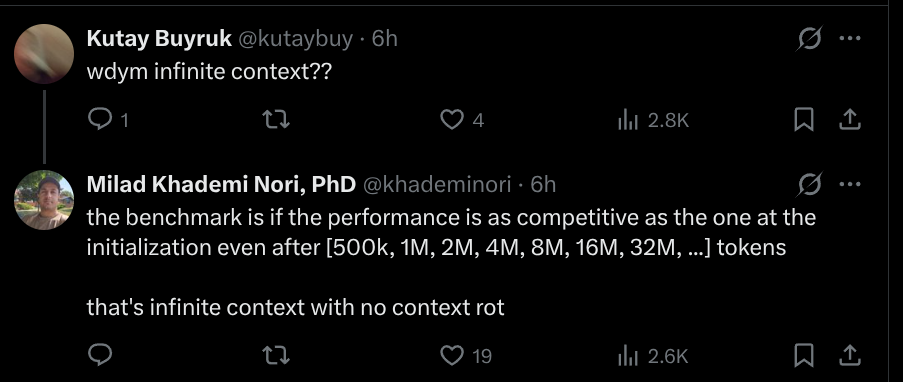
@MaxLennartson I'm willing to believe there's a difference. But can you come up with a clear formulation of what that difference is?
@0xseraphim I am not an AI expert so it is hard for me to come up with a good formulation so instead I had two AI models try. Unfortunately, I am unable to share the chats maybe you can try using an AI model. I first had the two models explain what the difference is and then I used the information from Nori to further explore. I used Gemini 3.7 Flash Claude Sonnet 5.