MANIFOLD
Tesla has more fully autonomous rides than Waymo in 2026?
477
Ṁ10kṀ740k
Dec 31
14%
chance

NOTE: This market includes any autonomous ride in a Tesla, not just the robotaxi service!

Waymo claims 700k fully autonomous rides in 2023, which was more than ~0 Tesla rides that were fully autonomous in 2023.

To define fully autonomous, I'll use the following definition:

  • No human operates any direct controls inside the vehicle like the steering wheel or pedals

  • No human in the car actively monitors the driving being ready to intervene

  • Must be of a non-trivial distance (e.g. crossing the parking lot does not count)

  • Can't be in a fixed track, like the Las Vegas Loop

See also: /JamesGrugett/will-tesla-serve-more-fully-autonom

I will delay resolution until both companies report results or until the result is extremely clear, or until it's January 2028, where I'll make an informed guess.

Market context
Get
Ṁ1,000
to start trading!
Sort by:

Another week, another half dozen non-updates:

  1. As Reuters reports, Tesla seems to be intentionally not moving forward on getting humans out of the driver's seats for their California rideshare service.

  2. No scaling up in Austin in recent weeks. Long wait times, and at most a handful of cars with no passenger seat safety monitor. Still driver's seat safety drivers for highway routes. (The California fleet is growing, but, see above, that doesn't mean much.)

  3. More NHTSA crash data coming in a couple weeks. I continue to look at the existing data every way I can think of and am finding no rationale in the data for a bull case on Tesla robotaxis catching up to human-level safety, let alone Waymo. The vibes in the Tesla community are another story and it's not impossible that the next FSD version will deliver some more 9's of reliability. It's happened before and just a couple more 9's should do the trick. Those last couple can be a bitch though.

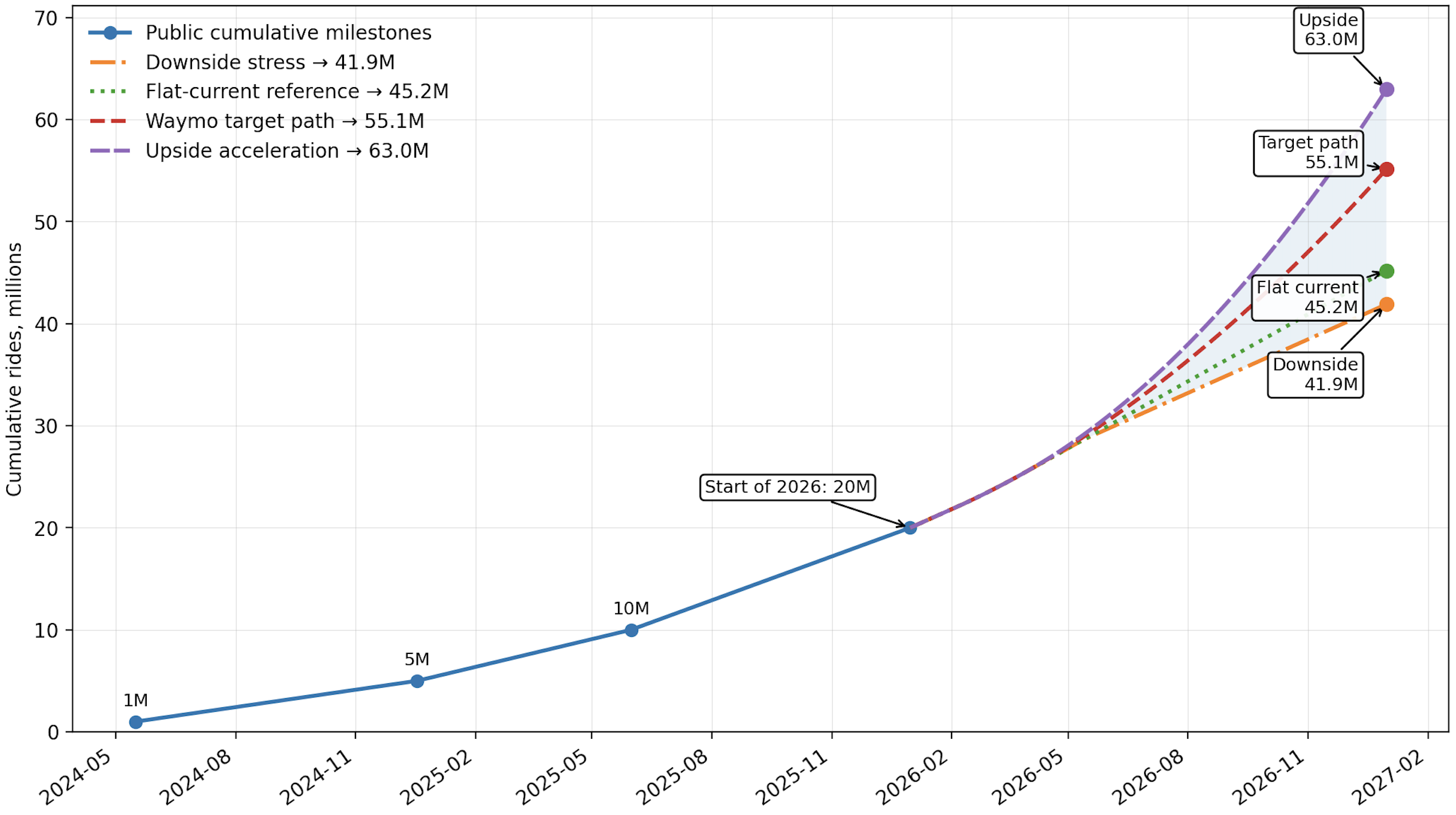
  4. That still leaves me at well under 10% for this market since each new version of FSD needs months of testing to know whether the requisite jump in miles-per-incident has materialized. Meanwhile Waymo is projected to hit a million rides per week by the end of the year.

  5. But aren't the cybercabs going into mass production? Not quite. Elon Musk is managing expectations by admitting that production will be excruciatingly slow at first. I imagine he sincerely believes, as he has for like 10 years, that the next FSD version is going to be the one that really cracks vision-only level 4 autonomy and so he's just getting all the ducks in a row to scale up the moment that happens. To be clear, I don't think he'll be wrong about this forever. I mean, he might be, I think his brain broke a couple years ago. But even if that's wrong, the probability that this is the year, for any given year, is low.

  6. My longstanding prediction is that FSD will live up to its name when Musk relents on lidar, or we get something like a year of additional AI progress, starting a bit before last year's Austin robotaxi launch. So... any month now?

PS: An important caveat on my "longstanding prediction": I didn't think to add the "or a year of AI progress" when I originally made the prediction about a year ago. So you should rightly treat that as cope and if Tesla does pull this off anytime soon, count me as wrong. In fact, let me try to keep myself fully honest by collecting my timeline of predictions:

  • 2025-04-25: No Tesla level 4 self-driving without Lidar and radar and hi-def pre-mapping and remote assistance (not to be confused with remote supervision). Definitely not level 4 by the end of August 2025. Most likely the launch just doesn't happen.

  • 2025-06-20: It’s feeling more plausible that this will finally happen maybe next year.

  • 2025-06-27: The autonomous delivery was effectively a publicity stunt and no normal customers will be getting autonomous deliveries at least through the summer.

  • 2025-07-18: I believe (with, um, just barely over 50% confidence?) that Tesla is stringing us along with these controlled demos while they finish getting to actual level 4 autonomy.

  • 2025-09-19: I’m ever-so-gradually more sanguine about my at-the-time seemingly cope-addled prediction that Tesla is faking being at level 4 autonomy.

  • 2025-11-07: Another possibility is Tesla is yolo’ing it, keeping the total autonomous miles low enough that luck is on their side while they finish figuring out actual level 4 autonomy.

  • 2025-12-26: In retrospect in April I should've said either lidar etc or another year of AI progress. No strong prediction but vision-only level 4 self-driving in 2026 is looking steadily less far-fetched. At least it should become clear in 2026 how full of shit Elon Musk has been about this.

  • 2026-01-02: You'll be duly impressed if you try Tesla's FSD. The progress is palpable and eventually it's going to happen for real.

  • 2026-01-23: I don't think the safety-monitor-less robotaxi rides count as real yet. But if, in 2031, I can't read a book in the driver's seat of a Tesla, I'll be surprised. On the other hand, if Tesla pulls off vision-only self-driving by summer 2026, I'll officially have been super wrong last April.

  • 2026-01-23: Conditional on 100 million miles of possibly illegally unsupervised FSD in privately owned Teslas by August 31, 2026, at least one person dies that way.

There is the wrong assumption of the accuracy of crowd robotaxi counts BUT only 139 out of 200 Waymos counted in Austin with same methods. At least 30% undercounted. Harder to find robotaxi (Waymo-Tesla) in the SF Bay Area. 67 Waymos counted in SF Bay Area out of 1000 Waymo claimed. I believe the main mechanism if bothering to submit the license plate of the ride you got by less than 1% of the customers. No Tesla employees will submit license plates of tesla employee robotaxi fleet. Waymo license plate count is below the words VEHICLE FLEET.

So Robotaxitracker.com massively undercounts claimed Waymos BUT people think it has a good count of Tesla Robotaxi?

Tesla has registered and filed paperwork for 1655 robotaxi in December 2025 for SF Bay Area. They must have set aside or are using those cars with license plates. They have filed paper work for 798 drivers for SF Bay Area. There are hundreds of drivers and cars giving employee rides which would not get reported in the counts.

Tesla said 500+ robotaxi in Jan 2026 where lying on the earnings call can get them sued. Evidence supports that there are now 1000+ active robotaxi (~800 SF Bay Area, ~200 Austin and 200+ Employee rides) but count fails like counts huge misses for Waymo. There are 2000+ set aside or active robotaxi. 1655 at least in SF Bay Area, 200-300+ Austin inferred by miscounts, 100-200+ cybercabs in factory.

opened a Ṁ250 NO at 20% order

@brianwang please put limit orders

I love this market. Can somebody place large orders on YES?

opened a Ṁ500 YES at 1.0% order

@MachiNi order to win 50k up for a limited time. 🤣

My understanding of the state of things:

Waymo hit 200M autonomous miles this week and launched in Houston and Orlando et al, bringing them to 10 cities altogether. They seem serious about scaling. Also Waymo is unambiguously many times safer than human drivers. See Kelsey Piper's excellent analysis.

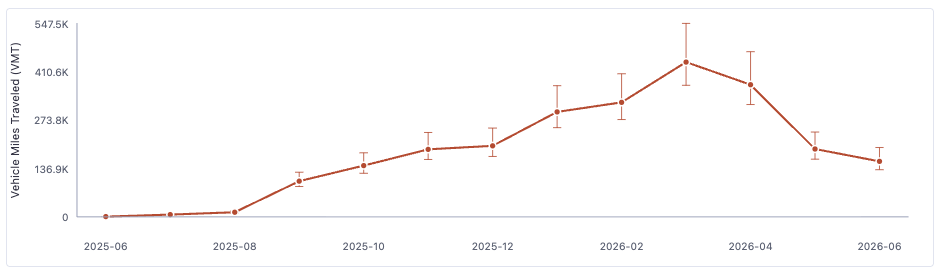
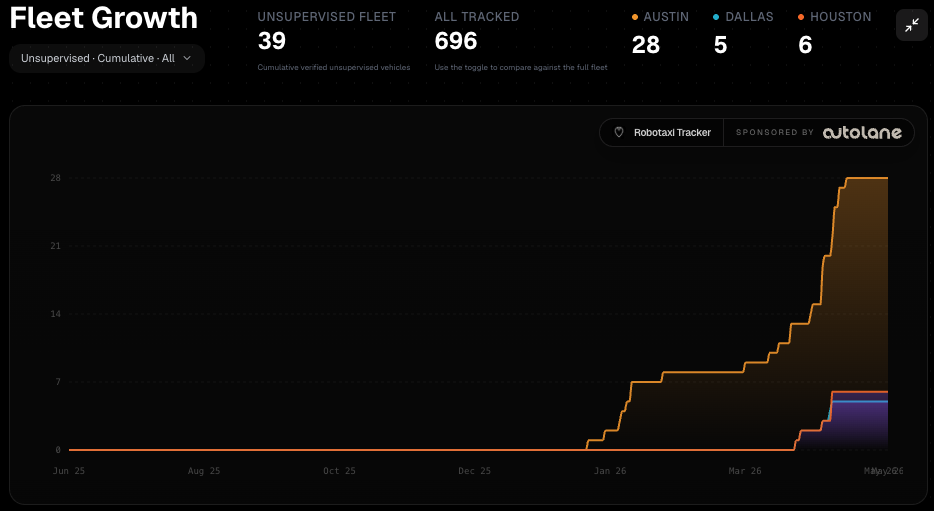
Tesla is up to around 840k miles if we believe crowdsourced estimates, with little growth in recent months and not enough data to say much about how safe the full self-driving is when unsupervised. It seems to be somewhat worse than humans so far, per NHTSA data. In California, Tesla has humans in the driver's seat and they haven't applied for the permits to remove them. (My guess is that that's because California requires more transparency than Tesla's willing to be subjected to at this early stage.) In Austin they're at 45 robotaxis with mostly empty driver's seats -- exceptions for trips that include highways, and for bad weather for a couple days at least. Of those 45 robotaxis, 8 are what they call fully unsupervised: no passenger seat safety monitor, no chase cars, remote supervision unknown.

@dreev 5 recent incidents of Tesla robotaxis from NHTSA, which included a stopped robotaxi hit by a bus, three 1-4mph incidents and one minor damage object hit at 17mph.

Raines has some of the most thorough analysis of Tesla robotaxi safety.

https://x.com/raines1220

Tesla California vehicles can transition to remove safety driver in about 4 months. Tesla has 1600 drivers registered in California and 300-600 deployed now. Say they add vehicles with drivers in CA, 800 in March, 1600 in april, then remove drivers over process taking about 2 months or so.

Hundreds of Tesla Cybercabs are in the factory as seen by Joe Tegtmeyer on a tour. 25+ Cybercabs in use in Austin and dozens early builds under various testing. Over 400+ Tesla robotaxi in California and Austin by crowdsourced count of license plates which is an undercount. Perhaps in the 50% range of total vehicles. If even hundreds of Cybercabs per month are deployed and then scaled to a few thousand then those will be robotaxi and it will be game over. Cybercab will have full scale production of 3+ million per year from Gigatexas. 10,000 per day. Getting to 10% of production would be comparable to a model 3 or model y line. 1000 per day.

10X parameter model Tesla FSD will be released soon. A safety leap with 10X parameter model when at fault crash rate is already at levels shown mean scaling inflection can happen March-May 2026.

Waymo is trying to double or at best triple miles in 2026. They cannot custom build vehicles with sensors more than a few per day.

@brianwang
>"Tesla California vehicles can transition to remove safety driver in about 4 months."


How long do you think it will be from application submission to getting licence? A much easier regulatory ask, to do taxi rides for employees with safety drivers took about 6 months IIRC.

Is that before your 4 month changeover period starts? Also might be a while before application is submitted?

It is obviously easy to see possibility that for states requiring a licence application process that has not started yet, the transition to driverless/monitor-less might only begin very late in the year if this year at all. Are there enough states that don't have protracted licence application process?

Grok suggested
"realistic 2026 output is expected to be low—likely only a few thousand to low tens of thousands of units total for the year"
Most of those are going to be towards the end of the year due to early part of S ramp shape. Will that be enough to catch up? If it is 20k or 30k produced in time to be operating for last month of year then there might be enough cybercabs to do it but will they have that many cybercabs produced and if so will there be that many places where they can be deployed?

Waymo will certainly build their lead for many months of 2026. Whether Tesla goes rushing past them in late 2026 or early 2027 or later or more slowly still seem open questions.

Raines has some of the most thorough analysis of Tesla robotaxi safety.

https://x.com/raines1220

I've been looking into the raw data and Raines is incorrect about what the NHTSA data tells us so far. I added an addendum to this post about it:

https://agifriday.substack.com/p/crashla2

To go further out on a limb, in case it inspires more markets or wagers we could have: I believe Tesla is intentionally keeping mileage low enough (including not pursuing permitting in California) that it's hard to tell exactly how safe they are. Because vision-only self-driving, impressive as it when tested over thousands of miles by individual people, is not yet safe enough to scale up.

I think even folks like Raine who are making plots showing Tesla's progress are admitting that unsupervised FSD hasn't hit human-level yet. They're squinting and torturing the data (eg, only counting at-fault incidents, despite Tesla redacting the incident details so these are rough guesses on fault) until they see an upward trend. Here's the graph I get using unfiltered incident data:

And if I filter by fault it has a vaguely similar shape, but the confidence bands are even wider.

I'm anxious to see if there's a jump in safety with Tesla's new AI chips. Any markets on that specifically?

@ChristopherRandles Elon interview at Gigaberlin out on video.

https://www.youtube.com/watch?v=sTxnv59CwuY

A few minutes in. Tesla has started production of cybercab at gigaberlin. Same video toward the end optimus is in production. Previously said the million unit capacity line will scale production in second half of 2026. Ten million unit optimus line being built in texas and should start 2027 probably later half. From other videos about the Texas optimus line.

There are hundreds of cybercabs inside the factory. They do not have steering wheels or pedals.

https://www.youtube.com/watch?v=USzVDZdpbQM&t=594s

Only a few thousand could be placed into a parking lot near the factory.

There are 25 cybercabs testing in Austin. 8+ vehicles without drivers, monitors or chase cars. 400+ vehicles. Prices being charged for rides is 25% of the cost of Waymo.

@dreev AI5 will not come into cars until mid 2027. The big safety jump is to come with 10X parameter model and reasoning model. The early AI5 chips will be made in bursts. Those can be placed into Optimus. Cars need inventory of fully qualified complete AI5 in kits ready to add into cars with no issues of disrupting production. Optimus can come out in dribs and drabs with no impact because there is no strict delivery times.

@brianwang

The big safety jump is to come with 10X parameter model and reasoning model.

Do you mean another 10X jump between today's FSD v14 and 2027's AI5? FSD v14 was itself a 10X jump, right? It did seem to make a noticeable difference. I'm unclear if there's something else concrete for Tesla bulls to pin their hopes on for 2026.

Over 400+ Tesla robotaxi in California and Austin by crowdsourced count of license plates which is an undercount. Perhaps in the 50% range of total vehicles.

It makes sense to suspect that crowdsourced data from robotaxitracker.com is undercounting but they seem to be going to great lengths to avoid that. In particular, they anchor their plots based on official numbers from Tesla and interpolate. So I don't think they're systematically underestimating. Quite the opposite, I suspect Tesla is counting miles where they have a human in the driver's seat. Not California rides -- those are separate -- but Austin rides that include highways, plus a few cases we know of where Tesla moved the safety monitors back to the driver's seat during questionable weather. I'm willing to believe that those are small enough fractions of rides that it doesn't change the numbers much but I think if anything the crowdsourced mileage numbers are overestimating, not underestimating.

@dreev The robotaxi tracker has counted about 144 Waymo in Austin out of a claimed 200 Waymo fleet. So if you believe the specific Waymo claim than the Waymo sample says they counted about 70% and it is easier to spot Waymo with Lidar vs telling the difference between regular Tesla and Tesla with robotaxi writing on it. I think it would be even harder to count in the larger SF Bay Area. Tesla had registered with California CPUC 798 drivers and 1655 vehicles for robotaxi as of Dec 2025. Made a mistake before mixing up drivers and vehicles.

REmoving safety drivers. Tesla under its current testing license can and actually must remove safety drivers for the 50,000+ miles of safety data to be submitted. the additional supervised driving safety miles can be submitted as an addendum to the submission. 50,000+ miles must be representative sample of the miles for the area to be approved (like the whole Bay Area).

Exact DMV Mileage & Data Requirements (Proposed Rules)

Driverless Testing Permit (first step to remove safety drivers; §227.42 in proposed Article 3.7):

  • Minimum 50,000 autonomous miles (fleet total/aggregate VMT across all vehicles, not per vehicle) on public roads throughout the proposed Operational Design Domain (ODD).

  • Miles must be logged under a valid DMV Drivered Testing Permit (the basic one Tesla already holds) while the Automated Driving System (ADS) is fully engaged in autonomous mode (SAE Level 4/5 equivalent).

  • ODD must be explicitly defined in the application (full SF Bay Area = specific counties, road types, speed limits, weather/visibility conditions, time of day, traffic density, etc.). The 50k miles must be representative and spread across that ODD—not concentrated in easy suburbs.

Deployment Permit (required for paid commercial robotaxi service; proposed Article 3.8):

  • Additional/minimum 50,000 autonomous miles throughout the intended ODD (can be accumulated under Drivered or Driverless Testing Permit).

How the data package must be collected & submitted

  • Miles, disengagements, collisions, and braking events (≥0.5g deceleration with ≥7 mph speed drop) must be formally reported to DMV (monthly/annual during testing; prompt collision reports if property damage >$1,000, injury, or fatality).

  • Full Safety Case / Safety Assessment submission with the application, including:

    • Use-case description and detailed ODD map/boundaries.

    • Non-proprietary system design, validation/verification testing (simulation + real-world).

    • Safety management system, fleet maintenance, remote operations/assistance protocols.

    • Incident response, post-crash behavior, first-responder interaction plan.

    • Cybersecurity, misuse mitigation, data on disengagements/collisions/braking events (with root causes, remediations, and comparison to human baselines).

    • Proof of $5M financial responsibility, emergency geofencing, law-enforcement override, etc.

  • DMV can request supplemental data (sensor logs, video, etc.).

  • Tesla’s current supervised TCP “Robotaxi” miles (with human safety drivers under Level 2 FSD) and consumer FSD Supervised miles do not count—they are not logged under a DMV AV Testing Permit as autonomous-mode miles.

No fixed intervention or crash-rate standard in the proposed rules. Approval is holistic: DMV evaluates whether the Safety Case demonstrates “no unreasonable risk.” A near-zero intervention rate over 50k–200k+ miles in relevant Bay Area conditions would be exceptionally strong evidence (far better than historical submissions) and would almost certainly meet or exceed what regulators have accepted from others. There is no automatic “X miles per disengagement = approved” checkbox.

  • Valid DMV Deployment Permit + at least 30 days of actual operations under that DMV permit in the intended ODD (with attestation of dates, locations, hours).

  • Submit via Tier 3 Advice Letter: TCP authority (already held), Passenger Safety Plan (detailed policies on remote operator response times, passenger egress in failures, emergency handling, shared-ride safety, accessibility, complaint processes, etc.), passenger consent/notice plan, ODD map, remote-operator training outline.

  • CPUC reviews for passenger/public safety and operational readiness (30-day initial review + possible protests/public comment; total process can take 3–9+ months).

  • Once approved: Quarterly reporting on trips, VMT, incidents, complaints, accessibility, etc. (no disengagement reporting once in deployment).

Full guidance: CPUC AV Program Applications document (August 2024, still current).Comparison to Waymo, Cruise, Zoox & Geofencing

  • All three accumulated far more than 50k miles under the old case-by-case rules (Waymo: tens of millions total; Cruise and Zoox: millions each). Early public disengagement rates were ~1 per 10k–13k miles (Waymo 2019: 1 per ~13k; improving dramatically later). They submitted massive Safety Cases with crash data competitive with or better than human baselines in their ODDs.

  • They started with small geofenced ODDs (e.g., specific SF neighborhoods or Foster City for Zoox) for initial driverless testing/deployment approvals, then filed amendments/expansions with additional data. No evidence of a “higher standard” written into rules for larger areas like the full Bay Area—but the ODD must be justified by representative data. Proposing the entire Bay Area from day one is allowed if your 50k+ miles cover the diversity (hills, fog, dense urban, freeways, etc.); regulators can (and likely will) impose initial limitations or phased rollout for caution

@dreev Do you mean another 10X jump between today's FSD v14 and 2027's AI5? FSD v14 was itself a 10X jump, right?

10X parameter model was claim to drop in Aug-Sep but it did not. 10X parameter model fits on AI4. They even said they could make some kind of distilled FSD 14.X lite model for AI3/HW3. But they would not try until after unsupervised was working for AI4/HW4.

They also talked about a full reasoning model for FSD 14.3 by end of 2025. This did not happen either but they did start introducing reasoning into the FSD 14.2.XX models.

>It did seem to make a noticeable difference. I'm unclear if there's something else concrete for Tesla bulls to pin their hopes on for 2026.

10X parameters did not happen yet. Full reasoning did not happen yet. There is some reason that extra testing was needed before releasing. Tesla is not rushing it. Tesla standards and avoidance of causing safety problems is a higher standard than CPUC applications.

Tesla level of commitment and confidence goes to the billions already spent and the hundreds of millions associated with making hundreds ($30-60M) or 1000-2000 cybercabs ($300M-600M) without fully deploying them. Delaying from April Cybercab would be setting a significant pile of money on fire each month there is not the better FSD models and full unlock of robotaxi miles. But rushing and having incidents would be big lawsuits and longer delays from a 100X worse media treatment versus Waymo.

Firmware analysis (which can indicates new features that will be rolled out) indicates going beyond basic FSD voice commands to more elaborate voice commands. This would obviously makes sense to integrate with robotaxi. Massive user experience increase and non-trivial improvement in safety and perceived safety and control.

Tesla bull case. Getting full FSD approvals in Europe (starting in March 20 in Netherlands apparently). FSD approval in China was targeting March but delayed. Full local AI training data center operational already (Tesla able to use and train with local China data, not able to export those results but usable for perfecting FSD China). Full FSD in China would be as big or bigger than FSD US revenue impact.

Tesla FSD quality and experience quality is also connected to improved XAI Grok. Getting XAI Grok 4.20 voice and XAi Grok 5 Voice or even a non-voice model integrated with Tesla cars will matter. This will have car sales, FSD sales percentage and robotaxi experience and safety impacts.

Using a smaller version of Grok 4.20 (the beta is a 500B parameter model). Distilling it to 100-200B would fit into the 16GB of the 300 Teraops AI4/HW4 (10X a regular laptop compute) for digitally emulated humans - an AI automated version of Terminal Viewer where remote support people take control of computers. Would use this to displace say Asia or Eastern europe based groups of millions of humans doing customer support. need a module on the customer service or other enterprise computer to capture and stream the screen live (like FSD captures video of driving) and capture the keystrokes and mouse and the inverse. ALso having a Grok model for inference would be able to utilize potentially 5+ million 160 watt chips for about 800 MW of distributed inference compute in the fleet. The advantage of leveraging $10+ billion of deployed distributed compute.

@brianwang I had that impression too. However it is probably wrong? Relevant tweet appears to be
https://x.com/elonmusk/status/1953003713666400755
Tesla is training a new FSD model with ~10X params and a big improvement to video compression loss. Probably ready for public release end of next month if testing goes well.
6 Aug 2025

Training suggests not released at that 6 Aug 2025 date. Robotaxis started with v14 in June. So could be v15 that is 10 X parameters of the v14 being used by robotaxis. However v14 was only available to Tesla customers from about October so it could well make sense that this refers to v14 that was still in training before being released to Tesla owners in October.

Seems more likely wasn't released within a month of 6 Aug but was released late Oct ie v14. Otherwise that one month to release has become nearly 7 months.

@ChristopherRandles FSD 14.3 was previously the full reasoning model (able to drop a driver or passenger in front of destination and then able to go find its own parking). A capability that is in the robotaxi FSD builds. The 10X parameter model was described as a different FSD build. But with the delays and chunking of which reasoning capabilities were in the various point releases. It is unclear if the full 10X parameter will release together with remaining reasoning and unclear what the naming of that model will be. 10X parameter model release would be declared in the release notes, official X posts, elon post and would be seen by people analyzing the footprint and technical specs of each model. Full reasoning release same deal. Ashok, Elon, robotaxi team etc.. would tell us. Those would be spike the ball moments.

@brianwang
https://www.notateslaapp.com/news/2999/tesla-fsds-10x-parameter-update-many-new-features-release-in-september

Tesla FSD V14: 10x Parameter Update, New Features, Releases in September
These new skills will be enabled by a massive new FSD model that is currently in the late stages of training and could see a public release as soon as the end of September.

...
CEO Elon Musk has been teasing a major new FSD update, v14, based on the progress made with the version of the software deployed in Robotaxi that Tesla aimed to roll out to customers in September.

Above article seems to me to indicate fairly strongly that 10x parameters model is v14 compared to v13

>"The 10X parameter model was described as a different FSD build."
Where is your source for this and why are you restating this without supporting evidence? Different fsd build could be v14 rather than v13 AFAICS.
Robotaxi v14 had not and still hasn't been publicly released seems a plausibly defensible position.

One risk is that Tesla prioritizes the recursive loop of Optimus robots building Optimus robots instead of self driving.

@JamesGrugett I haven't been following Optimus progress very closely but I'd probably bet against mass production of Optimi in 2026, just on priors.

But with self-driving, I'm gradually getting convinced that Tesla is maybe months away from having a bonafide level 4 system (that's at least as safe as human drivers -- we know that a human plus FSD is already safer than humans alone). So shooting past Waymo in 2027 is something I wouldn't necessarily bet against at this point. But I'm still rooting for Waymo and hope they're able to hyperscale as well.

And just to reemphasize, Tesla's unsupervised robotaxis are arguably still at the controlled-demo stage, with big question marks on whether they're cheating with remote supervision (contrast with Waymo's remote assistance, in which the car always autonomously stops before asking for human help). Those doubts will be put to rest when Tesla scales up but we're not there yet, which is why I'm still betting on NO at current market odds (31%). Tesla has to first fully crack vision-only autonomy and then pass Waymo, which is also growing exponentially. (Looks like Waymo's about to hit 200 million autonomous miles, less than a year after hitting 100 million.)

@dreev Yeah haha, the Optimus thing is a few years out. Probably not super relevant, just thought I'd throw that in for the people who haven't heard of the larger Tesla vision.

(And strategically, I think you could make the case that Tesla should bet the whole company on prioritizing Optimus. They started doing this by halting production of S and X models so they can retool those factories for Optimus.)

I basically agree with the current state of things in Tesla self-driving, but am just a bit more optimistic they can ship full self-driving in the next few months and gain lead with a vastly larger number of deployed vehicles.

@dreev Waymo cannot hyperscale for years. It is impossible. Why? There is not enough volume of their type of robotaxi grade Lidar. They have a projected forecast of maybe 6000 vehicles by the end of 2027. If they did not contractually commit enough so that the Lidar and other sensor suppliers can expand or make new factory then there will be no supply of that component. They have been making the vehicles at 1000-1500 per year. Only recently starting averaging 100 units per month. Cannot be someone elses robotaxi grade Lidar because they have not tuned the software to it. They are hand building the added sensors onto someone elses car. They would also need some kind of factory to work on scaling the process of making complete with all sensors vehicles. Have the announcements of contracts for factories and guaranteed purchases been made? Do they have a few billion behind the scaling of supply chain?

Tesla’s head of Vehicle Engineering, Lars Moravy, stated in a U.S. Senate committee hearing that Tesla has invested over $2 billion (capex) in the purpose-built autonomous vehicle (AV) production line at Giga Texas — this is the dedicated Unboxed manufacturing line for Cybercab.

Unboxed has been in development since at least Tesla’s March 2023 Investor Day (publicly announced as the process to enable ~50% lower production costs and ~40% smaller factory footprint). Multiple patents were filed/granted 2024–2025. It is being implemented inside the existing Giga Texas footprint (which has had cumulative investment of roughly $10–12B+ since 2021, shared across Model Y, Cybertruck, and now Cybercab)

Tesla guided over $20 billion in total capex for 2026 (more than double 2025’s $8.5B).

  • Dedicated Cybercab production lines (Unboxed ramp)

  • Optimus robot lines

  • Semi truck

  • Battery/LFP/lithium refineries

  • AI compute

@TimothyJohnson5c16 Ah, thanks for this. That's a meaningful update for me. I've written down my thoughts in a comment on my Tesla robotaxi market.

© Manifold Markets, Inc.TermsPrivacy