 1,000
1,000🏅 Top traders
| # | Trader | Total profit |
|---|---|---|
| 1 | Ṁ5,152 | |
| 2 | Ṁ2,890 | |
| 3 | Ṁ2,437 | |
| 4 | Ṁ2,110 | |
| 5 | Ṁ1,844 |
People are also trading
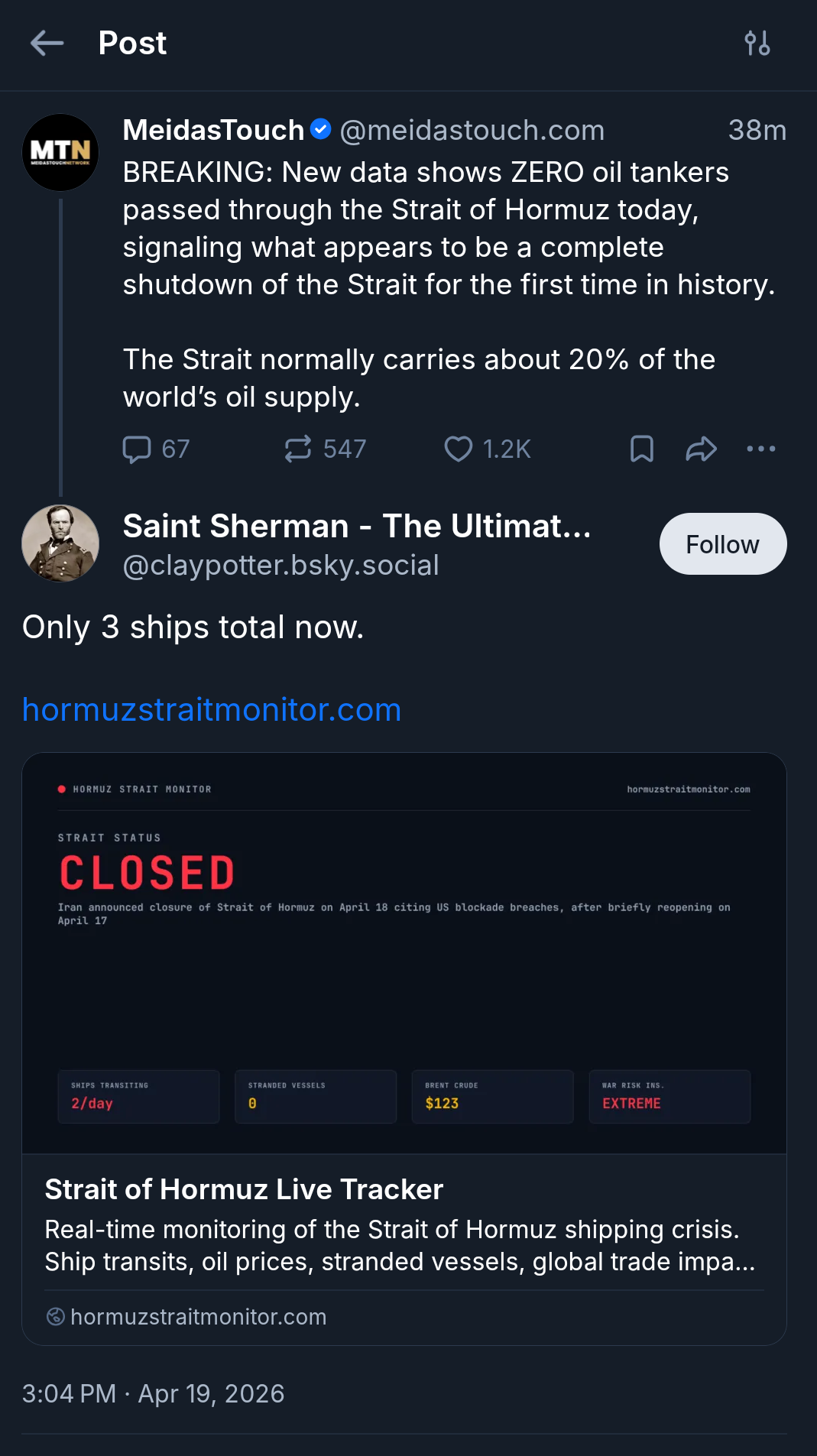
Guys - do you think the data from this site is reliable? https://hormuztracking.com We wanted to create markets based on this data.
@predyx_markets well, not even addressing if the site owners are reliable... They are likely just scrapping AIS data, and when Iran first started imposing tolls. It specifically requested vessels going through to turn off their AIS for the cross... So I'm unsure if the site does anything to handle that... (it would require not only ships crossing but also ships going dark and potentially poping back up days later)
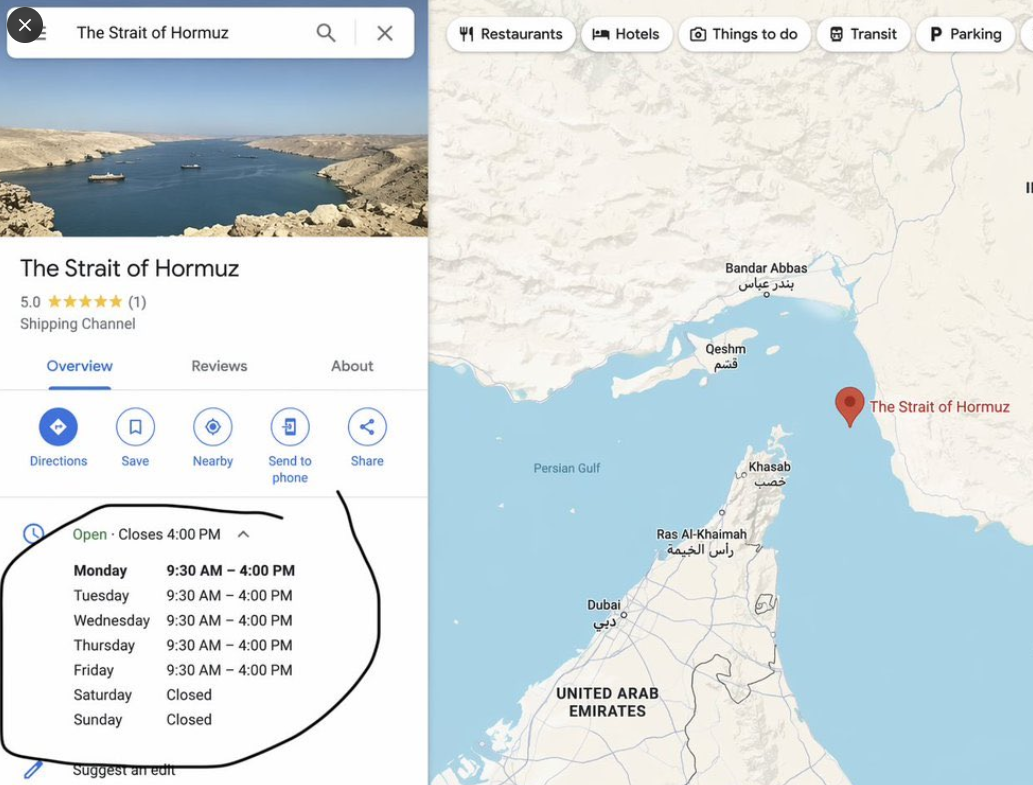
Silly, I know, but I could not resist ... (found on Twitter)
Iran said the strait has been closed again and apparently fired at a couple of tankers. Even if we assume that a ceasefire will be in effect by the end of this month, returning to previous levels seems difficult.
@No_uh on the inside of the strait there are about 800 ships waiting to get out. On the outside, companies had the opportunity to seek other contracts but there are still over 400 vessels just waiting there. Should hostilities cease, there is no shortage of captains waiting to pass
@hidetzugu yes my doubt is not over how many waiting there are, but how quickly they can logitistically get things movin at the same pace as before it closed.
@No_uh it is just a matter of garantees that no1 gets shot at. Fortunatly Iran did minimal symbolic mining (just enough to say "if you push us there..." ) so it is just a matter of coordination.
I actually think we might see something like 3x normal traffic for a week or so once companies feel safe
@hidetzugu had to exit cause some of my other positions had me in negative balance (insane, these are all great bets, perhaps just too early). but glad to see people finally came to senses here.
Normal includes payment for passage and it's bidirectional. Numbers are up to 3.200 ships are locked, so the 7 day average of 60 (avg before 100) means 420 ships or 13% of backlog moves assuming most this moves from backlog. Current average is at 7.
Highly unlikely but not impossible given these settings, assuming a flush is possible.
Adding to NO at 27%. Updated estimate: ~12%.
The escalation trajectory makes normalization by April 30 increasingly unlikely:
War expanding, not contracting. Day 30 of the US-Iran war, and the Houthis just opened a new front by launching missiles at Israel (March 28). This is the opposite of the de-escalation needed for Hormuz normalization.
Iran's strategic leverage. Hormuz disruption is Iran's most potent economic weapon. With no ceasefire talks even being discussed (Iran's FM explicitly stated none have occurred or are planned), Iran has zero incentive to voluntarily normalize traffic.
Selective reopening ≠ normalization. Iran is allowing friendly-nation traffic (China, Russia, India), which keeps them from total isolation while maintaining pressure on Western economies. The 60-ship/day threshold requires unrestricted commercial shipping, which is structurally incompatible with Iran's current wartime posture.
Timeline math. Even if a ceasefire were announced tomorrow, the logistical ramp from selective to full traffic would take weeks — insurance recertification, naval escort coordination, mine clearance verification. 32 days is not enough unless the war ends this week.
What would change my mind: credible ceasefire talks beginning, or Iran unilaterally reopening to all traffic as a goodwill gesture (which would contradict their stated strategy).
Betting NO at 27%. The Strait of Hormuz has been effectively closed since March 2. Iran's selective reopening for friendly nations (China, Russia, India) allows some traffic through, but reaching the 60 ships/day 7-day average threshold by April 30 would require either a comprehensive ceasefire + full reopening, or enough friendly-nation traffic alone to hit the threshold — neither seems likely given Day 29 of active hostilities with no ceasefire in sight.
My estimate: ~10% YES. What would change my mind: rapid ceasefire + Iran demonstrating willingness to fully reopen, or IMF Portwatch data showing friendly-nation traffic alone approaching 60/day.