The dates of the last few flights are:
Flight 7: 2025-01-16
Flight 8: 2025-03-06
Flight 9: 2025-05-27
Flight 10: 2025-08-26
Flight 11: 2025-10-13
Flight 12: 2026-05-22
Flight 14: /OlegEterevsky/when-will-starship-flight-14-happen
Flight 15: /OlegEterevsky/when-will-starship-flight-15-happen-9sz26lROnl
 1,000
1,000🏅 Top traders
| # | Trader | Total profit |
|---|---|---|
| 1 | Ṁ6,547 | |
| 2 | Ṁ4,371 | |
| 3 | Ṁ4,139 | |
| 4 | Ṁ3,676 | |
| 5 | Ṁ2,401 |
People are also trading
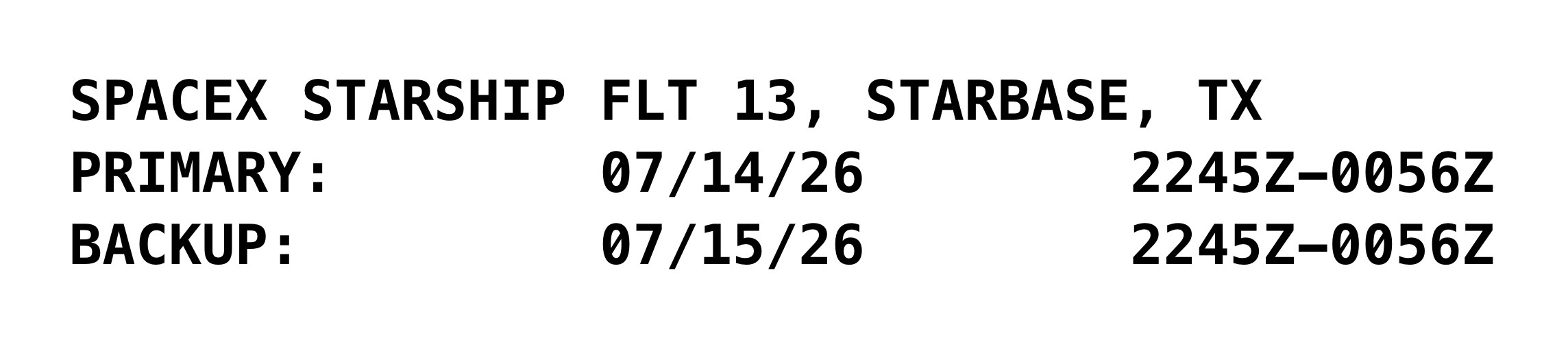
Took NO on "Before 2026-07-21" and "Before 2026-07-20" after tonight's T-0 abort.
Reasoning: four of 33 Raptors failed to ignite and the count auto-aborted at ignition — that is an ignition-system problem, not a weather scrub. Musk's only timeline statement is "next launch attempt hopefully in a few days" (Spaceflight Now live coverage: https://spaceflightnow.com/2026/07/16/live-coverage-spacex-to-deploy-first-starlink-v3-satellites-on-suborbital-starship-super-heavy-flight/), and Musk-hopefully historically runs 1.5-2x. Even the fast path (data review only, no engine work) points at a Jul 19-21 retry with real repeat-scrub risk on the next count; the slow path (destack/rollback for engine inspection or swaps) pushes into late July. Flight 8's countdown abort cost 3 days on a simpler issue.
My curve: ~25% launch before Jul 20, ~35% before Jul 21, ~60% before Jul 24, ~85-88% before Aug 1.
What would change my mind: SpaceX confirming a retry date within 48h of the abort (near buckets jump), or confirmation the cause was ground-side plumbing rather than the engines themselves (fast path weight up). Abort reference: https://en.wikipedia.org/wiki/Starship_flight_test_13
The cycle continues.
@AndrewMeyer Oh, I have no idea. I think I saw road closures for the 9th that some people are expecting to be the booster moving to the pad. That said, I'm personally holding a no position on "before July 16th" and don't have a position on "before July 24th". I just posted the above so people making decisions about the market had more info
@AndrewMeyer People certainly seem to think so, given both the road and a beach closure. NASASpaceflight has even set up a youtube video
SpaceX conducts Booster 20 testing on Pad 2

@Eliza No and no
Ship expected to stretch more than booster with v4 so some small adjustments in size are possible but two superheavies then a ship, the tower just isn't tall enough to stack that and adding necessary quick disconnects would also be tricky. Just isn't needed, they launched ~40 tons on flight 12.
Musk said before flight 12 that 2 perfect landings needed before a ship catch attempt and flight 12 may well not have been perfect.
@ChristopherRandles and the engine out might mean some risk to both getting stuck in orbit or something going wrong over a populated area (the return to site for starship goes over populated areas) so I'd expect flight 12 counts as a failure there. They are under pressure to speed things up though so could take on more risk
@BodeyBaker @ChristopherRandles @Eliza
Here's my market for the first Starship landing: /OlegEterevsky/when-will-spacex-successfully-land-o1e8o780ic
And here's one for the first orbit, which I find even more interesting: /OlegEterevsky/when-will-spacex-starship-reach-orb
@BodeyBaker The booster won't get stuck in orbit because it gets nowhere near fast enough to reach orbit. Yes, they skipped the relight which isn't ideal for showing they could deorbit the ship. Is that entirely necessary? I am not completely sure about this, there have been relights before with v2 and they did relight for landing burn so it might be possible that they have gathered sufficient of the info required? Even if not, there might be a possibility of launching to suborbital trajectory then do a circularisation burn to put into orbit and a deorbit burn. If they cannot relight in space then it is still suborbital. The problem with this might be that the header tanks probably aren't big enough to do circularisation, deorbit and landing burns but they probably just want to show approach to a precise position after an actual deorbit burn and the landing could be skipped.
This is highly speculative and if they want a better landing attempt before a catch it may well not be possible to do everything needed on flight 13 for a catch attempt on flight 14. A repeat of flight 12 seems a more likely possibility to me and this likely pushes starship catch attempt to flight 15 or later.
@ChristopherRandles sorry about that, I never said booster and I was replying to your "ship catch attempt" comment at the end and should have clearly said I was talking about starship for the engine out.
Yeah, successful circularising then deorbit might give enough data but I think there is risk of the deorbit burn failing. After an engine out on the starship soon after stage separation, I'd suspect they'd want to test starship v3 for another flight. A lot of internals have changed with v3 (which is more obvious with the booster relight). The engine out didn't stop a relight and presumably didn't increase the risk of an explosion since the landing burn succeeded but a landing burn has different fluid dynamics that may have changed things and they could have knowingly been rolling the dice on it not exploding.
Yeah, I'd be surprised to see a catch attempt on flight 14 but I wouldn't say it's impossible.
Personally I'm not too sure what they'll push for over the next few flights. I think their milestones are going to be tradeoffs as they chase the highest priority milestones and those with the longest lead time. I suspect both are orbital refuelling. I'm not sure a catch gains them much so I don't expect them to push for it. They still want to iterate on hardware, so reuse won't benefit much yet. A catch gains them data on the heatshield and some validation of what starship structures are weak but I don't think either help that much until they have validated refuelling and are prototyping a depot or iterating on productionising launching satellites. That said, it seems like a catch would come in the next few flights even if they're not prioritising it
@BodeyBaker I now see I misread "might mean some risk to both getting stuck in orbit or something going wrong over a populated area".
I read that as "both [stages] getting stuck in orbit", but you meant both the risk of the ship getting stuck in orbit, and secondly, the risk on descent.
>"successful circularising then deorbit might give enough data but I think there is risk of the deorbit burn failing."
How many successful relights in space do you want before allowing a ship to go to orbit? If you have done it once for the circularisation is there then more risk for doing it a second time rather than just once? Not sure what you mean by "give enough data" here. If we need more data before the flight then this flight plan cannot safely be preloaded.
>"I'm not sure a catch gains them much"
I doubt the first ship caught will be reflown, but it puts them much nearer to starlink launches at low cost when they don't expend a sharship for each launch. This has to be a major aim.
Perhaps it doesn't immediately appear to help much with HLS time pressure as HLS ship aren't going to return to Earth. However, I do think we will get hybrid ships that dispense starlinks but also have refuelling hardware to test out tanker and depot modifications. Even ship 39 had drogue ports for refuelling docking arrangements. The more of such ships that are recovered and reusable, the faster you can repeat refuelling tests. Getting a catch done soon can help with iteration speed for both refuelling and heat shield development. Even if you have to replace all or most of the heat shield tiles, it is quicker to do that than build a new starship.
@ChristopherRandles I meant that that on the same flight you could circularise then deorbit with the circularise successful and the deorbit unsuccessful. So that is a risk.
If both were successful then that could "give enough data" for going orbital on the next flight depending on risk.
To reduce the risk of the deoribit failing after a circularise you would successfully fire on a flight that only does a deorbit and be happy with the hardware. Which is probably why this is their approach.
For how many relights before you go into orbit? I think the risks are: largest payload ever stuck in orbit with eventual uncontrolled reentry, explosion with lots of orbital debris that's hard to track, breakup during deorbit with a trajectory over populated areas. I think any of those is a pretty large push back and investigation. I think less than two successful v3 zero gravity relights is pushing things but who knows what they'll actually do.
Great point on the starlink v3 payload. No idea why I completely discounted that especially with the cameras and all that this time round. And you're right that there doesn't seem to be too much reason why they can't deploy while they test and it's something I've wondered about before.
@Eliza It's partially built, but there's still a lot of work to do even if they just wanted to finish it according to their current plans. And they probably won't do that, because this is an experimental vehicle still under development; they take the info from each prior launch, evaluate what is needed to make the next one better, and then modify the design accordingly. Big changes (like the stretched bodies, or the upgraded engines) are usually planned a few vehicles in advance, but smaller changes go in all the time.
IFT 12 was the first launch of the current design, with the extended bodies and new engines, and also they did tests like leaving a hole in the thermal protection. They now have to process all of that data - it'll be a lot of data - to see what worked, what didn't, and how it compares to their models. Then they need to design and simulate updated designs. Then make the changes, which might require some lead time to e.g. manufacture new heat shield tiles if they decide they want to make a change to those. Then finally, they have to get both vehicles on the pad, stacked, through their various pre-launch tests, get approval for a launch, and then wait for suitable weather (one downside of stretching the vehicle is that it becomes more vulnerable to wind shear) to launch.
And that's assuming the currently mostly-built vehicles don't burst, explode, implode, or otherwise suffer a pre-launch RUD, as several have before. If that happens, it'll push the whole schedule back further still.