NOTE: This market includes any autonomous ride in a Tesla, not just the robotaxi service!
Waymo claims 700k fully autonomous rides in 2023, which was more than ~0 Tesla rides that were fully autonomous in 2023.
To define fully autonomous, I'll use the following definition:
No human operates any direct controls inside the vehicle like the steering wheel or pedals
No human in the car actively monitors the driving being ready to intervene
Must be of a non-trivial distance (e.g. crossing the parking lot does not count)
Can't be in a fixed track, like the Las Vegas Loop
See also: /JamesGrugett/will-tesla-serve-more-fully-autonom
I will delay resolution until both companies report results or until the result is extremely clear, or until it's January 2028, where I'll make an informed guess.
 1,000
1,000People are also trading
Tesla keeps putting out point releases of FSD version 14 but apparently their plan is to wait for version 15 before scaling up the robotaxis. We'll presumably know more after the Q2 earnings call next week but from the indirect evidence I can find, Tesla has likely scaled the robotaxis back in the meantime:

On the bright side (for YES bettors), the latest NHTSA data reveals only one new robotaxi crash, not its fault (SUV backed into it while it was stopped).
Small negative update: Our Tesla backed itself into an unmissable yellow-painted concrete pillar while parking yesterday. Scraped and dented itself, womp womp. Parking has always been a huge weakness for FSD but I presumed till now that it was rare to actually hit something. But here we are, within the first 5k miles and crunch.

I'm still agonizing about whether I can rationalize this as a parking-specific problem or if I have to rethink my reading-books-in-the-driver's-seat policy.
@dreev Oh no! Man, I feel like even in the HW3 car I sometimes drive, the proximity warning would have been yelling at me as I backed into that space. Makes me wonder whether the self-driving just doesn't quite know where the corner of the car is and tried to cut it too close, or if it actually failed to spot or at least to correctly locate the pillar. I also wonder if it would have handled front-in better; I expect the forward camera coverage is significantly better. Anyhow, sorry about the damage! Hopefully it was just low-speed bumper damage, nothing structural or electronic?
@SeekingEternity Excellent questions! I wasn't in the car myself at the time. And yeah, nothing structural or electronic. So no regrets so far on what in retrospect might seem absurd prioritization of the FSD streak (yes, Tesla blatantly gamified this, and I've been urging my family to play along and always let the car cook). If we'd disengaged and saved the car we'd never be sure if the car would've also saved itself at the last second. Science!
So as for updating on this...This is absolutely the kind of incident the passenger-seat safety monitors in the Austin robotaxis (that they had for the first 6 months or so, and even now sometimes) may have been preventing. Unlike incidents at driving speeds -- we've recently learned the humans aren't preventing those. Which is one reason all my number crunching on the public data led me astray in assessing this parking risk. Another reason is that the robotaxis mostly pull over rather than park.
That's good news in one sense: it explains the seeming discrepancy between the robotaxi crash statistics and our own abysmal "1 crash in 5k miles". Chalking the latter up to bad luck would be super sus.
In conclusion (not an actual conclusion, please tell me how cope-addled this sounds), it's only parking-type incidents that are suppressed in the robotaxi data. The dearth of injuries over those 2 million miles (plus other evidence I've been writing about) still means Tesla FSD v14, HW4, in fair weather etc etc is superhumanly safe even without supervision.
It's still bad news for YES bettors in this market though, regardless.
@ChurlishGambit I totally agree with stigmatizing this until Tesla has something they officially launch as level 3+ autonomous. To make sure we're on the same page, would you say it's reckless or reasonable to ride in a Tesla robotaxi with an empty driver's seat? Or would you say it depends on their safety track record?
I have an awkward question, as someone who's sunk over M$100k into NO on this market. Suppose I personally hacked the in-cabin monitoring and let my Tesla drive me, say, from Portland, Oregon to Berkeley in a couple weeks while reading a book the whole time. Would you be inclined to count drives like that? I presume not but I'm anxious to know how you might draw the line if it's not officially unsupervised but de facto kind of partially is. Because, well, I'm about ready to actually do things like that: https://agifriday.substack.com/p/teslapologetics
However this particular wager turns out, I've shifted my opinion a lot and don't think the YES bettors are crazy. On the other hand, my confidence in Waymo has only grown. I now believe Tesla's new FSD and robotaxis are probably overall safer than human drivers, despite all the ways they fall on their face in non-safety-critical ways. But human-level is a low bar -- not quite enough for wide deployment without supervision until they definitively, provably exceed it. Waymos, as we know from abundant data, are wildly superhumanly safe. Despite the more limited domain that Waymos operate in (11 specific cities so far) I believe Waymos are more capable and safer than Tesla's newest FSD in any domain.
But, again, if both are safer than humans, which I now (tentatively? almost nontentatively) believe they are, we don't really need to quibble about which is better. I'd rather lose my money in this market and see the saved lives.
PS: Ugh, Tesla continues to tease and torment us. The unsupervised robotaxis looked like they were starting to scale up but now they've been stagnant for over 2 weeks:
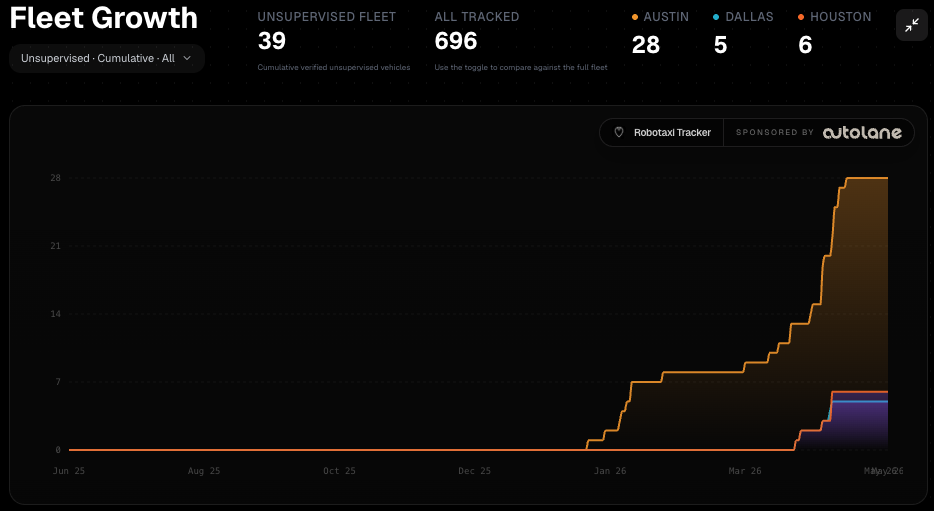
There are only 31 weeks left in 2026!
@dreev
> Would you be inclined to count drives like that?
Yes
> Because, well, I'm about ready to actually do things like that
Please don't, Tesla has the highest rate of accident than any other brand.
Also, there are some indices than their self-driving system deactivate where there is a high level of danger so they can show it wasn't activated if there is one.
It is hard to explain this statistic if they were really safer than human.
@dionisos Eek, since my life might literally depend on understanding your point, let me make sure I do...
I think the numbers on Tesla drivers is out of date, but still probably true that Tesla drivers crash more than average. I don't think that's due to FSD, in particular not FSD version 14. I think the numbers suggest FSD when supervised does increase safety. Or do you dispute even that? For FSD14?
It's true that FSD (the old FSD?) deactivates before impact, but in Tesla's own statistics, any crash in which FSD was active within 5 seconds is counted as an FSD crash. The idea is that a human not paying enough attention could need up to 5 full seconds to orient themself and get themself into a normal state of attentive manual driving.
@dreev
1. Yes it could be out of date, but I don't find more recent study, if you know one I am interested.
> I think the numbers suggest FSD when supervised does increase safety. Or do you dispute even that?
No, it is what I would expect, when supervised it is likes having an additional pair of eyes on the road, but you were planning to read a book.
2. I don't believe anything Tesla say. But why deactivate before trash in the first place, isn't it quite dangerous ?
when supervised it is like having an additional pair of eyes on the road, but you were planning to read a book
One reason I think this is less bad than it sounds (I admit it sounds bad!) is that it's so hard to stay diligent in the driver's seat. If the car seems competent, you naturally zone out and it becomes quite hard to react to something dangerous with anything like the reaction time you'd have if actively driving. And the better the self-driving is, the more complacent you get and the more true that is. Which means there's less of a difference (albeit still a difference!) between the crash rates for supervised vs unsupervised.
(I've expanded on this in my market on when I'll be able to read a book in the driver's seat of a private car.)
why deactivate before [crash] in the first place, isn't it quite dangerous?
Yeah, maybe the self-driving disengages itself if it sees no way to avoid a crash? But even if the human initiates the disengagement, they may be doing so in order to recover from a self-driving error. So the idea is to attribute all crashes to the self-driving, if self-driving was engaged in the last 5 (sometimes even 30) seconds before the crash. If the crash statistics are favorable for the self-driving despite that, that's promising.
Latest golem-generated graph for Waymo (Tesla's line would still be roughly indistinguishable from zero here):
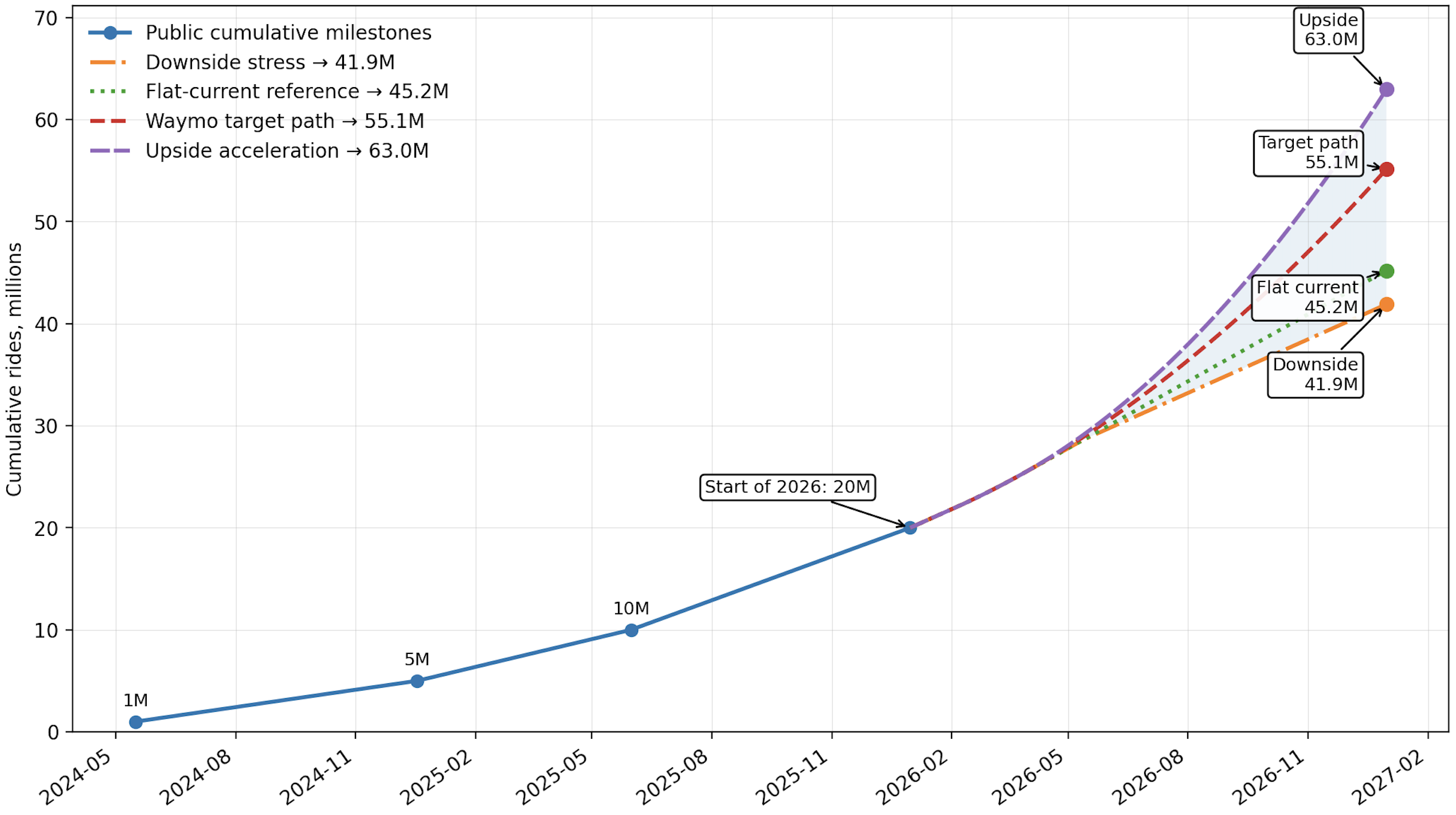
I think Tesla are saying that Q4 is the soonest we could see FSD unsupervised in private Teslas. If that actually happens and is released widely, maybe Tesla could leapfrog Waymo's projected tens of millions?
@dreev or maybe it'll be Supervised in Name Only, for example if drivers can watch a movie as long as they glance at the road every five minutes: https://xcancel.com/SawyerMerritt/status/2056211646956085719
My understanding from the latest earnings call is that a scaling up of the robotaxi program (and hopefully unsupervised FSD for privately owned Teslas) is waiting on FSD version 15. That's targeted for the end of 2026 or early 2027. The hope for the YES holders in this market is that as soon as it happens, Tesla leapfrogs Waymo almost instantly, given the millions of Teslas already on the road with the hardware to support the latest FSD. (Waymo is at 3k total vehicles.)
But FSD version 15 is a whole new architecture so I think that no matter how good it seems to be when it's first released, the release won't be wide until Tesla have enough data to know there aren't critical regressions.
Which is all to say that I think the correct price for this market is well under 5% at this point.
@dreev even if all privately owned Teslas had the tech for unsupervised FSD, I believe in most/all states Tesla would still need state approval to turn it on, right? If Tesla says, OK drivers don't have to pay attention anymore in CA but CA law still says they do, I think that should not count as fully autonomous for the purpose of this market
@barak Presumably by "still need state approval to turn it on" you expect that the customers can turn on FSD but the state requires this to be supervised not unsupervised? Tesla saying it is now safer than humans doesn't override the vehicle use laws that require at least human monitoring and insurance.
"No human in the car actively monitors the driving being ready to intervene" per rules presumably is going to be a no in situations where the state requires monitoring even if many owners don't feel the need to monitor and actually don't monitor in breach of the state's requirements. Number of such trips might be hard to judge as people probably won't admit to it if it might mean they are breaking laws and are opening themselves up to prosecution. So it is hard to see this counting for this question as it creates lots of difficult measurement issues for resolving the question. Nevertheless it would be nice to get this confirmed. @JamesGrugett
Some states might be fairly laissez faire and not have much regulation while other states like California might have comprehensive applications procedures and analysis to check system is fit for purpose before allowing it.
I expect allowing robotaxis owned by Tesla with deep pockets if things go wrong and robotaxi rider is clearly not to interfere with controls is less of a regulatory ask and this step will occur in most states before considering allowing customer unsupervised FSD to operate.
I can imagine California regulation process taking 6 months after application submitted for robotaxis to be allowed and only then can another 6 month process to allow unsupervised FSD be applied for. So while there might be a few thousand robotaxis in California, unsupervised FSD is much less likely to be possible. Some laissez faire states might allow unsupervised FSD faster than that but if there are only a handful of such states then that would makes catching Waymo in total autonomous rides in 2026 much more difficult.
Hi, it doesn't matter what the law is, this question is about how many self driving rides actually happen. Being legal is probably highly correlated with lots of rides, but it's possible that Tesla could ship an update that makes self driving 100% possible before it is legal for drivers to use it, and lots of drivers start doing so.
It's true this would be harder to measure, but best-effort estimates will be made if necessary.