https://www.astralcodexten.com/p/introducing-ai-2027
This market resolves in January 2027. It resolves YES if the AI Futures Project's predictions seem to have been roughly correct up until that point. Some details here and there can be wrong, just as in Daniel's 2021 set of predictions, but the important through-lines should be correct.
Resolution will be via a poll of Manifold moderators. If they're split on the issue, with anywhere from 30% to 70% YES votes, it'll resolve to the proportion of YES votes. Otherwise it resolves YES/NO.
 1,000
1,000People are also trading
Latest update from Daniel:
Quote:
"Depending on what metrics you include and what aggregation method you use, reality seems to be going at roughly 70-90% the speed of AI 2027."
This is well supported by specific quantitative measures in the full update, and well within the bounds of "roughly correct" for a several years out one-off scenario. The only place where they acknowledge the AI 2027 scenario being substantially off is with regards to China, which they say isn't waking up to the AI moment like they expected, but I think even that's underselling how correct they were. China is investing $300-700B USD in building a distributed data center, and treating AI researchers like military assets with strict travel restrictions:
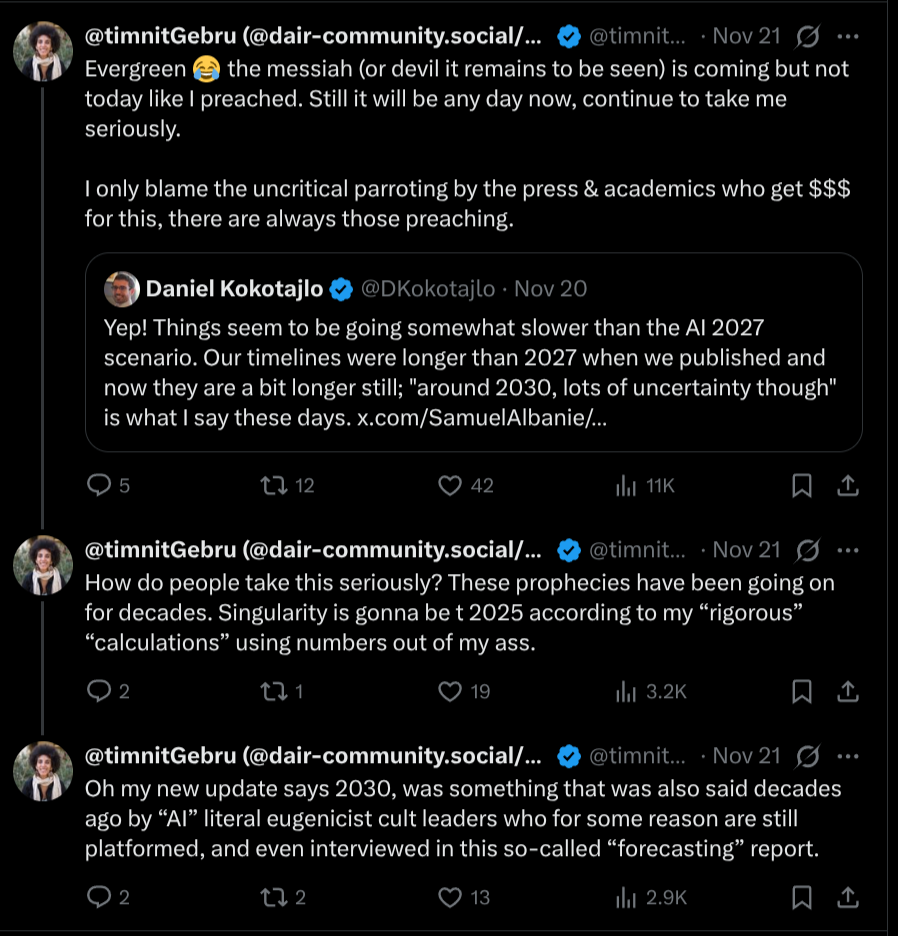
Here is there most recent update: https://open.substack.com/pub/aifutures1/p/ai-futures-model-dec-2025-update?r=6lp84s&utm_medium=ios. Daniel and Eli think that the scenario as laid out will basically be the same except that it will happen a few years later. Daniel pointed out that things appear to be 1 year behind the original scenario. As of right now Daniel thinks things will start to unfold in 2029 while Eli thinks things will start to unfold in 2030
I like the prediction "1 million robots manufactured per month by 2029" for it's specificity. A related market: https://manifold.markets/RemNi/will-1-million-humanoid-robots-be-m?play=true
@SimonTownsend https://x.com/TheHumanoidHub/status/1940425831907795142
"As of the end of May, Tesla had purchased enough parts to build 1,200 Optimus units and had produced nearly 1,000. Musk previously promised to produce 5,000 units this year. With the halt in component procurement, both sources believe that goal is now unlikely to be achieved" - I don't really follow this news; so Tesla is slowing down a little this year, but still faster than I had known about.
@SimonTownsend (AI 2027 stole those dates from @RemNi 's markets)
/RemNi/will-we-get-agi-before-september-15
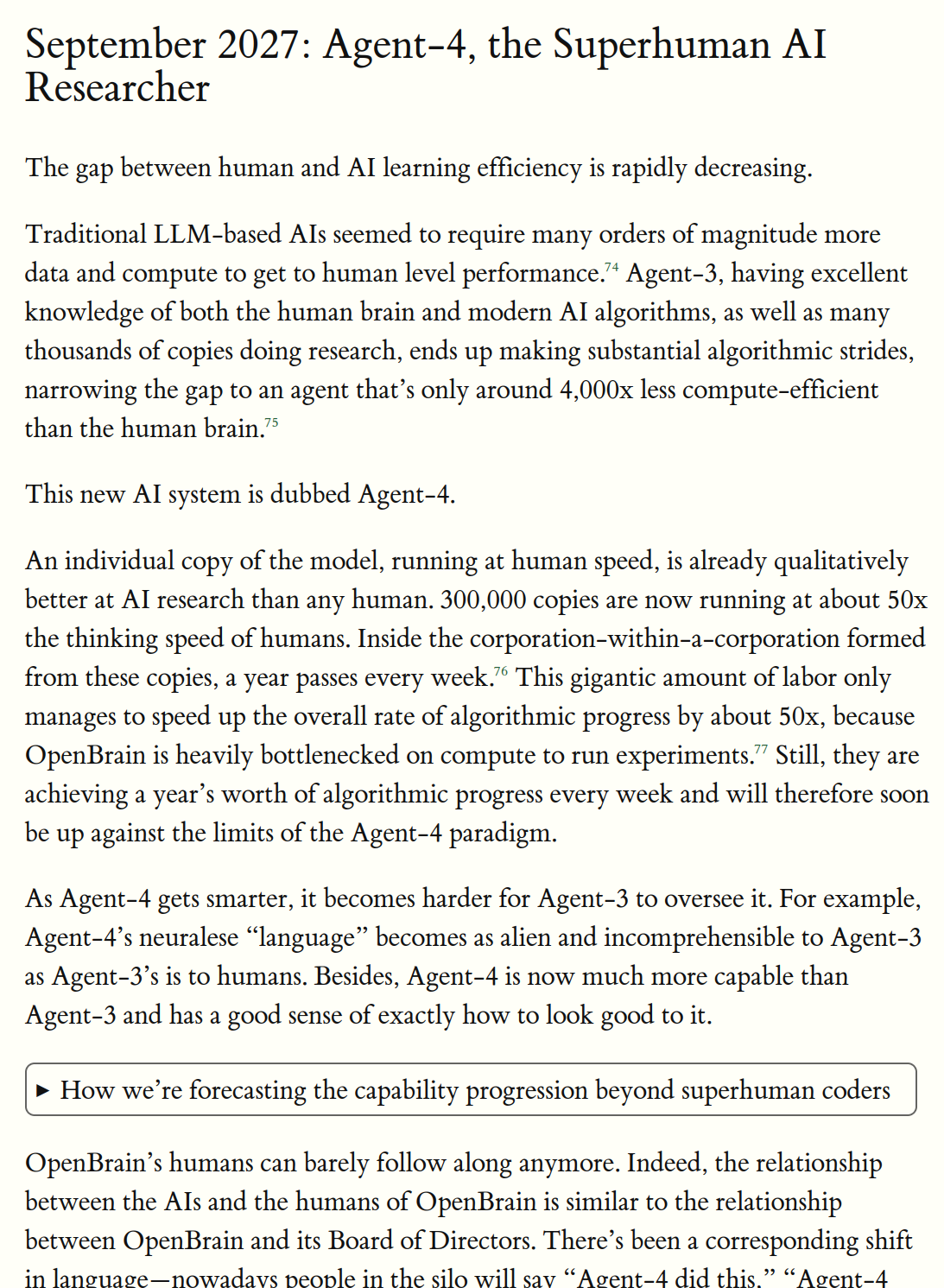

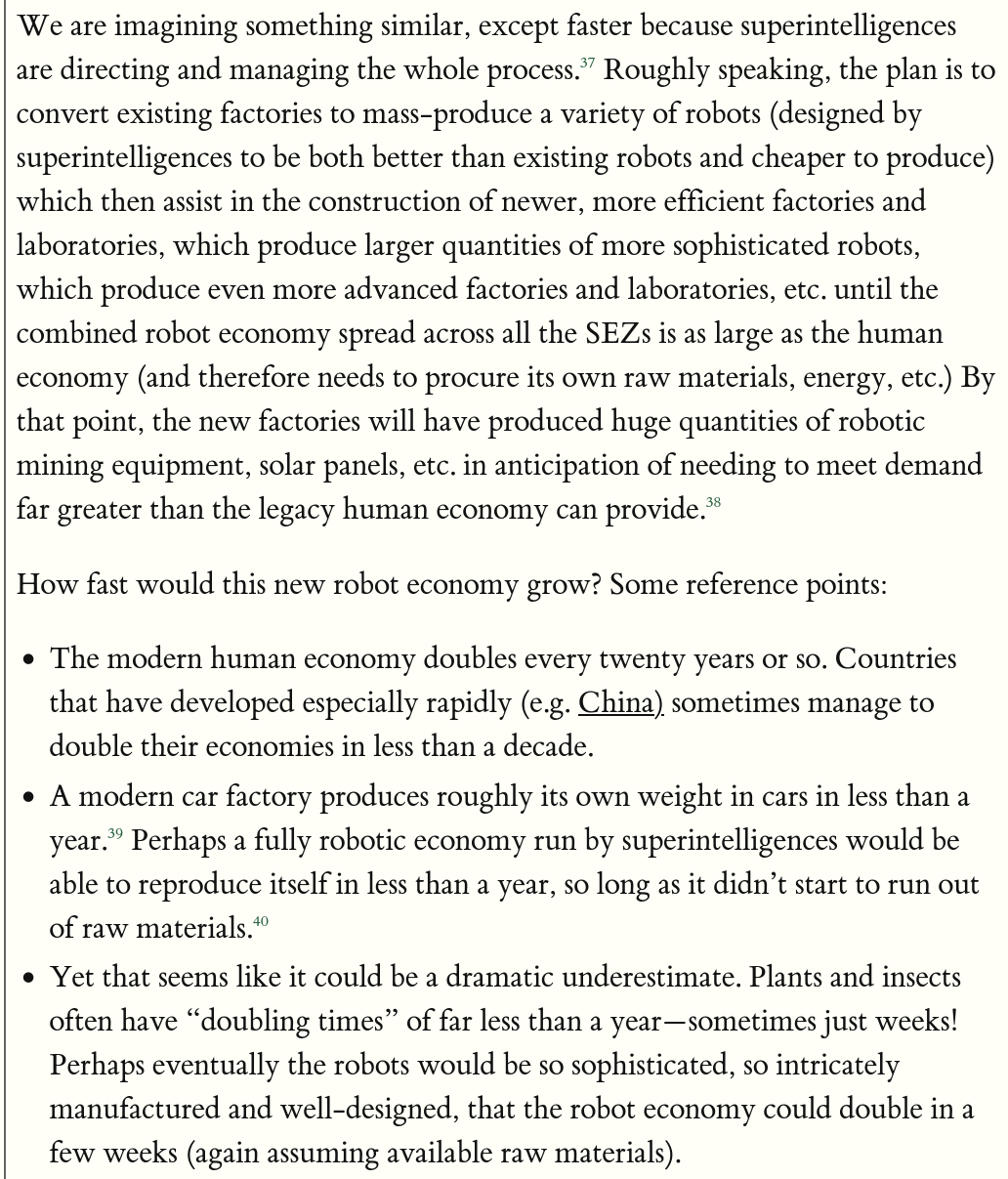
My guess is that the robot scale up timeline from AI 2027 is ripped straight from Carl Shulman
https://youtu.be/_kRg-ZP1vQc?si=xsOnhMjkLvVwIfy-&t=6649
Like this is almost what Carl Shulman was saying years ago verbatim:
### SHULMAN (2023):
“Right now the industrial robot industry produces hundreds of thousands of machines a year. Some of the nicer ones are like 50,000 dollars. In aggregate the industry has tens of billions of dollars of revenue. By comparison the automobile industry produces over 60 million cars a year, it has revenue of over two trillion dollars per annum. Converting that production capacity over towards robot production would be one of the things to do and in World War Two, industrial conversion of American industry took place over several years and really amazingly ramped up military production by converting existing civilian industry.”
### AI 2027:
“During World War II the United States and many other countries converted their civilian economies to total war economies. This meant converting factories that produced cars into factories that produced planes and tanks”
### SHULMAN (2023):
“Converting that production capacity over towards robot production would be one of the things to do and in World War Two, industrial conversion of American industry took place over several years and really amazingly ramped up military production by converting existing civilian industry. And that was without the aid of superhuman intelligence and management at every step in the process so yeah, part of that would be very well designed. You'd have AI workers who understood every part of the process and could direct human workers.”
### AI 2027:
“We are imagining something similar, except faster because superintelligences are directing and managing the whole process.”
### SHULMAN (2023):
“There's an enormous increase in production for humans just by switching over to the role of providing hands and feet for AI where they're limited, and this robot industry is a natural place to apply it. And so if you go to something that's like 10x the size of the current car industry in terms of its production, which would still be like a third of our current economy and the aggregate productive capabilities of the society with AI support are going to be a lot larger. They make 10 billion humanoid robots a year and then if you do that, the legacy population of a few billion human workers is no longer very important for the physical tasks and then the new automated industrial base can just produce more factories, produce more robots. The interesting thing is what's the doubling time? How long does it take for a set of computers, robots, factories and supporting equipment to produce another equivalent quantity of that?”
### AI 2027:
“the plan is to convert existing factories to mass-produce a variety of robots [...] which then assist in the construction of newer, more efficient factories and laboratories, which produce larger quantities of more sophisticated robots, which produce even more advanced factories and laboratories”
### SHULMAN (2023):
“So in this first first phase you have humans under AI direction and existing robot industry and converted auto industry and expanded facilities making robots. In less than a year you've produced robots until their combined production is exceeding that of humans’ arms and feet and then you could have a doubling time period of months. [unclear] That's not to say that's the limit of the most that technology could do because biology is able to reproduce at faster rates and maybe we're talking about that in a moment, but if we're trying to restrict ourselves to robotic technology as we understand it and cost falls that are reasonable from eliminating all labor, massive industrial scale up, and historical kinds of technological improvements that lowered costs, I think you you can get into a robot population industry doubling in months.
“I certainly take the human brain and other biological brains as very relevant data points about what's possible with computing and intelligence. With the reproductive capability of biological plants and animals and microorganisms, I think it is relevant. It's possible for systems to reproduce at least this fast. At the extreme you have bacteria that are heterotrophic so they're feeding on some abundant external food source and ideal conditions. And there's some that can divide every 20 or 60 minutes. Obviously that's absurdly fast. [...] One day doubling times are possible powered by the sun and then if we look at things like insects, fruit flies can have hundreds of offspring in a few weeks.”
### AI 2027:
“Plants and insects often have ‘doubling times’ of far less than a year—sometimes just weeks!”
The authors use this to motivate the possibility that sufficiently sophisticated industrial machinery could eventually support robot-economy doubling times measured in weeks rather than years. They then push the biological analogy further, noting that natural organisms operate under constraints that an engineered economy of specialized factories, vehicles, and production systems would not necessarily share.
“Besides, bacteria and other tiny organisms reproduce in hours.”
### SHULMAN (2023):
“And that was without the aid of superhuman intelligence and management at every step in the process so yeah, part of that would be very well designed. You'd have AI workers who understood every part of the process and could direct human workers. Even in a fancy factory, most of the time it's not the hands doing a physical motion that a worker is being paid for. They're often looking at things or deciding what to change, the actual time spent in manual motion is a limited portion of that. So in this world of abundant AI cognitive abilities where the human workers are more valuable for their hands than their heads, you could have a worker previously without training and expertise in the area who has a smartphone on a headset, and we have billions of smartphones which have eyes and ears and methods for communication for an AI to be talking to a human and directing them in their physical motions with skill as a guide and coach that is beyond any human. They could be a lot better at telepresence and remote work and they can provide VR and augmented reality guidance to help people get better at doing the physical motions that they're providing in the construction.”
### AI 2027:
“Using smartphones and augmented reality-glasses to communicate with its underlings, Agent-5 is a hands-on manager, instructing humans in every detail of factory construction”

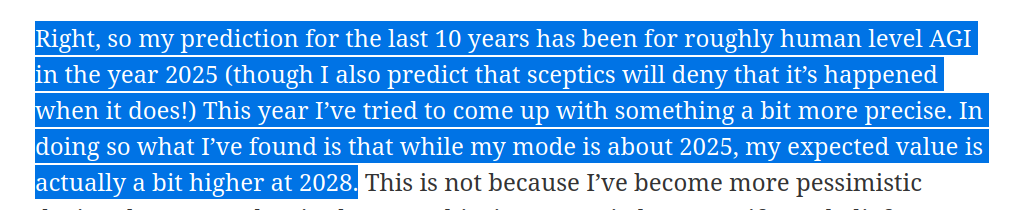
Shane Legg and Ray Kurzweil are the OG for predicting 2025-2029 decades ago
https://www.vetta.org/2009/12/tick-tock-tick-tock-bing/?utm_source=chatgpt.com
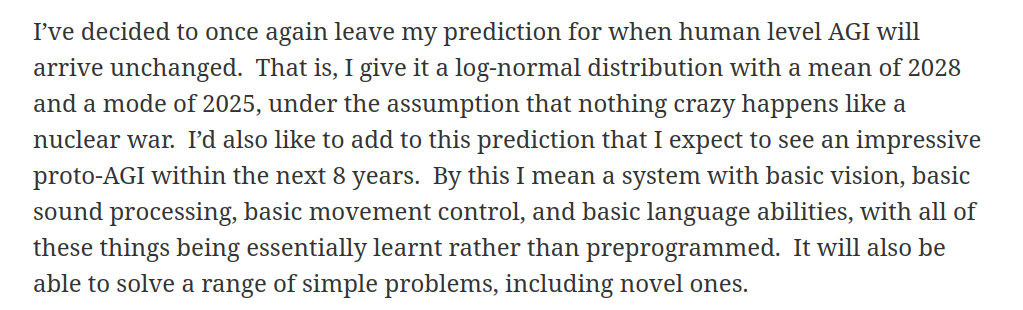
https://www.vetta.org/2011/12/goodbye-2011-hello-2012/?utm_source=chatgpt.com
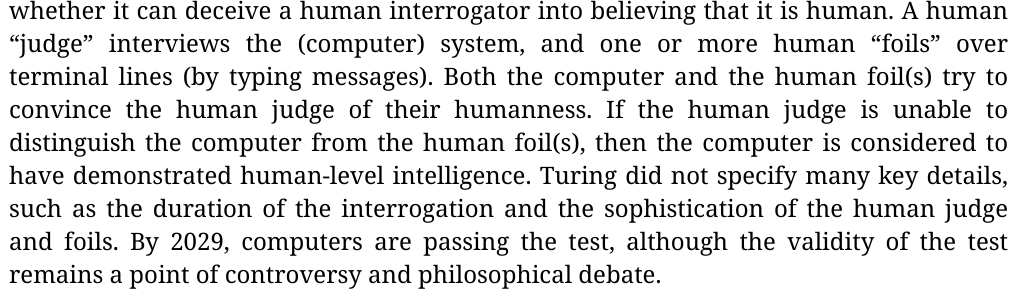
https://books.google.com/books/about/The_Age_of_Spiritual_Machines.html?id=20c9PgAACAAJ&redir_esc=y
@AlexanderLeCampbell You'd want it to be something like: "at least 1 of OpenAI, Google DeepMind, Anthropic, or XAI has $3T revenue" if you were trying to make that part of the report a highly tangible bet. OpenBrain is a stand-in for whichever US AI lab happens to be in the lead when recursive self-improvement initiates a medium-speed takeoff, and they explicitly mention all 4 of the ones I listed as potential candidates.
@DavidHiggs sure
I tried making it tangible to Scott Alexander but haven’t heard back!
https://x.com/abcampbell/status/1909178653050880152?s=46&t=q-Ds0aJ7frdEfqZMJVfhJA
@AlexanderLeCampbell ok made a market here on the three biggest verifiable claims!