Usage of the word “Zionist” over the past 12 months on Google trends:
https://trends.google.com/trends/explore?&q=Zionist
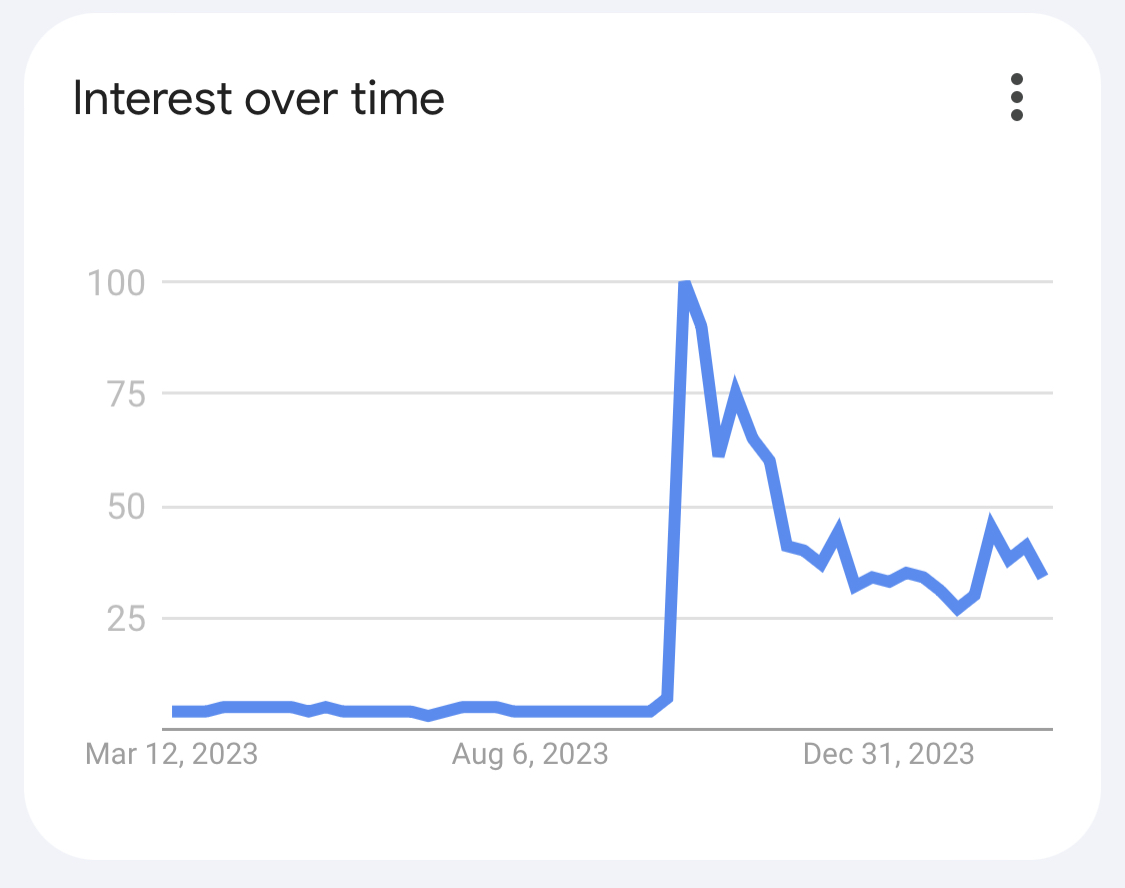
There has been an explosion of the usage of the word “Zionist” since October 7th, and continuing during the Israel-Hamas war. What will be Manifold’s opinion on whether the usage of this particular word has lately been mainly used in a descriptive matter, or alternatively been used as a slur?
This will resolve to a YES/NO poll, that I will create in 7 days with the title “Do you consider ‘Zionist’ a slur?”. The poll’s length will be 7 days, and this market will resolve YES or NO based on the results.
 1,000
1,000🏅 Top traders
| # | Trader | Total profit |
|---|---|---|
| 1 | Ṁ166 | |
| 2 | Ṁ71 | |
| 3 | Ṁ25 | |
| 4 | Ṁ20 | |
| 5 | Ṁ14 |
I mean it has absolutely been USED as a slur, does that make it a slur
@Riley12 Most slurs begin as neutral or descriptive terms. Only after a significant number of people use a term as a slur is when they become recognized as slurs.
@simoj This market, while resolving based on a poll, is intended to be vibes based. I’m hoping for respondents to respond in a way they believe is the most relevant to modern times and language trends.
This article inspired me to create this market:
“Salt Lake City Bar Under Fire for Its ‘No Zionists Allowed’ Policy”
@soweliSon That article is written by an "Allison Quinn" which is a most beautiful name, I should point out. Anyway, it's been clear for quite a while that "Zionism" refers to support for the state of Israel, and to some extent, its policies, and has nothing to do with Jews in general. The policy is ridiculous for obvious reasons, but that's about it.
@AlQuinn What exactly “Zionist” means nowadays beyond vague support for Israel is obviously complicated. Likewise term "Anti-Zionist” is as, if not more complicated. In the Soviet Union, for instance, "Zionology" emerged alongside a state-sponsored anti-Zionist doctrine that often contained anti-Semitic elements. At the same time, many Jews and non-Jews who are critical of Israel’s policies may or may not specifically identify themselves as “Anti-Zionist”.
The incident in Salt Lake City seems to me part of a very recent phenomenon, that has undergone in the past 6 months: People use the word “Zionist” more often nowadays, even taking into consideration the times of other flare ups of the Israeli-Palestinian conflict.
@soweliSon Yes, that checks out (I can't remember what happened in May 2021 though). I relate it back to wokism and the tendency to view all issues in terms of an oppressor group and the oppressed. It's much easier to think this way than to better understand the context and apply actual moral reasoning, and the current flare up in Israel/Palestine is an ideal case for the oppressor/oppressed rubric to be applied (notwithstanding the brutality of the initial terrorist acts by Hamas). But even if the concept is adjacent to and sometimes co-opted by those who are actually anti-Semitic, I think it's wrong to conclude that anti-Semitism is a necessary component of anti-Zionism.
There is a corresponding problem with the rhetoric around anti-illegal immigration efforts in the US. First of all, being against illegal immigration doesn't mean you're against legal immigration. Second, even if you're against both legal and illegal immigration, it is not necessarily for racist reasons.
@AlQuinn none of these are necessarily implications, but there sure are some pretty heavy correlations and a strong incentive to only identify yourself with the socially acceptable version even if you believe both, so it's still reasonable to be suspicious if people don't explain the details of their beliefs.
@soweliSon I'm not sure those are related? "Lgbt" isn't a slur but people would be pretty upset over a bar that had a "no LGBTs" policy.