Global energy-related CO2 emissions grew by 1.1% in 2023 (IEA), increasing 410 million tonnes (Mt) to reach a new record high of 37.4 billion tonnes (Gt).
Here is the graph for the past few years.
China alone grew around 565 Mt. China's growth was greater than the rest of the world's decrease but some think it may be close to peak.
Will 2025 emissions be lower than 2024?
This market will resolves based on IEA's numbers when released based on the actual change in CO2 emissions between the two years, no matter what extraordinary event (like COVID) may happen each year.
I have created the same market for 2024, hope it helps adjust your bets!
Update 2026-03-13 (PST) (AI summary of creator comment): The market will resolve using the next IEA Global Energy Review report (expected: global-energy-review-2026), comparing year-on-year figures within that single report. Mixing data from two different reports will be avoided. If the report does not include a clear year-on-year comparison, the creator will propose a fair alternative.
 1,000
1,000🏅 Top traders
| # | Trader | Total profit |
|---|---|---|
| 1 | Ṁ1,415 | |
| 2 | Ṁ402 | |
| 3 | Ṁ224 | |
| 4 | Ṁ141 | |
| 5 | Ṁ130 |
People are also trading
@figo
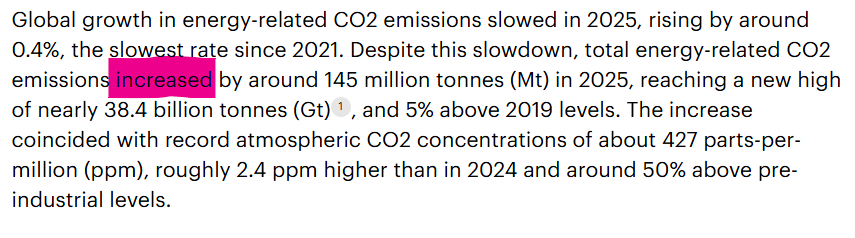
Total energy-related CO2 emissions increased by 0.8% in 2024, hitting an all-time high of 37.8 Gt CO2
https://www.iea.org/reports/global-energy-review-2025/co2-emissions#abstract
March 2025
Annual global energy-related CO2 emissions reached a record 38 gigatonnes (Gt) in 2024
https://www.iea.org/reports/world-energy-outlook-2025/executive-summary
November 2025
Not sure if that 38GT for 2024 is a rounded number or whether there have been revisions. Do we look for 'global-energy-review-2026/co2-emissions' and compare to the same report for 2025 or is a different report or comparison needed?
@ChristopherRandles I am planning on using the next report and expect it to compare year on year. I don't think mixing two reports would yield anything good. If they don't have the yoy number, then will try to propose something fair.
@RichardKnoche US has decoupled GDP and emissions growth with shale gas and renewables. China popped a property bubble and reduced GDP growth. Europe both decoupled AND stopped growing.
In 2024 it seemed like India's emissions growth made up for China's reduction but it's at least plausible that the reductions could win. I'm going by Carbon Monitor which has a different methodology to IEA (and extremely confusing graphs): https://carbonmonitor.org/variation
@adssx Yeah but as long as other countries develop the emissions would probably increase.
I think this would only happen if we have a global recession.
@RichardKnoche I don't think we need a global recession, just in India, right? Slower growth might even be enough. Most other countries are either developed enough to have peaked or have not developed enough to make a big difference in 2025.
Anyway, a global recession seems pretty unlikely so if you're right you should make a good profit filling my order at 25%, let me know if it's not big enough!
@fwbt If Carbon Monitor is right and we're already at +0.7% as of April 30th then we would need a fairly large recession starting this summer to offset the growth of the early months, no?
@adssx I would have guessed that's the YoY number but I'm honestly unsure. Looking at individual months the numbers seem quite noisy but that could just be seasonal variations.
@fwbt I think I'm not confident enough 😂.
It's pretty tough to estimate over 1 year.
- China wants to be energy dependent which is why they invest so much in renewable
- Europe wants to reduce their emissions but somehow have a bigger increase than the US.
- No idea why Indias emissions are decreasing.
- The rest of the world probably doesn't care that much and wants to prioritise growth. But since their emissions are low compared to the "advanced economies" they don't matter for this market.
Trade war also probably reduces the emissions in the short term.
On top of this AI will probably require not clean energy in the short term to meet demand...
@RichardKnoche Your comments aged much better than mine did! Carbon Monitor has China+India down -184 Mt in the first half of the year, but US+EU up +171 Mt. Rest of world adds around 100 Mt.