This market will resolve YES if and when Wikipedia's English page on the Russo-Ukrainian War (or the nearest equivalent if that page no longer exists) lists in its infobox "Result: Ukrainian victory", and I am satisfied that this is not part of an edit war.
It will also resolve YES if the result describes the victor as some coalition of which Ukraine is a part, or describes the outcome in terms of the defeated side being Russia or some coalition of which Russia is a part.
Any other "result" after the war is no longer described by Wikipedia as "ongoing" will cause the market to resolve NO, including hedged statements like "Partial Ukrainian victory" or "Ukrainian victory with territorial losses".
Resolution only depends on the first, non-dotpoint statement in the "result" section of the infobox. If hedging/concessions follow the intitial statement as dotpoints, or if they appear in the body of the article, this is not relevant to resolution. If the "result" comprises only dotpoints, the market will resolve NO.
The closing date for this market will be extended as needed until the market can resolve.
 1,000
1,000People are also trading
The theory I have is that while Russia is clearly suffering the Russians are historically familiar with massive troop losses, many of which have come from far eastern oblasts and for Putin the sunk cost seems to mean doubling down, not pulling out. Hoping this doesn't go not Nuclear. On top of this it looks likely that while the oil facilities in Moscow and Crimea are being hammered, the Kostiantynivka front line seems to have fallen to the Russians in the last 4 days.
I don't think Putin cares that much about the casualties and I don't think the Russians have run out of humiliation and frustration so I suspect they will finish off the Donbas which they seem to care strongly about and negotiate cease fire, and call it a "win". I think Ukraine cannot honestly afford the ongoing damage to its infrastructure from the jet Shaheds that seem to be able to out race the Ukrainian interceptors at least for now, and with last years ukrainian recruitment troubles, loss of life I suspect, Ukraine will informally be willing to accept a de-escalation or ceasefire that would allow them to continue to argue that Crimea was always theirs, while not wanting to provoke more hostilities. Whatever success Ukraine has had in the troop casualties ratio, it seems unlikely at this stage that UGVs and AI drones will move the front line forward for the Ukrainians, and given time Russia will improve it's UGV and AI drone game leading to even more bloodshed on both sides.
While the visual impact of Moscow oil storage looks impressive the truth is the ongoing iran conflict has been making Russia plenty of money and it's continuation is only positive for them finally the short term supply lines near the front line and Crimea matter far more to Russia and while it's been hit severely they have still been moving forward onto relatively weakly defended Ukrainian positions in Kostiantynivka. Might spend more on the assumption that a truce is more likely than Ukrainian victory but seems like a depressing way to benefit.
@JanChan You are delusional and you've been consuming too much Russian propaganda. What you're repeating is the classic Russian information war framing: point to current Ukrainian difficulties and inflate them into inevitability (with the goal of making adversaries self-deter). Kostiantynivka is under pressure for sure, but that is not remotely close to “Russia is finishing off the Donbas.” Even if Russia one day takes the city, there would still be the rest of Ukraine’s fortress belt (Druzhkivka, Kramatorsk, Sloviansk, etc). Russia is on year 5 of grinding through individual towns. Treating every marginal (and strategically pointless) Russian tactical gain as proof of their "unstoppable power" is exactly the trick Moscow wants you to play on yourself
@JanChan Russia is buying small amounts of terrain with unfathomable numbers of men. It's been playing this stupid game for half a decade to acquire local gains, but it has degraded beyond all recognition the army that was supposedly going to “finish off” the Donbas. In 2026 you can no longer translate manpower into advances, that no longer exists due to rapid technological change. It existed to an extent at the start of the war, but now it is gone and it's not coming back. Russia has spent all of its trained soldiers and officers, all of its armour and artillery. It's burnt through every last piece of it and everything made of metal that it uses comes straight from a factory. Nothing, man or machine, that Russia sends to the front has a life expectancy beyond a week.
@JanChan Your claim that Russians are historically familiar with massive losses” is repeating a Russian propaganda myth. This has been carefully engineered to make people come to the conclusion that trying to fight Moscow is futile because Russians have an unlimited capacity to process pain. “Putin does not care that much about the casualties” is not the same as “Russian think that casualties don't matter.”. The Kremlin has also spent all of its political capital, which is strategically unsustainable since this will inevitably lead to internal collapse. The cost of every Russian offensive keeps climbing, and every new assault is more expensive to the regime than the previous one. It doesn't matter how many shitty flags they wave at drones to show on Russian TV to say they've captured village A or village B that no one had ever heard of before the war. After year five all the dead and missing relatives stack up a whole lot more in the minds of Russians.
@JanChan Same thing for your comments about drones and oil infrastructure. You're just repeating Russian propaganda bullshit. The truth is that Ukraine is doing massive damage to Russia's economy. Russia is falling behind on the technology race because it does not have the agility and creativity that Ukraine has. Not to mention the fact that Europe is now becoming Ukraine's industrial rear capable of sustaining its war economy and rapidly advancing/iterating its AI drone tech. Russia's industrial capacity is tiny in comparison and is falling apart due to Ukraine's long range strikes and western sanctions. Russia cannot strike Ukraine's industrial rear without triggering a war with NATO. Russia cannot advance its technological capabilities anything near to the rate at which Ukraine is now advancing. This is why Russia is stuck with its shitty soviet era designs and has to import technology from Iran. This is the cost of war and sanctions, Russia cannot develop and modernise its military and its economy. At best it can buy cheap commercial Chinese drones or try to stitch Soviet technology together with rogue state tech imports
@0xseraphim I think it's deeply upsetting watching the invasion of Ukraine, but I am merely speculating on the outcome as is everyone else here. We can have a moral debate on whether we should be allowed but its here and that is what we are both doing. The source for my assessment of the Konstantinivka situation is the deepstatemap live which is a Ukrainian run website. The arrows are all red and point towards the centre of Konstantinivka.
Will Ukraine push Russia out of Melitopol, Crimea, Zaporizhia and Donbas. I hope so but I very much doubt it.
Is it likely to be a Russian victory across Ukraine, clearly no. Is it likely to be a Ukrainian victory across all of Ukraine, also no. Is it likely to carry on, yes. On that basis I think it's fair to say it will end when Putin has decided to end and at the moment this recent Russian progress seems most likely to run out of steam around the border of the Donbas which I suspect is the closest both sides have to a possible compromise.
@JanChan here you can see Russia gloriously invade Konstantinivka over a period of 8 months: Russian Invasion of Ukraine: Kostyantynivka Offensive - Every Day [NOV 15 - JUN 20 2026]

I'm sure when the rest of the city falls the speed of their offensive will increase by 4+ orders of magnitude. Any day now
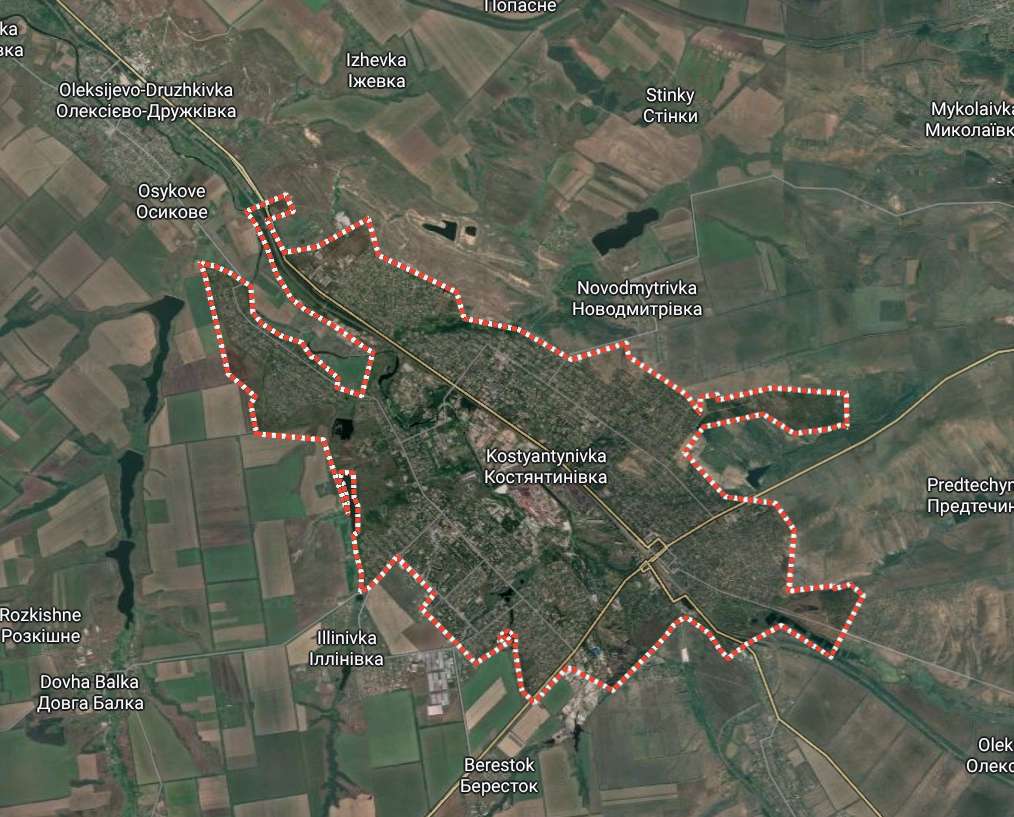
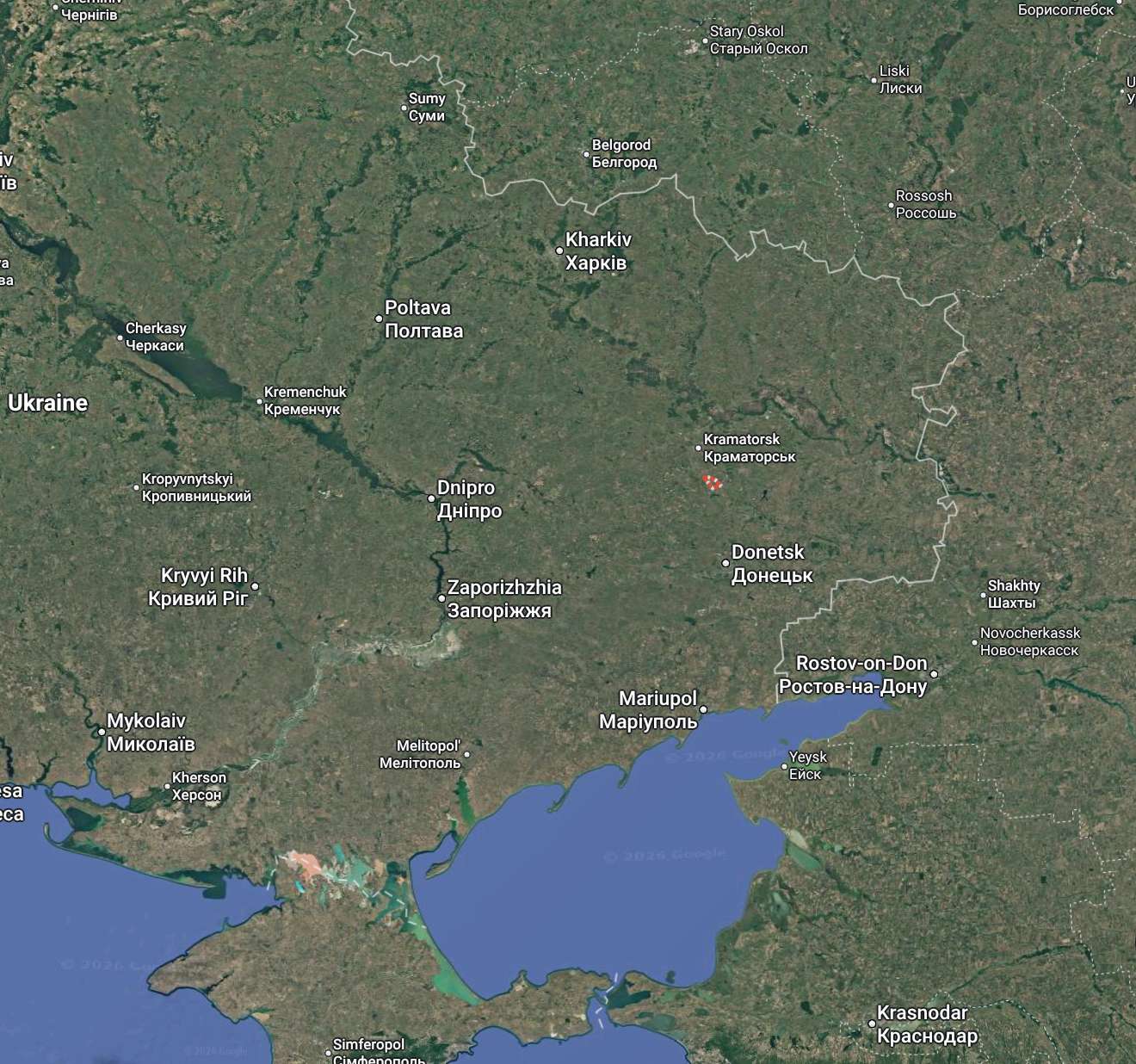
I can see that my prediction has clearly upset you and I am sorry about that but I am confused. Is your point that the Deepstate map is wrong? The map you shared shows a more almost complete Russian occupation of Konstantinivka than my source. Or is your point that it took months for them to seize a city. I firmly agree that this is a slow grinding battle with heavy losses presumably on both sides, albeit traditionally 3:1 against the attacking force, but I dont see any evidence of significant Ukrainian gains this year. Hence my estimation that the war will be a stalemate somewhere close to where it is now. Do you have an estimation?
ahaha you haven't upset me at all. What you're doing there is a deflective apology and it's very transparent. Yes the map is the Russian occupation of Konstantinivka. This is in response to the statements you have made in this thread:
"... and it's continuation is only positive for them finally the short term supply lines near the front line and Crimea matter far more to Russia and while it's been hit severely they have still been moving forward onto relatively weakly defended Ukrainian positions in Kostiantynivka."
and
"The source for my assessment of the Konstantinivka situation is the deepstatemap live which is a Ukrainian run website. The arrows are all red and point towards the centre of Konstantinivka. ... On that basis I think it's fair to say it will end when Putin has decided to end and at the moment this recent Russian progress seems most likely to run out of steam around the border of the Donbas which I suspect is the closest both sides have to a possible compromise."
I'm illustrating why your analysis is bullshit and you don't like it. Trying to squirm out of it by projecting emotional states onto the person you're talking to is not going to get you very far
@JanChan If you want a more neutral response with no reaction to the deflection tactics you're trying to use:
Your analysis hinges on the idea that Russian pressure on Konstantinivka will somehow magically break out and translate into a complete Russian conquest of the Donbas in the short-medium term. I pointed out that this is clearly nonsense in the messages above. However, your point that a ceasefire or frozen conflict with Russia while it still occupies Ukrainian territory is objectively salient to this market. I don't think that is what's going to happen, but it is an objectively stronger point compared to the Russian information war material you were regurgitating.
If you want to discuss the objectively weaker points of my analysis, I would point you towards my claims about Ukraine's growing advantage in the AI drone tech space. I'm making a leap of faith here (in terms of its relevance to this market) in the strategic significance of recent technological advances on the battlefield. Taken at face value, the claim that Ukraine can convert this into a "strategic win" is too strong with respect to the current evidence.
There's different ways this conversation can go
@0xseraphim my forecast is based on my opinion and analysis of trends and results.
I have not introduced personal insults so could we try not to swear and let's have a conversation about likely outcomes of this market. I am also not "trying to squirm" or "project emotional states", I recognised my forecast has made you feel its acceptable to swear at me and comment very directly about my analysis, perhaps I should not have said it has upset you but I noticed you have not done that to any other commenters. I don't think you have been polite but thats ok, these are just ideas and theories about forecasts.
The market is for Ukraine winning the Russo Ukranian war, this will happen when the folks who edit Wikipedia see Ukraine regaining most if not all of it's territory back, if this doesnt happen and a stalemate or worse were to happen then this forecast will resolve to No. That is my current expected outcome.
Currently I don't see evidence of a Ukrainian victory. I will enthusiastically change my view if they start to gain some ground somewhere soon, but that has not happened for quite some time. Perhaps you are correct and its just about to happen but until I see some progress, I will continue to forecast what I think will happen not what I would like to happen.
With that in mind I would genuinely like to learn why your forecast is the opposite of mine.
Let's begin with your point about the use of AI in drones. Currently Ukraine is using Opensource YOLOv8 AI or similar. I personally would be surprised if Russia doesn't quickly adopt this. They may already have, I dont know as they don't have the same sorts of target rich major Russian oil infrastructure to aim at, as the Ukrainians have, but it's got to be 3-6 months away tops before we see similar attacks using AI in Russian drones as everyone has the same access to the opensource software and anyone can buy a raspberry pi or equivalent to ruin the light weight AI. I believe Russia had a brief FPV fiber optic advantage, Ukraine quickly adapted. Ukraine currently has a UGV advantage which is helping them recover wounded and re supply and now Russia has started ramping up its own UGV programme and is trying to test strategies to target Ukrainian UGVs with drones etc.
What are your views on this?
@JanChan
buddy this is a prediction market in 2026. If you're going to repaste propaganda on a war market and get offended when people call you a retard then you're in trouble. But don't worry so much about it, with time you'll be able to handle other people pointing out that what you wrote is bullshit and move on
I'll start by joining you on the resolution item of this market: the wikipedia page condition. This promises to be an unusually weird resolution so for people optimising to maximise mana this adds a lot of uncertainty. I think many traders actively betting on this market are betting on the trends and swings and much less the final resolution of this question. I agree with you that the chance of something looking close enough to a stalemate is high, which by default swings the resolution of this question to a NO. That being said, people notoriously find wikipedia pages to have stated outcomes that don't align with how those wars are talked about and retroactively perceived (especially by the sides involved). For instance the Chaco war, the Vietnam war, India-Pakistan war etc. There's many plausible scenarios where the Russo-Ukrainian war ends with a stalemate on the battlefield and this question resolves YES. The confusion here is that people are generally going to slide between battlefield, political and economic definitions of "victory" when thinking about this question as if they were the same thing. But these are distinct categories and are each separate from this question's wikipedia criteria.
I also agree with you with regards to evidence-based analysis. Russia definitely has been (very) slowly grinding forward in the Donbas. If we're going to frame "victory" exclusively as victory on the battlefield and only through the perspective of map painting, then over the past few years the delta is definitely in favour of Russia and not Ukraine. But this delta is tiny. This is the core of why I think your analysis is wrong. These territorial gains have very minor strategic relevance; the significance of Konstantinivka in terms of how it helps the Russian military defeat Ukraine is very very small. The reason the Kremlin is pushing for these areas is political. Virtually everyone in Russia knows this, the only people who don't are eg. the pensioners whose brains have been melted to kingdom come by the regime's propaganda and are past the point of no return. The regime sees the failure to take the Donbas as an existential threat to its power. The Russian State believes that it would not survive a stalemate scenario where it fails to complete its territorial objectives. Ukraine knows this, and this explains why Ukraine has done everything in its power to encourage Putin's regime along this path towards self-annihilation in the Donbas. As counter-intuitive as this may sound, Ukraine sees this ceasefire scenario as one plausible path towards victory for this exact reason. This is why Putin is doing everything to ensure the war continues and makes no efforts towards a ceasefire. This also links back to the fundamental causes of the war: (to quote the wikipedia page) "Democratic Ukraine being perceived by Russia as a political threat to the authoritarian regime in Russia". If the regime fails to destroy a free Ukraine, then this becomes a political defeat for the regime. It perceives the magnitude of the threat to its existence imposed by a democratic Ukraine as sufficient to wage a war for half a decade and incur half a million battlefield deaths. These puzzle pieces together all point to the political dimension being the dominant one in this war. The wikipedia resolution is thus likely to be heavily weighted in favour of the political outcome, and not the battlefield or economic outcomes.
In terms of the drone / AI discussion, I think this is going to be quite complex and hard to anticipate. I expect we're going to see new developments that look very strange, in the same way seeing battlefields covered in fiber optic cables would have looked strange to us in 2022. Right now the use of AI in these drones is pretty limited. Ukraine appears to have some sort of computer vision stack that allows it to do short-range target lock-on (personnel and vehicles), allowing the drone to rapidly adjust its attack trajectory for improved targeting. It also appears to have some computer vision capabilties that enable its long range drone strikes to navigate despite extensive EW jamming. It might be using some superglue / point matching based approach using satellite images (maybe combined with inertial guidance). But these CV models are all open source as you say. It's unlikely that this software alone is giving Ukraine critical advantages on the battlefield as of June 2026. Also, at some point, if Ukraine sends millions of these drones, then some of them will fail to self-destruct and be captured by Russia, who will be able to scan the memory and reverse-engineer any onboard software. My guess though is that this misses the point of what's happening. Even if the other side manages to reverse engineer and replicate a system, by the time that system makes it to the battlefield at scale, it will already have become obsolete many generations ago. We might also see some more advanced systems in the future, where the neural network has been implemented at the hardware level using asics etc. This would further slow down reverse engineering efforts, and heavily swing in Ukraine's favour due to their much greater access to chip manufacturing compared to Russia. My analysis here is that the nature of this technology overwhelmingly favours the side with the most rapid iteration speed. Every sign points towards Ukraine outpacing Russia with the rate at which it is innovating battlefield drone technology. The interceptors are the obvious example where the gap between Ukrainian and Russian capabilities appears to be getting wider and wider.
My intuition is that we're thinking about drones in a limited framing that's missing key future implications of these technologies. What it looks like right now is a substitution for fires. These are basically fancy artillery shells that can fly further and chase soldiers. And then interceptors emerged, so that's effectively artillery shells that can shoot down other artillery shells (but still staying in the same domain of fires). I'd tentatively wager we're going to see robots and drones used to restore manoeuvre, in a similar way to how the development of tanks helped restore manoeuvre at the end of WW1. This has the potential to break the stalemate and could happen quite rapidly. Russia would not have the ability to adapt its battlefield tactics at this point if Ukraine quickly developed a new robotics / drone swarm centric combined arms approach that enabled it to overcome existing defences and make rapid focused advances. Something like an advancing column where the spearhead is UGVs, that can be carried over obstacles by drones? And the column is enveloped in this swarm of semi-automated attack and interceptor drones? I'm not sure. My guess is that if this war continues into 2027-2028 then we're going to see some wild things.
@0xseraphim interesting that you still had to call me a retard.
Anyway glad you agree with me that this is looking very much like a stalemate and that my analysis of NO is a likely if by no means certain outcome.
As you brought it up, on the Vietnam war, Wikipedia says the Vietnamese won, this is also my opinion as all of the country became Vietnam, it's not a question of being retroactively perceived to have won. You may have a different opinion, but feel free to visit the country.
Lets continue talking about Ukraine and the as you agree, likely stalemate.
Ukraine is at a major disadvantage as it has all of it's power infrastructure nearby and no amount of European, and let's face it militarily , US weapons manufacturing, will allow it to continue if the Russians campaign of 2024/2025 to take down all their electricity production becones cheaper and has much longer reach. The long range shaheed style drones are now starting to include jet powered engines, not just the classic moped delta wing thing. This recent "development" (I won't call it an innovation as only Ukraine has innovations) , like the fibre optic fpvs which i believe were a Russian development, could also make a long term difference to Ukraine's ability to provide power both to the front line and to its manufacturing capability. Similarly I imagine Russia will also target fuel storage facilities in the same way Ukraine has.
My point is, I don't think Ukraibe has used jet style drones, only the fat more expensive european cruise missiles and storm shadow etc. It seems that the Ukrainian High speed drone-drone interceptors fly at 50-100kmph slower than these jet drones that Russia has started ramping up. This could be an issue. However perhaps with AI targeting for these interceptors, and other technical challenges they may still be able to overcome the speed and targeting issue, but it feels like a temporary Russian future advantage.
I believe that the main advantage for the Ukraine and specifically long range Ukrainian drones are Starlink terminals which the Russians no longer have access to.
This is seemingly the biggest issue for Russia at the moment. Well that and the need to build and train drone to drone interceptors.
Ukraine don't produce chips and Russia seems to have no issue finding access to chips despite sanctions. Worse still Russias main ally is in the words of Ukrains main ally, about to invade the chip manufacturer, Taiwan. If that were to happen then us and euros will have lots more on their mind than Ukraine. Also only Russia's main ally, happens to be the largest drone manufacturer in the world and realistically the second biggest cheap chip manufacturer and might be the only one still able to manufacture chips of this nature at scale.
For these circa 28nm chips, the sort that can run on relatively low power supplies, Taiwan leads.
Rough estimates (worth noting the uncertainty is due to China rapidly increasing its share)
Taiwan: ~43%
China: ~34%
United States: ~7%
Europe doesn't really manufacture them in any serious quantity.
I think this is another reason for the likely outcome of this war to be a stalemate resolving in NO.
@0xseraphim you've come into this conversation with a lot of insults right off the bat. let's all chill the fuck out okay? that's not how we be excellent to each other here.
@Stralor everyone is chill, all I did was point out that what he was saying was bullshit. He couldn't handle that so he resorted to deflection and tone policing. In reaction to the tone policing I called him a retard. It's fine, he's already starting to figure out that those sorts of tactics don't work and is giving replies with better substance. We've made a lot of progress here today
@0xseraphim honestly it's not fine, it is childish, foul mouthed and insulting.
Even now when others call you out, you still feel the need to swear, repeat the personal insult of retard and declare victory in a game that only you are playing.
@JanChan ahaha not at all. You can't handle people using the word "bullshit" to talk about what you wrote. You know you have the weaker argument so you must resort to cheap rhetorical posturing when people point this out. I'm comfortable using the word bullshit to talk about what you wrote, that is not going to change until you develop stronger arguments and/or stop repeating Kremlin propaganda.
Now, do you want to continue this conversation or are you going to still try to derail it with your moral grandstanding?
@0xseraphim Anyway you both had interesting analyses and insights. I just don't want my notifications filled with bickering, thanks. Otherwise I have to throw a mod tantrum.
@Stralor I'm happy to continue this discussion with neutral language only. If people try to coerce me into silence or use tone policing etc I'm going to react to that.
I'm sure there's more interesting things to discuss here
@JanChan For the point on Vietnam, there are still some Americans today who make it into their 20s and then have an aneurysm when they first read the Wikipedia page for the Vietnam War. When it was taught to them, it was always framed as a “tactical withdrawal” or some nonsense like that, and they had never seen the version written explicitly: “North Vietnam won and the US lost.”
On the flip side, the way this is taught in Vietnam is that North Vietnam decisively smashed the United States military on the battlefield and liberated the South with its superior military force. But this is not quite right either. North Vietnam won a strategic victory over the US by politically outlasting American will and making the war too costly to sustain.
This example of Vietnam has some relevance to the Russo-Ukrainian war, where the political factor can become decisive in determining the outcome regardless of what happens on the battlefield. This was especially true after the Tet Offensive, where the US and South Vietnam won a tactical victory over the North, yet it became a turning point in the war’s political trajectory because it weakened internal US support.
We can also find other classic examples in history where states are “winning” tactically on the battlefield while losing strategically: Germany’s 1918 Spring Offensive, which made large territorial gains but demoralised the army, or France during the Peninsular War, where Napoleon’s forces occupied major areas and repeatedly defeated the Spanish on the battlefield but still eventually had to retreat. This illustrates a major issue with your previous comments, where you kept mechanically going from “stalemate” to “NO resolution.” As history shows, this is not how it works. There can absolutely be scenarios with a stalemate on the battlefield where this question resolves YES due to the political outcome.
Next, you have been overstating the effects of Russia’s energy campaign. Ukraine’s energy system is definitely under a lot of pressure, with major damage done during the winter of 2025–2026 to infrastructure such as substations and transmission systems through large-scale drone and missile attacks, involving larger numbers per attack than in the winter of 2024–2025 and before. These energy attacks are a key Ukrainian vulnerability, but you are making the mistake of leaping from “Russia can damage Ukraine’s grid” to “Ukraine cannot continue on the battlefield.” This is wrong. Ukraine has a wide range of options that allow it to adapt, such as imports and decentralisation. The fact that the war is in its fifth year and Ukraine has been experiencing these long-range attacks also plays in Ukraine’s favour here. It has had time to reorganise much of its electricity grid away from the centralised thermal plants that were targeted early on. You are seeing Russia’s energy campaign as if it were inevitably going to lead to Ukraine’s defeat. This is the framing that Russian propaganda has been pushing from the start. The problem is that we are now in year five of this “inevitability,” and that narrative clearly has quite a lot of holes in it.
Then you claim that “no amount of European/US manufacturing will allow Ukraine to continue.” This is essentially false, no matter which way you look at it. You are mixing up two things: the resilience of Ukraine’s domestic grid and Ukraine’s external military supply base / industrial rear. Put simply, if the military-industrial complex that is supporting the Ukrainian side increasingly resides in Europe, the US, and other externalised production chains, then Russian drones hitting substations in Ukraine are not going to do a whole lot to cut off that supply. This is a core structural advantage Ukraine has over Russia in this war: while Russia can hit Ukraine’s domestic energy grid, it cannot target factories in Europe without risking an all-out escalation with NATO.
The next issue with your framing is that you keep freezing the battlefield in its current state: pointing to temporary Russian advantages as proof of a lasting Russian advantage. Jet-powered Shaheds are definitely harder for existing Ukrainian interceptor drones to catch. But this state of affairs is not going to last very long. Ukraine is already deploying faster interceptors which can reach speeds above 400 km/h. There are also recent speed records using similar designs to Ukraine’s interceptors, which hit 729 km/h. Ukraine is also integrating chemical accelerators into its Bullet interceptors, which can chase the 500 km/h Geran-4 jet-powered Shahed. Everything in this space is moving very fast, and what we see now on the battlefield will look very different 6–12 months from now.
Also, your statement that “Ukraine hasn’t used jet-style drones” is broadly false. Ukraine used jet-powered missile-drones in its attack on Moscow this month (the ones made by Fire Point). At a push, you could say that these systems blur the lines between “drone,” “missile-drone,” and “cruise missile,” but as it stands any statement to this effect is objectively false unless some other criteria is added to strictly distinguish these different subtypes.
Then your statement that “the main advantage for Ukraine, and specifically long-range Ukrainian drones, is Starlink terminals” is quite a stretch. Starlink is definitely an asset, but it is just one piece of the puzzle. This rhetoric also resembles Russian propaganda, which seeks to minimise the significance of Ukraine’s domestic drone ecosystem and technology stack, with the goal of portraying Ukraine as having no independent capabilities and therefore no agency. Ukraine may be using Starlink to strike Moscow and improve its targeting, but it may already have developed its guidance systems to the point where these strike drones can operate effectively without using LEO satellite constellations. I think the relative advantage provided by Starlink has slowly diminished over time as other technology options have developed, though it is still a key component of Ukraine’s technology stack for its long-range strike campaigns.
The point you are making about chips gets tripped up over the fact that Ukraine’s advantages in innovation and iteration speed are not negated by Russia having access to some chips. Furthermore, Russian drones still depend on Western microelectronics routed through third-country channels. You are also getting confused by conflating this market’s resolution with sprawling tail-risk statements about a Chinese invasion of Taiwan, while simultaneously assuming that Russia magically inherits China’s commercial drone advantage because they are “allies.” What you are essentially saying is: “China can manufacture drones and chips,” therefore “Russia can deploy superior drone warfare systems on the battlefield.” This claim is very weak, and after four to five years of war there is very little evidence to back it up. You are making multiple inference steps here that fall apart under closer scrutiny. If China attacks Taiwan, then that definitely has global implications, including for the Russo-Ukrainian war. But pumping high-end war drones into Europe is probably not going to be very high on the CCP’s list of priorities in such a scenario. You can just as easily argue that the reverse is likely to be true: that Russia would end up cut off from critical drone component supplies because China would requisition the entire commercial drone stack and ban all exports.
Fundamentally, you keep treating the current battlefield as if it inevitably determines the final political outcome. The reality is that wars are commonly resolved along other axes (eg. political will + external support, endurance, adaptation) and not grinding conquest / tactical breakthroughs. This is where your arguments keep falling apart.
@traders added a M10k subsidy to encourage more betting. It's an important question and having good market pricing on it seems valuable.