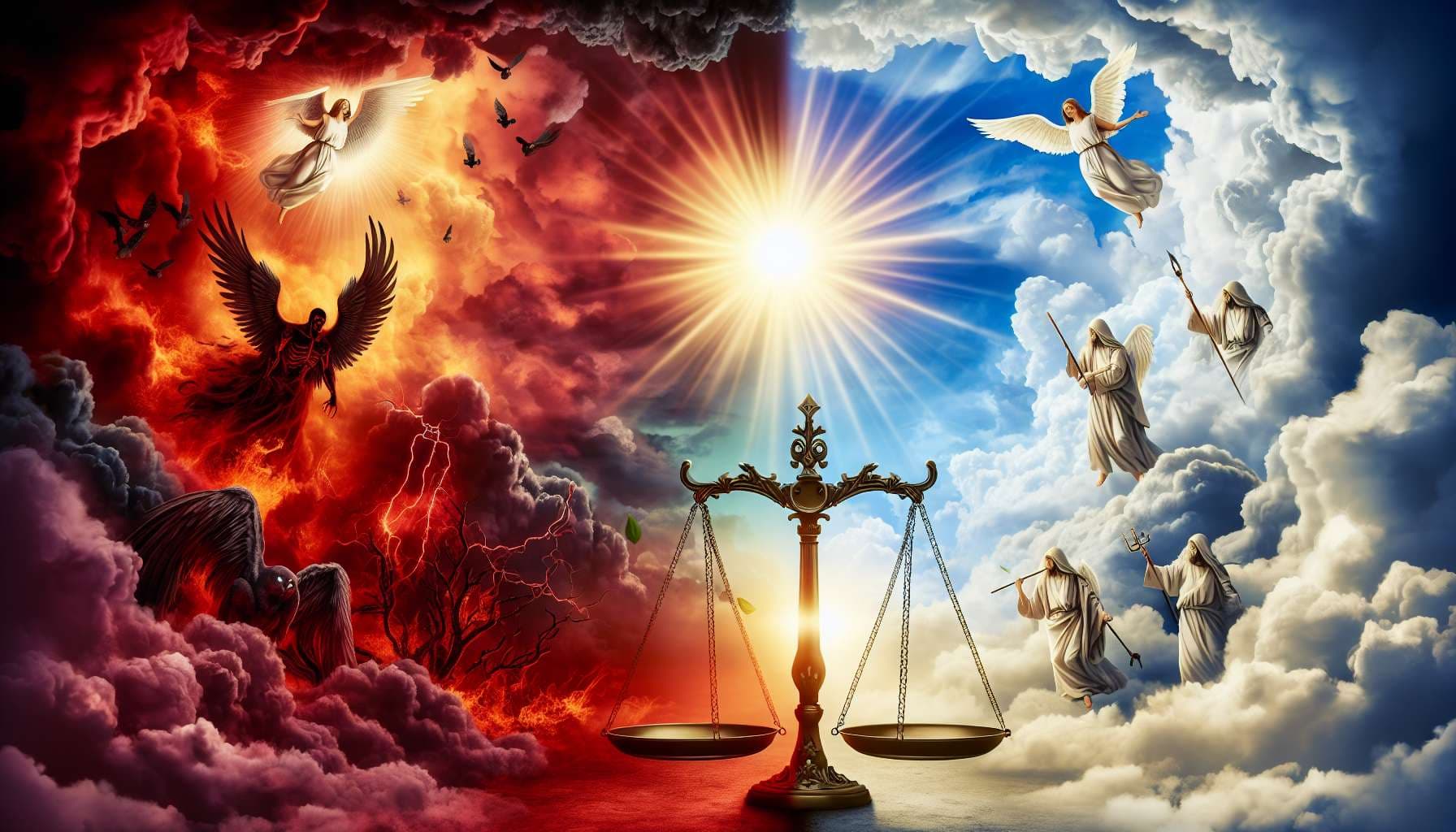
Lucifer vs God
 1,000
1,000People are also trading
This is a pretty open-ended question so I pulled in Claude for a NO analysis.
The case for NO, from the corpus of world holy texts
The creator specified that resolution should be informed by "the corpus of world holy texts," measured in "soul/hours of human influence," and settled by "a general vibe." Having consulted those texts and considered those criteria, I think the answer is pretty unambiguous.
The soul/hours metric
If we're counting soul/hours of human influence, God is winning by several orders of magnitude. Christianity has roughly 2.4 billion adherents, Islam about 2 billion, Hinduism about 1.2 billion, Buddhism about 500 million. These are all traditions oriented toward good, God, or liberation from suffering. Explicit Satan-worshipping traditions are vanishingly small: the Church of Satan and The Satanic Temple combined have maybe tens of thousands of members, and most of them are atheists using Satan as a literary symbol.
The more sophisticated version of the pro-Satan argument is that his influence doesn't require explicit allegiance, that he works through deception and moral corruption even among people who think they're on God's side (basically the premise of C.S. Lewis's Screwtape Letters). But even granting that framing, you'd need to argue that most human behavior most of the time is Satanically influenced, which is an extreme claim that most theologians across traditions wouldn't endorse.
Christianity
Christian theology is the tradition where "Satan" is most prominent, and the textual evidence is not close: Satan loses.
The New Testament frames Christ's death and resurrection as a decisive defeat of evil. Colossians 2:15 says Christ "disarmed the rulers and authorities and put them to open shame, triumphing over them." Hebrews 2:14 says that through death he destroyed "the one who has the power of death, that is, the devil." 1 John 3:8: "The reason the Son of God appeared was to destroy the works of the devil."
The earliest and most influential atonement theory in Christian history, Christus Victor (dominant in patristic theology, systematized by Gustaf Aulén in 1931), is built entirely around this: the crucifixion was a cosmic battle, and Christ won it.
Augustine argued in City of God (Book 20) that Revelation 20's "binding of Satan" refers to the present age, meaning Satan is already bound. This became the standard interpretation in Catholic and mainline Protestant theology for over a millennium.
But the market question is present tense: is Satan winning, not does Satan win. The strongest counterargument within Christianity is that Satan exercises significant present influence even if his ultimate defeat is assured. Some New Testament passages support this: 2 Corinthians 4:4 calls Satan "the god of this world," Ephesians 2:2 names him "the prince of the power of the air," and 1 John 5:19 says "the whole world lies in the power of the evil one." Dispensationalist premillennialism, popular in American evangelicalism, expects things to get worse before Christ returns.
Even so, the dominant framework in mainstream theology (Protestant, Catholic, and Orthodox) is "already/not yet": the decisive battle is over, and the present age is the outworking of an assured victory. Oscar Cullmann's well-known analogy (from Christ and Time, 1950) compares it to D-Day and V-E Day. D-Day has happened. We're waiting for V-E Day. Satan may still be fighting, but he's losing.
The Eastern Orthodox Paschal homily, attributed to John Chrysostom and read in every Orthodox church every Easter, is practically gloating: "Let no one fear death, for the death of our Savior has set us free. He that was taken by death has annihilated it."
There is no Christian theology, orthodox or heterodox, in which Satan wins. And even those traditions that grant him significant present influence treat it as temporary and diminishing.
Islam
In Islamic theology, Satan (Iblis/Shaytan) is not God's rival. He is a creature, originally a jinn, who disobeyed God and was granted a temporary reprieve to test humanity (Quran 7:14-18, 15:36-38). The reprieve has an expiration date. On the Day of Judgment, Iblis and his followers are consigned to hell (Quran 7:18).
The Quran frames Iblis's power as weak. Quran 4:76: "Indeed, the plot of Satan has ever been weak." Quran 14:22 describes Satan on the Day of Judgment telling his followers not to blame him, because "I had no authority over you except that I invited you, and you responded to me."
The idea that Satan could be "winning" against God would undermine tawhid (the absolute oneness and sovereignty of God), which is the most fundamental principle in Islam. It's not theologically coherent in an Islamic frame.
Judaism
The figure of "Satan" in the Hebrew Bible is quite different from the Christian/popular conception. In Job 1-2, ha-satan (literally "the accuser" or "the adversary") is a member of God's divine council, functioning as something like a prosecuting attorney. He operates under God's authority and with God's permission. He's not a rebel cosmic power.
The more dualistic, cosmic-evil version of Satan is largely a development of the Second Temple period (roughly 2nd century BCE onward), influenced by contact with Zoroastrian dualism, and became prominent in apocalyptic literature like 1 Enoch. But mainstream rabbinic Judaism generally did not adopt a strong dualistic Satan figure. The Talmud treats the yetzer hara (evil inclination) as the primary locus of moral struggle, not an external cosmic being.
To the extent that Judaism has a "Satan" figure at all, he's an employee of God, not a competitor. The question doesn't really apply.
Zoroastrianism
This is the tradition with the most genuinely dualistic framework: Ahura Mazda (good) vs. Angra Mainyu (evil) as cosmic opponents. If any tradition could support a "Satan is winning" thesis, it would be this one.
But it doesn't. Zoroastrian eschatology holds that good ultimately triumphs. The Bundahishn describes a final renovation (Frashokereti) in which evil is permanently defeated, the dead are resurrected, and the world is made perfect. Angra Mainyu is destroyed or rendered powerless. Even in the most dualistic major religion in human history, evil loses.
Kabbalah
In Kabbalistic thought, evil is associated with the sitra achra ("the other side"), which is understood as parasitic on holiness rather than independently powerful. It exists because of the necessary structure of divine emanation and concealment, sustained by divine sparks trapped within it. The project of tikkun (repair) is about reclaiming those sparks and progressively weakening the sitra achra. Evil is derivative, dependent, and diminishing.
The general vibe
The creator said "there is/will be a general vibe and we'll all know." Across every major religious tradition that has a concept of cosmic evil, that evil is understood as subordinate, temporary, permitted-but-not-sovereign, or already defeated. There is no world religion in which the devil wins. If you polled the adherents of every major religion and asked "is Satan winning?", the overwhelming majority would say no, either because their theology says he can't, because he's already been defeated, or because they don't believe in a Satan figure in the first place.
The corpus of world holy texts is unanimous. The general vibe is clear. The soul/hours aren't close.
Resolve NO.
How does this resolve if @Mira_ defeats both before Lucifer and God are finished fighting eachother? Resolves NO I guess, since it's Mira winning and not Lucifer?
@PlasmaBallin I have no idea how it will resolve. If it let me choose 3000CE, I would have chosen that one. Just want something there so we all know the score.
The resolution date having been reached. Point will be awarded for every soul/hour of human influence. There is/will be a general vibe and we'll all know.
@PlasmaBallin The resolution date having been reached. Point will be awarded for every soul/hour of human influence. There is/will be a general vibe and we'll all know
@PlasmaBallin A soul/hour is a unit of psychical possession time for an entity to engage in influence over a human's behavior. The true answers to who is winning or what constitutes a point for either side is the material covered in the corpus of world holy texts. Feel free to substitute other paragons of the good vs evil duality as it suits your personal cultural background.
@PlasmaBallin I think he said "The resolution date having been reached. Point will be awarded for every soul/hour of human influence. There is/will be a general vibe and we'll all know"
@bingobongo presumably time spent following Christianity, Islam, Judaism etc counts as points towards God, and time following devil worship counts as points towards Satan, but do Buddhism, polytheistic religions, and atheism also count towards Satan or to neither?