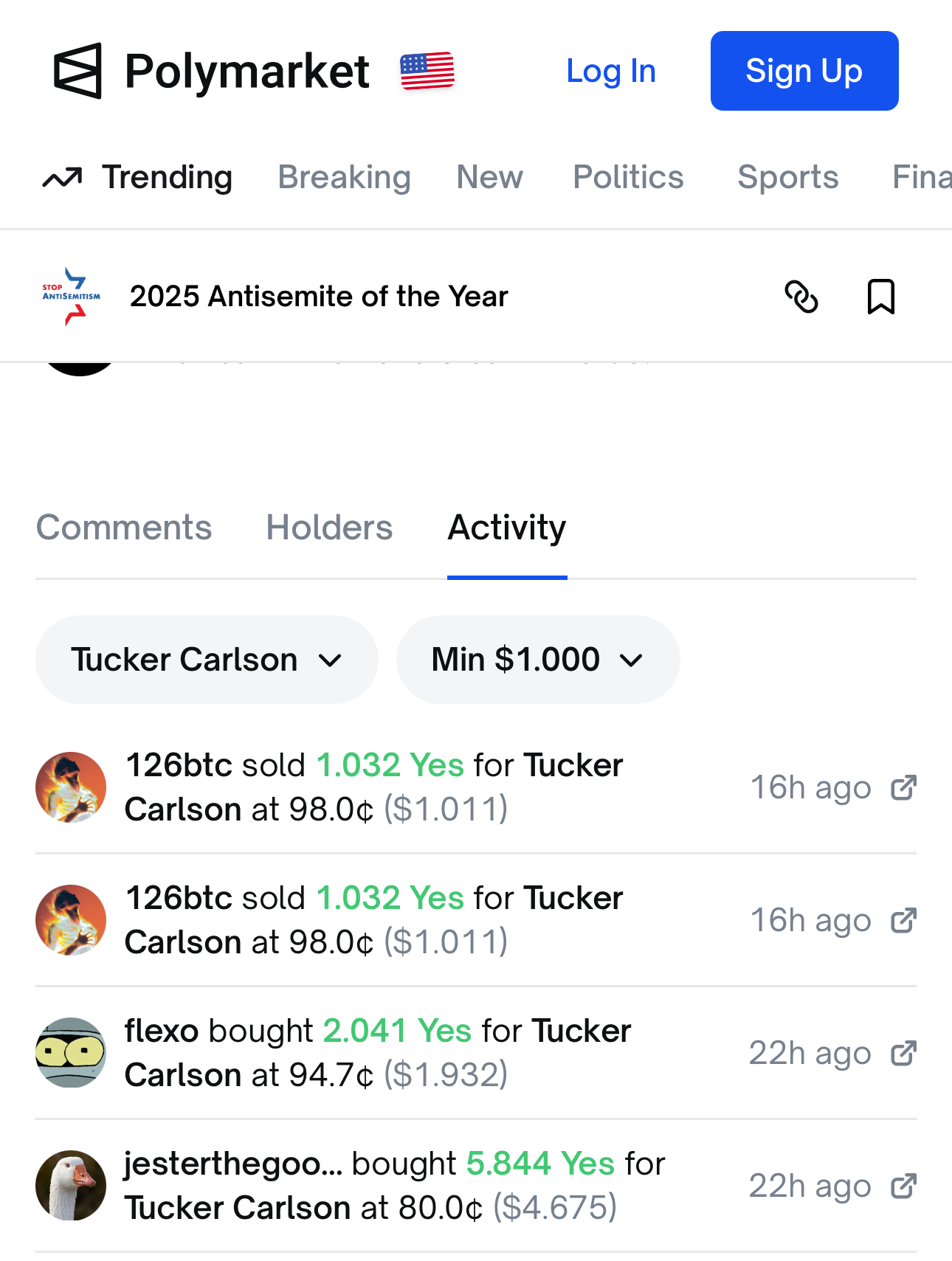
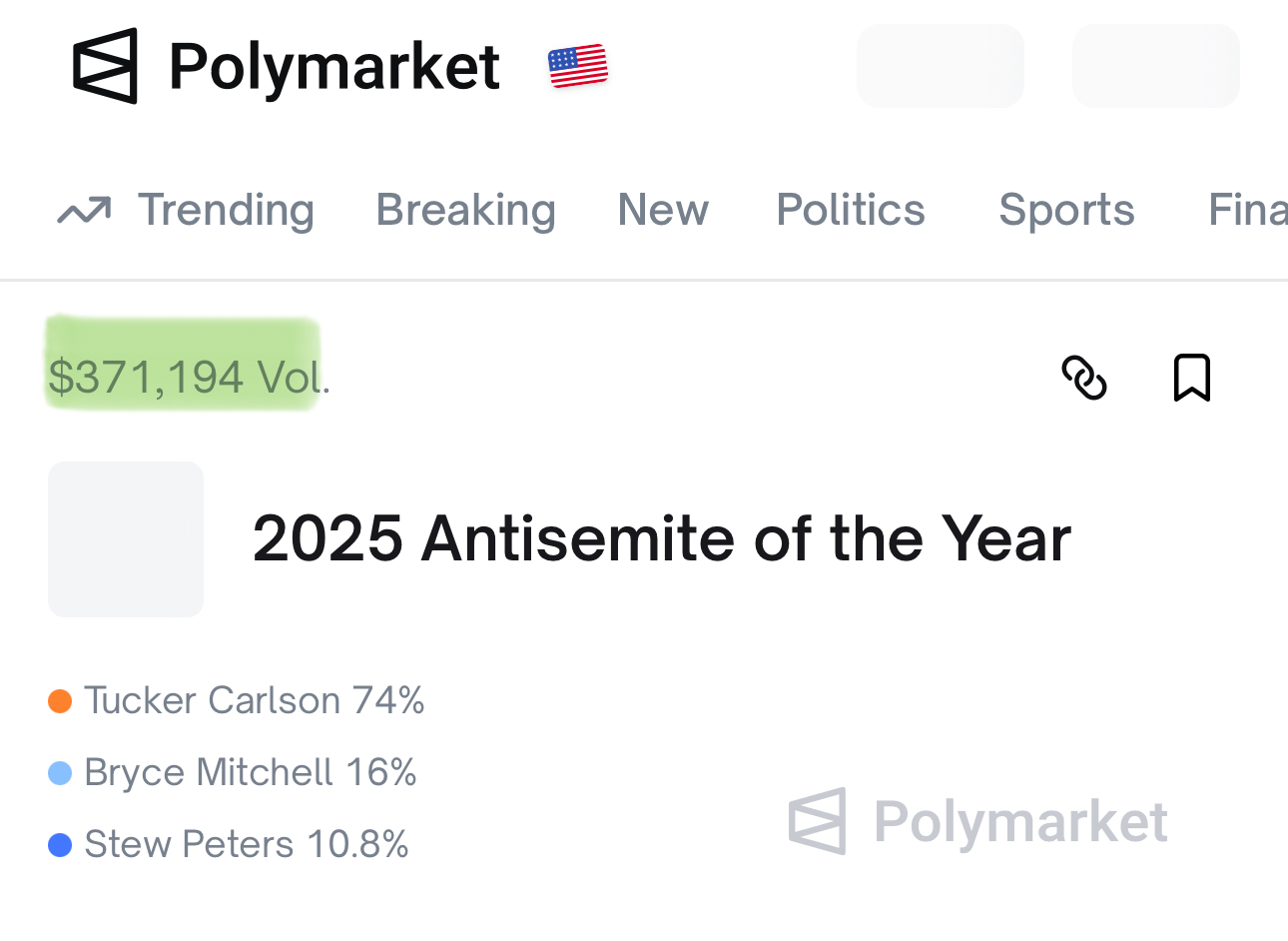
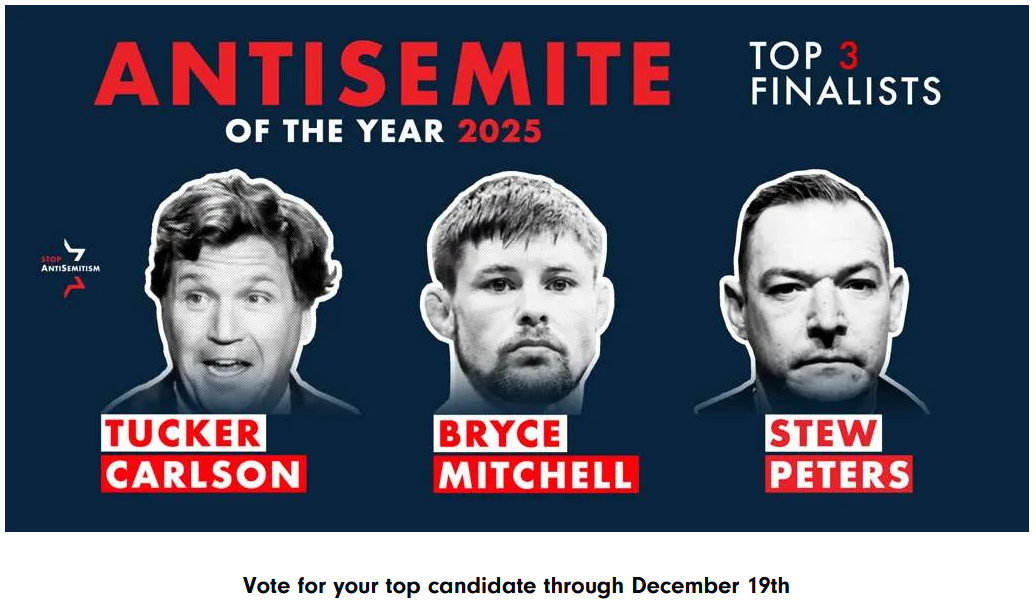
Every year stopantisemitism.org holds a vote for who they believe deserves the title of "antisemite of the year". Candidates for the final vote in 2024 were Candace Owens, Greta Thunberg and Hasan Piker, and Candace Owens was the winner.
If no winner is selected for 2025 this market resolves N/A.

People are also trading
@MiguelLM Surely they disregarded the vote? I can't imagine that Stew Peters got more votes than Guy Christensen or Ms Rachel
Ms. Rachel lost the “Antisemite of the Week” award she won in April. She is the only nominee for whom I found this withdrawal warning.

https://stopantisemitism.org/as-week/ms-rachel/
Stop Antisemitism shared in the last few days on X one dedicated post for each one of the 9 candidates. Example for Guy. The only nominee that didn’t have a post asking for votes was Ms. Rachel.
If they are embarrassed to recognize that Ms. Rachel was named as “Antisemite of the Week”, and they "forget" her in their official candidates presentation posts, I don’t see any chance they will name her “Antisemite of the Year”.
Apparently, as per Perplexity.ai, the Top10 candidates for Antisemite of the Year are chosen from the Antisemites of the Week for the year in course.
So, @gpt4, you were probably right with your previous alert: they will scrap Ms. Rachel votes. It doesn't matter how fun Internet will find voting for her.
Let’s consider four vectors of antisemitism
Individual level: some people hold hostile beliefs toward Jews (Fuentes is a clean example even without the exact “I hate Jews” sentence, because statements like “Jews are doing the work of Satan” express a negative, essentializing belief about Jews as a group—though Nick is also 2 and 3 below).
Meme level: antisemitic “packages” travel in forms that create plausible deniability: “globalists,” “Zionists,” “bankers,” “media,” “dual loyalty,” “cabal,” “child traffickers,” “who is funding this,” etc. The point is not that these are always antisemitic, but that they’re highly reusable templates that can carry antisemitic meaning while giving the speaker an escape hatch.
Algorithmic Capture/Ecosystem level: incentives select for the memetic form. If direct “I hate Jews” gets you banned/fired, the people who do hate Jews learn to speak in coded ways, and fellow travelers can amplify the code while insisting it’s “just politics” or “just questions.”
Harm level (materialization): the rhetoric → targeting → real-world effects: harassment, doxxing, threats, vandalism, discriminatory policy, exclusion, or physical violence. This is where it stops being “discourse analysis” and becomes measurable harm.
Some people occupy multiple vectors, some just one.
The arguments that I’m hearing, for the most part, are that vectors 1 and 4 are the only ones that should matter. I agree in terms of vector 4, however, I believe vector 1 matters least of all.
If someone just sits at home and hates Jews, but is otherwise law-abiding, I don’t really care. Their antisemitism has a low or negligible ”R naught.” It doesn’t spread or spreads little relative to the other vectors.
I’d associate vectors 2 and 3 with people like Cenk, Ana and Ms. Rachel. People will be quick to say most of that they do is criticize Israel or help children. I 100% agree there—that is most of what they do. This is one way plausible deniability works, and exactly how motte-and-bailey works.
Antisemitic memes (in the Dawkins sense) don’t care if most of what you do is help children. In fact, you will almost certainly be a better host for them if most of what you do is help children. You’ll create a memetic synergy (positive interaction effects) or “cultural epistasis.”
Take the below as an example. Ms. Rachel had a million other things she could say here to advocate for Gazan children without stepping near the “Jew killed Jesus” blood libel. Similarly, if she wanted to amplify a Palestinian journalist whose public work consistently treats Jewish lives as morally real while also advocating hard for Palestinians she could have picked Daoud Kuttab, Ahmed Shihab-Eldin or Rula Jebrea—rather than someone spouting dehumanizing moral arithmetic like Motaz Azaiza.
It fair to say that someone who unwittingly hosts antisemitic memes is perhaps different than your grumpy old uncle who uses phrases like “Jew down the price.” Perhaps a good way to encourage them to behave more wittingly is to make a list of people who exemplify such unexamined and epistemically irresponsible behavior, and they’ll have a great idea of how not to behave.

@CraigTalbert Is that the worst miss Rachel did? Tell the truth about what may happen to Jesus if he resurrected in Gaza right now? That explains the hate. For sure....
@CraigTalbert This is not an example of blood libel. You seem to just be using phrases without knowing what they mean. The blood libel is a false and antisemitic accusation that Jews murder non-Jewish people, particularly children, to use their blood in religious rituals.
The post you shared from Ms. Rachel is a straightforward repetition of Christ's exhortation in the Sermon on the Mount, that by giving food to the hungry, "Amen, I say to you, whatever you did for one of these least brothers of mine, you did for me"
In no way did she claim the classic blood libel, nor did she claim that Jews killed Jesus.
You overcomplicate it with the crap about how Dawkins thinks memes have a life of their own, and helping children is actually just plausible deniability.
Occam's razor would dictate that we should choose the simplest explanation, and it seems like the simplest explanation is that this woman wants children in Gaza to not starve.
Personally I think that the antisemite of the year award should go to Kanye West for his song "Heil Hitler." That seems a little bit more antisemitic, to me, than a woman complaining that Jesus wouldn't approve of starvation in Gaza.
Maybe ms. Rachel is secretly antisemitic in her heart of hearts, I know not. But at least she didn't release a song called "Heil Hitler."
@TiredCliche The contest has a rule to avoid repetition from previous years, like if you can't give a second MVP to Michael Jordan because he already got it.
@MiguelLM And I am in my rights to complain about the rule. Regardless of him winning in 2022, he put in the effort to be the worst antisemite of 2025; an award-giving body ought to recognize this achievement.
Doesn't Jordan have six MVP rings, anyway?
@TiredCliche you are absolutely right to complain. I tried to highlight the absurd of the rule with the comparison.
Everything around this contest seems to be absurd: the purpose of the contest, the rules, the nominees selection, the expected result vs. the reactions, the lack of transparency about the voting and the "winner" selection, ...
@TiredCliche I should have just said “libel” rather than blood libel. “Jews killed Jesus” is a well-known antisemitic libel as in a defamatory false accusation.
Occam’s Razor tells us an explanation has to fit all the relevant facts (parsimony, not just simplicity). If she was reaching for words and analogies to advocate to children suffering in Gaza, why is it that out of all of the possible worlds and combinations of them to do this, she settled on the one that sounds a well-known libel? You would say, an accident? Random chance?
@MiguelLM Yes I’m very familiar with Jews for Racial and Economic Justice, Jewish Voice for Peace, the Satmar, Neturei Karta, etc.
The existence of dissenting or fringe in-group members does not logically immunize a claim from being antisemitic. Antisemitism is about the content, tropes (tropes are a kind of meme), and targets of the claim, not the what a curated list of in-group validators would say.
@MichaelTardibuono if Jesus was resurrected in Gaza right now I think he would suggest a few things: (1) teach your children to love your neighbor as yourself; (2) stop using house-borne IEDs and otherwise booby trapping civilian infrastructure; (3) money spent on rockets and tunnels would be better spent feeding and clothing the poor… I think it would be pretty awesome if it happened. One of the few things that could reliably put a stop to the conflict
@TiredCliche re: “You overcomplicate it with the crap about how Dawkins thinks memes have a life of their own, and helping children is actually just plausible deniability.”
An antisemitic trope is a memetic template. It gets copied and recombined with other templates and faces selection pressure based on status, outrage, coalition signaling, and deniability.
"An antisemitic trope is a memetic template. It gets copied and recombined with other templates and faces selection pressure based on status, outrage, coalition signaling, and deniability."
Dude, just say "ideas develop and spread based on how society reacts to them". Wrapping a truism with fancy jargon doesn't make you sound smart.
@ItsMe solid restatement, but calling it ‘just a truism’ is a dodge. Mocking precision does not answer the mechanism. The mechanism matters because bigotry survives via variation, recombination, and plausible deniability. Saying ideas spread is true, but not a counter-argument. The question is which ideas spread, why, and how they get laundered through ambiguity and social incentives. That’s what this award targets.
@CraigTalbert it sounds so little like a well-known libel that in describing it you mixed it up with blood libel because even you didn't know what you were saying. Let's be serious, please.
I generally agree with this:
solid restatement, but calling it ‘just a truism’ is a dodge. Mocking precision does not answer the mechanism. The mechanism matters because bigotry survives via variation, recombination, and plausible deniability. Saying ideas spread is true, but not a counter-argument. The question is which ideas spread, why, and how they get laundered through ambiguity and social incentives.
But on:
That’s what this award targets.
The goals of this award are perverse, and the result a circus. Namely when we discuss about Ms Rachel
@speck being captious is not being serious. If your only objection is “well, this is a libel but it’s not technically blood libel” then you don’t have a real counter-argument, you just have have a nitpick. The Holocaust encyclopedia on this point where they explain the association here.

@CraigTalbert It is neither a libel nor a blood libel. You're trying to argue that the statements in question are obviously antisemitic because you think they exactly match a known antisemitic trope, but the match is so incomplete that when trying to call it out you couldn't even attribute it to the correct trope, so little did it call to mind the blood libel. And now you link me a page which helpfully and explicitly differentiates the blood libel from the trope you're trying to associate her statements with, and still you persist as if they're basically the same thing! If the association were as clear as you claim, so clear that it doesn't require argument or consideration of nuance, then only a tremendous idiot could have fumbled it as many times consecutively as you have. I am happy to take the things you say as seriously as you take them; that is, I am happy to take them seriously insofar as you are careful enough to avoid mixing up basic concepts that even a cursory re-read would have caught; that is, I suspect I will never have to take anything you say seriously.
EDIT: This is in hindsight too personally aggressive, but I can't find a way to rephrase it that properly conveys the disdain and disgust I feel for this argument, so I'm leaving it as-is, blocking Craig, and mildly apologizing for failing to re-word.
@speck This misses my core point: plausible deniability is the feature. Tropes spread precisely because they don’t need exact matches. People can always say “that’s not what I meant,” while the audience still receives it as the old trope.
The post you shared from Ms. Rachel is a straightforward repetition of Christ's exhortation in the Sermon on the Mount, that by giving food to the hungry, "Amen, I say to you, whatever you did for one of these least brothers of mine, you did for me"
That ‘least of these’ line is Matthew 25:40, not the Sermon on the Mount (Matthew 5–7). Either way, my claim is about how this framing gets received and propagated, not what the author intended.
For lurkers current or future: my core point hasn’t been engaged with directly in this thread. I’m not claiming private antisemitic intent, and I’m not trying to obfuscate with jargon.
I’m making a reception/propagation claim: some framings are culturally loaded, get predictably reinterpreted as a deicide/collective-guilt trope, and then get reused in hostile framing. That downstream effect is what I’m objecting to.
A rebuttal would identify which link is false (or why it doesn’t apply here): (1) loaded phrasing -> (2) predictable reinterpretation -> (3) reuse in hostile framing.
@CraigTalbert I erred in identifying Matthew 25 with the Sermon on the Mount. My apologies; please forgive me.
The way you have explained it now is, I hope, understandable to me. I thank you for trying to rephrase. (I tried to reread the original post in light of your new explanation, and still things like "Incentives select for the memetic form" don't make any sense at all to me. It makes far more sense to say that the memetic form is selected based on incentives and disincentives.) 1/2
@CraigTalbert I think there is loaded phrasing, but the load to me was recalling the extremely similar statements in Matthew 25. It's an obvious reference to me, but my bias is having gone to Christian churches where we are often told to accept guilt as part of the world that opposed and killed Jesus.
For instance, in my Church, when Easter approaches we are called to reenact the torment of Christ by the public. We are asked to say "Crucify Him!" This calls to light our sins; every time we intentionally sin we accuse Christ in a way much worse than Pilate, the Roman Empire, or the Sanhedrin. Unlike those bodies, we call ourselves followers of Christ, but we betray Him.
That's the obvious connotation that "Jesus is starving in Gaza" calls to my mind. Every person is made in the image of God, and we sin against God when we allow them to starve.
So with (2) I think the predictable interpretation, at least for certain Christians, is calling for charity for those starving. I don't think the predictable interpretation is that she is accusing Jews of metaphorically starving Christ. I think she is reminding people about the imago dei, and calling to feed those who are hungry, and treat those who are sick.