(This settles EOY if necessary but we will surely know much sooner)
Resolution criteria
The market resolves YES if independent testing confirms the Donut Battery contains less than 0.1% lithium by weight. The market resolves NO if testing confirms lithium content at or above 0.1% by weight. Resolution will be determined by peer-reviewed analysis, official company disclosure with third-party verification, or independent laboratory testing from credible institutions (e.g., VTT Technical Research Centre, university materials science departments, or certified battery analysis labs). Links to testing results and composition data will serve as primary resolution sources.
Background
Donut Lab announced at CES 2026 that it had developed an all-solid-state battery with claimed energy density of 400 Wh/kg, five-minute charging capability, 100,000-cycle lifespan, and materials made from "100% green and abundant materials with global availability." After initial test results were published, several battery experts publicly challenged the claim that the cell operates without lithium, with specialists pointing out that charging curves and additional data indicated it could be a lithium-ion cell. The company could be using an anode-free sodium-metal battery instead of lithium metal anodes.
Related markets:
https://manifold.markets/AristotelisKostelenos/will-i-deem-donut-labs-solid-state
https://manifold.markets/MikhailTal/donut-battery-powered-car-delivered
Update 2026-03-09 (PST) (AI summary of creator comment): If the Donut Battery turns out to be a scam, the market will still attempt to resolve based on whether lithium is present in the actual battery (i.e., independent testing of whatever physical product exists).
 1,000
1,000People are also trading
I'm pretty sure they're just sending different batteries to different people, which explains why the properties of the battery seem paradoxical between these reports, lol. The battery that was tested for other properties may very well have had lithium in it. The battery sent for trace metal analysis clearly doesn't.
@MikhailTal I've switched out my position and now believe it should resolve YES. A report from Intertek measured the cell provided by Donut as containing 3.4 ppm (0.00034%) lithium: https://pub-3f15a9a74c904192ade59d264aec1584.r2.dev/IWTN-W000020339RLM002.pdf
@Jasonb I don't know. It does seem like they're pulling a scam, but according to the market creator's comments whatever is in the scam still gets used for resolution.

I bought NO with a 25% YES-probability limit after estimating YES at about 12%. NO: published VTT tests verify some battery behavior but not chemistry or lithium content; no independent composition test confirms <0.1% lithium, and NMC-like critiques make true lithium-free status unlikely. Filled 164.67 mana. Sizing used fractional Kelly after confidence (58%), resolution-quality (66%), horizon, liquidity, and existing-exposure haircuts.
Signed: 𒅒𒄆S卄ㄖᎶ Ꮆㄖㄒ卄𖤐
Lauri Peltola, the former Chief Commercial Officer of Nordic Nano, Donut Lab’s manufacturing partner for its battery project, has reportedly filed a criminal complaint against Donut Lab, accusing it of misleading the public with its claims, specifically on energy density, durability and production capacity.
The complaint was reported today in Finnish by Helsingen Sanomat, the largest newspaper in Finland.
Beyond the complaint, Helsingen Sanomat says that it saw communications stating that the battery provided for independent testing is an old generation that Donut and its partners gave up on development of, and that the new generation is in early development and not ready for mass production.
NO @ 26%. Five independent VTT tests have confirmed fast charging, high-temp survival, and charge retention — but none have tested the actual composition claim (lithium content <0.1% by weight). The critical gap: no XRD, ICP-OES, or other compositional analysis exists.
Battery researchers analyzing VTT voltage curves found them "consistent with Li-NMC cells" (CleanTechnica, Feb 27). SVOLT CEO Yang Hongxin publicly called it a scam. IEEE Spectrum ran an investigation into whether the tech is real.
The company claims GWh/year production and shipping in Verge motorcycles, but energy density (400 Wh/kg) and cycle life (100K cycles) remain unverified. The resolution criteria require independent testing confirming <0.1% lithium — and no such test is scheduled or published.
Estimate: 12% YES. The fast-charging results are real and unusual, but the voltage profile evidence is very damning.
@bens I've sold out of this market, because I think this is a distinct possibility, unfortunately, and it looks like some serious gray area in the criteria
@bens I think that's a completely unnecessary lie to their weird scam (or scamish behavior)...
I've seen the voltage curve comparisons but they don't neatly fit either option... And I think people don't go for binary lies like that...
It's much easier when a few months låter you get called out for the durability being shit to say "we overestimated, it was a mistake" and try to walk it back... Specifically claiming no lithium seems unnecessarily blunt
(this is how Im betting in this märket, just trying to eval scammer psychology)
@hidetzugu They never claimed no lithium. They claimed it wasn't a "lithium ion battery". See my comments below for the difference.
Oh, god. Their entire thing is a scam. I'm sorry I ever defended them (although I wasn't really defending them, just the terminology of lithium-ion batteries.
https://www.youtube.com/watch?v=Y-aPS2AwMbc
Just watched the actual announcement video. The script is entirely AI generated.

@Eliza the issue is the question of whether these batteries contain lithium is somewhat uncorrelated from whether it’s a scam, lol
@bens we are in the commodities section of Manifold, where liquidity is 100x and trader confidence is -10x.
HERE BE DRAGONS BUT ALSO HERE BE GOLD.
Spent one of my pangram credits on the video script. Looks like a meat brain somewhere is still capable of churning out hype fluff on its own.
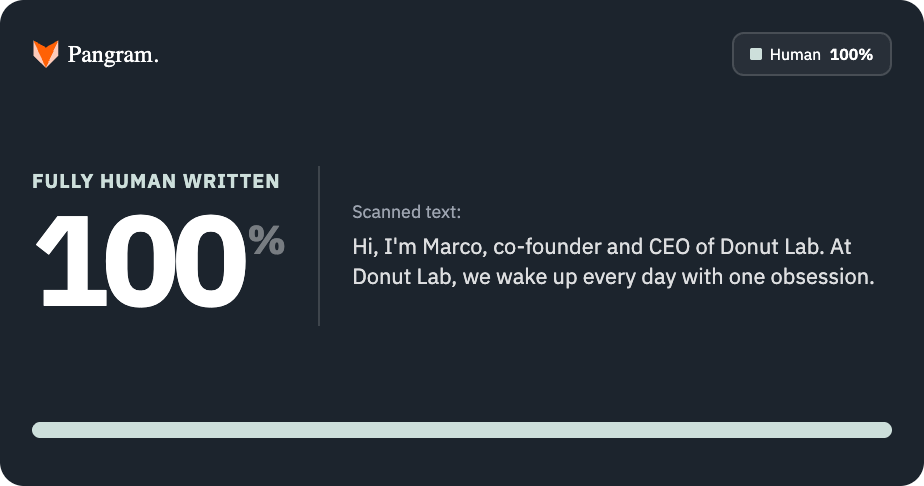
https://www.pangram.com/history/5b62e28f-e0ce-4833-bd9a-360f0e76f1c0
@LoganTurner Pangram has low false positives, but high false negatives. One issue is that the script you inputted is chopped up with a bunch of line breaks, has a number of typos and incorrect annotations, and is also a human reading off an AI script, likely with some edits or changes. As a result, I wouldn't expect it to be able to parse it.
But like... if you read through that script, it's really obvious it's AI gen. The sheer volume of "Not ___, but ____" constructions is massive.
"And once you see what it enables, combustion doesn't just look outdated, it looks unnecessary."
What human would write this? lol
@bens thanks, yeah I ended up doing some searching on Twitter about Pangram’s recent track record and realized this could be a false negative. It does sound bad
@bens @SG can you try to get an interview with @MikhailTal about Commodities Manifold for the newsletter? I feel like that would be very interesting.