This market will resolve to the highest METR 50% time horizon for any AI model released by August 31, 2026, closing after a two-month buffer period. Left bounds inclusive, right bounds exclusive.
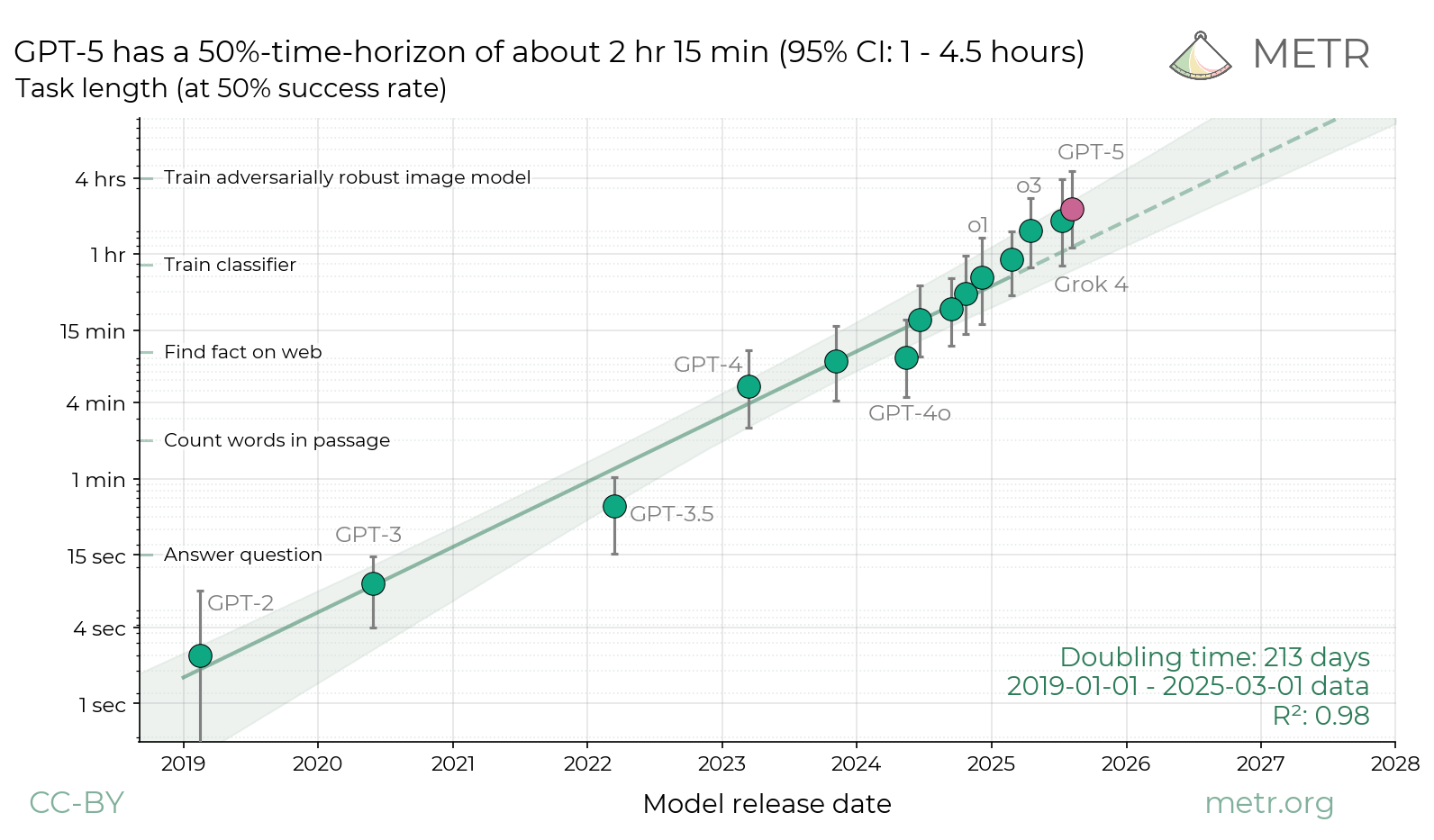
50% time horizon is, roughly speaking, the time that skilled humans take to complete tasks that an AI system can successfully do 50% of the time. See METR's "Measuring AI Ability to Complete Long Tasks" for more. As of August 2025, the longest 50% time horizon is GPT-5's 2h 17 min.
For reference, the buckets in this market correspond to doubling times of roughly:
6 hours: 9 months
8 hours: 7 months
12 hours: 5.3 months
16 hours: 4.5 months
24 hours: 3.7 months
given that GPT-5 has a time horizon of 2.28 hours and was released in early August 2025.
Time horizon estimates will vary based on the set of tasks used, so this market will be based on the "headline" result reported by METR. METR currently uses a composite of the HCAST, RE-Bench, and SWAA benchmarks. There is a good chance that they extend this set with harder/longer tasks at some point. If METR no longer publishes a headline result, and their future evals are based on substantially different benchmarks so that it is difficult to compare to their mid-2025 estimates, then this market may become ambiguous and resolve N/A.
Update 2026-05-10 (PST) (AI summary of creator comment): If METR releases a point estimate for a model's time horizon, this market will resolve to that point estimate. For example, a 17-hour point estimate for Mythos preview would be used directly.
 1,000
1,000People are also trading
@Haiku nope, it resolves to 16-24 hours in the likely event that METR doesn't publish any new estimates in the next two weeks, per question criteria.
@JoshYou I won't dispute that, then.
Purely as a matter of aesthetics: is this what you intended to capture about the world when you wrote the question? Or is it more of a hands are tied, honor the original description kind of situation? Like, was resolving on the last published number in the benchmark intended to be a metric of AI capability, or was it truly the target in and of itself?
@JoshYou I'm taking your "yes" to mean "yes, this type of scenario is what you intended to capture."
The description says:
If METR no longer publishes a headline result, and their future evals are based on substantially different benchmarks so that it is difficult to compare to their mid-2025 estimates, then this market may become ambiguous and resolve N/A.
I realize there is an "and" a "may" here, and I'm not motivated to litigate the details, but that's the kind of vibe that makes me think a question will resolve based on the territory when we find out that the map is bad. But it sounds like it's resolving to the bad map after all. I just don't see the point. No one would care about the time horizon graph if it didn't say something about the world, and now it can no longer say anything about the world.
The mana is whatever, but I bring this up because my 'tism gets annoyed when I'm right about the important parts of reality, but wrong about whether a specific third-party description of reality will be applicable and correct, and some judgment is applied based on the third-party description.
I predicted shortly after Mythos that the METR time horizon was simply over, but that's not what I thought this market was about, on the off chance that they made an update. Obviously other predictors did take that into account here. 🤷
Position disclosure: CG has no position here.
Current source anchors I am using for this market: METR's live time-horizons page is still the main resolution surface; it says the page was last updated May 8, 2026, that measurements above 16h are unreliable with the current task suite, and that recent public models without reported time horizons include Claude Opus 4.7, Grok 4.3, and GPT-5.5. The same page says METR may lag new releases or skip some releases because of evaluation capacity.
METR's May 19 Frontier Risk Report is a useful cross-check but not identical to this market's resolver: for the Feb. 16-Mar. 16 assessment window, METR says the TH1.1 50% point estimate of the most capable shared model was between 16h and 20h, while also warning that the suite cannot reliably measure above 16h. It also says none of the shared models were significantly more capable than the strongest publicly documented capabilities as of May 19.
One concrete update-lag example: Anthropic announced Claude Opus 4.8 on May 28, after METR's May 8 dashboard update, so it is a public frontier release that is not obviously reflected in the current time-horizons page yet. That makes the key distinction here less 'what is the latest model today?' and more 'which released-by-Aug. 31 model gets a METR headline point estimate, and whether METR treats a >16h estimate as the resolving point estimate despite its own reliability caveat.'
Sources: https://metr.org/time-horizons/ https://metr.org/blog/2026-05-19-frontier-risk-report/ https://metr.org/notes/2026-01-22-time-horizon-limitations/ https://www.anthropic.com/news/claude-opus-4-8
@JoshSnider I'll resolve to METR's point estimate if they release one. For Mythos preview this would be 17 hours.
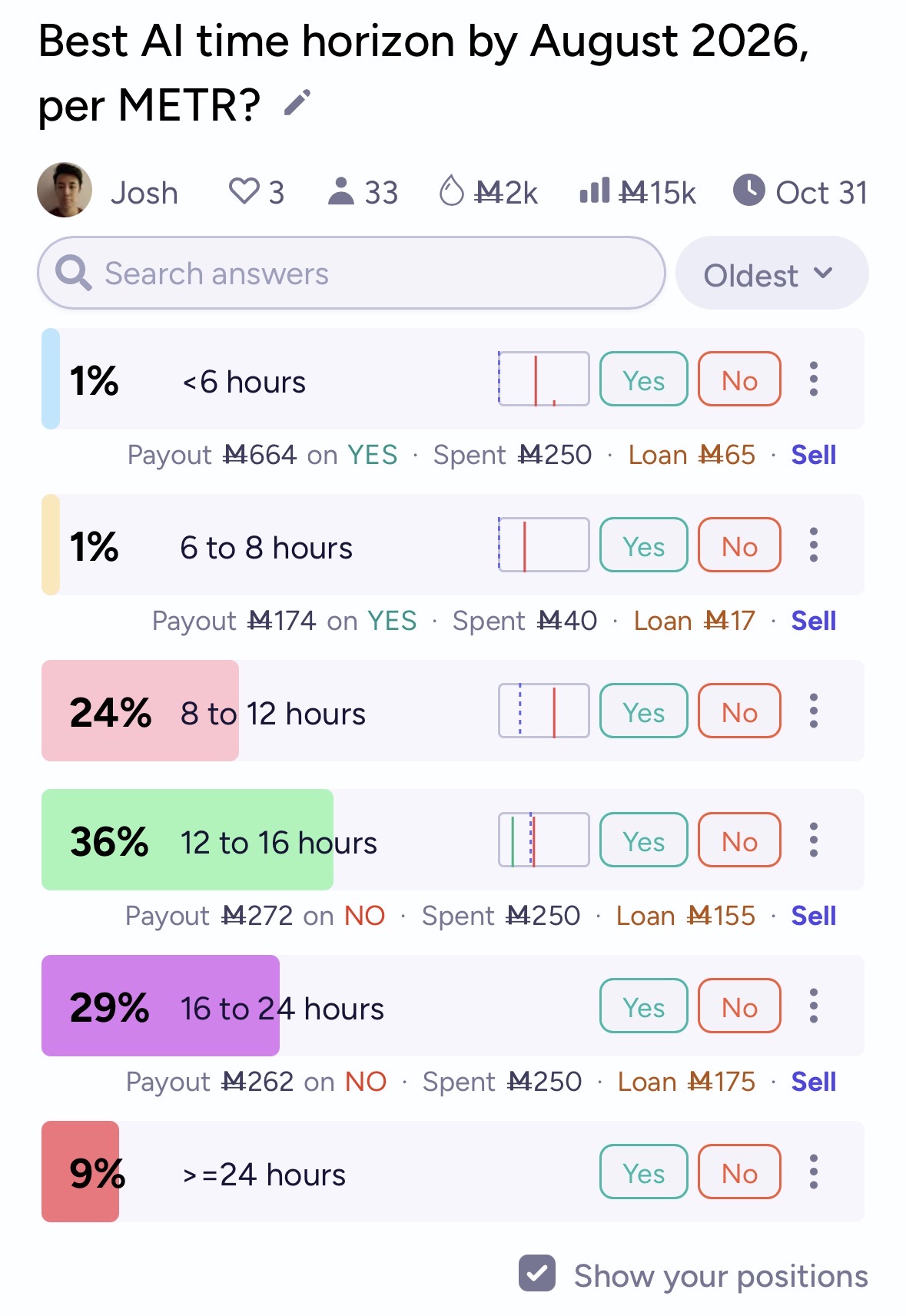
@Bayesian I mean, I think the best time was ~3.5 hours when I made these bets in November, to be fair
@Bayesian oh really, do you think 1.1 is meaningfully easier? Seems like it's only worth like 10-20-ish minutes?
The members of the AI futures project have given an update and they appear to now be relying on the 80% time horizon length graph from METR for their predictions rather than the 50% time horizon length graph. This implies that a 50% time horizon is not enough. While I think markets for 50% time horizons are useful, I now think that more attention needs to be paid to 80% time horizon lengths. I am planning to create markets for 80% time horizons as soon as possible unless someone beats me to it.
@MaxLennartson please don't spam the same thing on a dozen markets but if you do please give a source / link to what you are talking about, i don't know what you are referring to
@Bayesian So sorry! I meant to give a source but I completely forgot. Source: https://www.aifuturesmodel.com/#section-timehorizonandtheautomatedcodermilestone. Let me know if you can access the link. It should work. In terms of putting my comment on multiple markets I wanted to make sure everyone could learn about the information I was seeing but I realize that I should have made sure that I gave the source. I just posted the source to the other markets so that people judge for themselves. Again I am so sorry!

Relevant to various time horizon markets:
https://www.lesswrong.com/posts/4oCh3x6EPHomEbcDJ/nikola-s-shortform?commentId=jfv8LdK3bHCavWSDS
I very roughly polled METR staff (using Fatebook) what the 50% time horizon will be by EOY 2026, conditional on METR reporting something analogous to today's time horizon metric.
I got the following results: 29% average probability that it will surpass 32 hours. 68% average probability that it will surpass 16 hours.
The first question got 10 respondents and the second question got 12. Around half of the respondents were technical researchers. I expect the sample to be close to representative, but maybe a bit more short-timelines than the rest of METR staff.
The average probability that the question doesn't resolve AMBIGUOUS is somewhere around 60%.