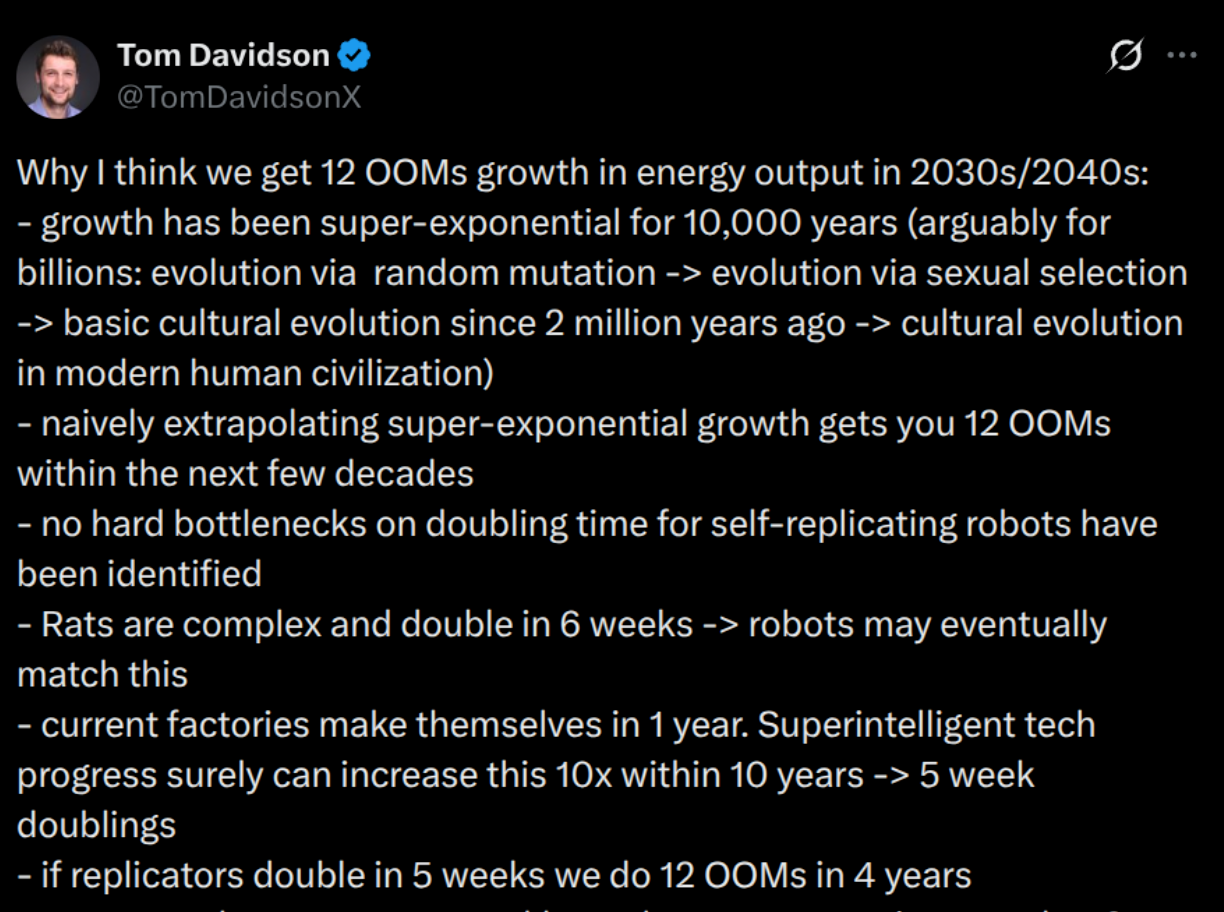
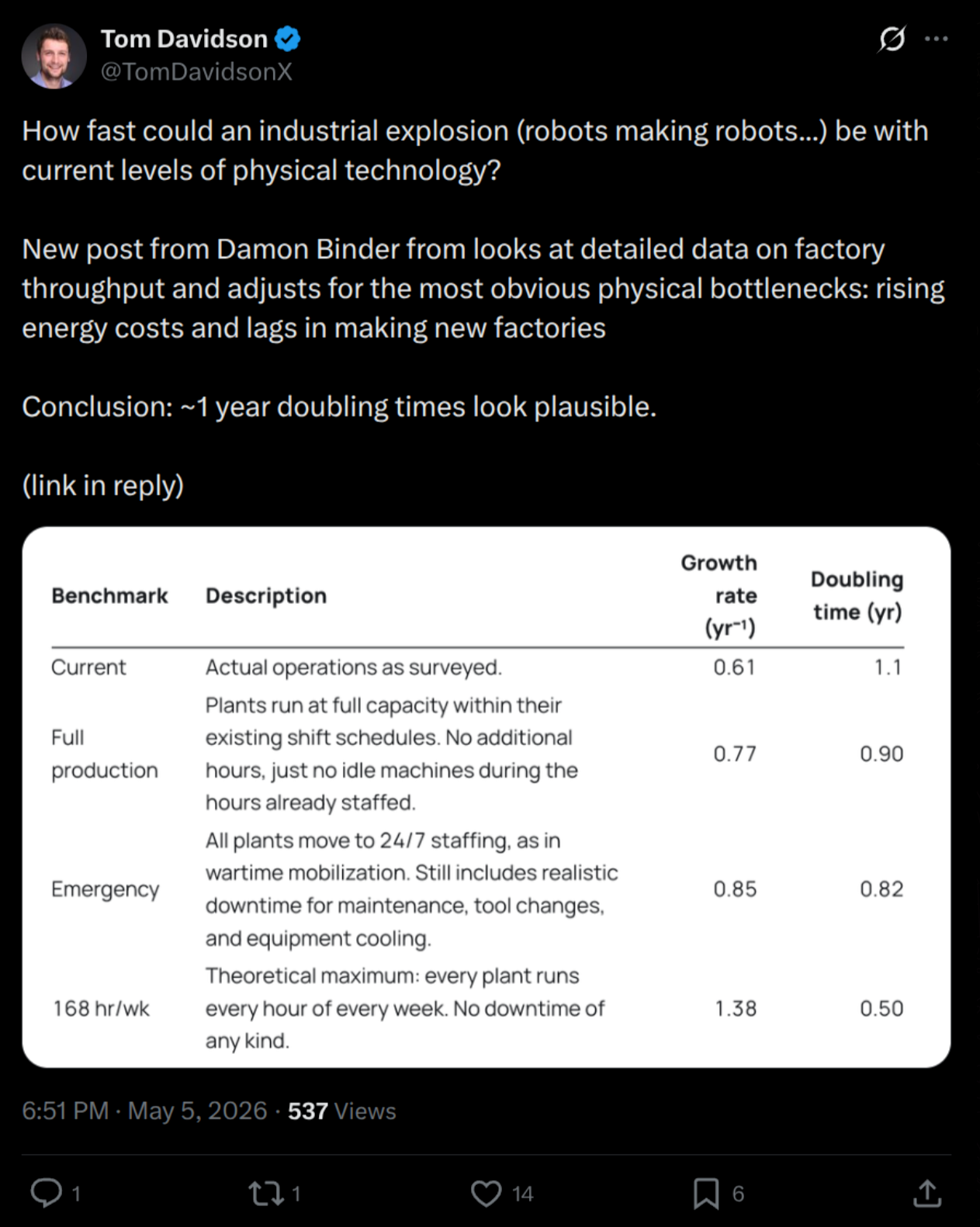
Resolves as YES if there is strong evidence that an AI-and-robotics-driven “industrial explosion” in physical manufacturing capacity is underway or has already occurred before January 1st 2040, according to the criteria below.
What counts as an “industrial explosion”?
For this market, an industrial explosion means more than just “lots of automation” or “high GDP growth.” It refers to a positive feedback loop where:
Physical industrial output (e.g., real manufacturing value added, tonnage of key materials, output of heavy and high-tech capital goods) is growing at historically unprecedented rates, plausibly driven by AI and robotics.
Factories, robots, and related capital goods are being produced largely by earlier generations of automated factories and robots, so that industrial capacity itself is expanding via a machine-driven feedback loop.
The phenomenon is widely regarded by domain experts as a qualitatively new industrial regime, not just another business cycle, sectoral boom, or catch-up industrialization.
Indicative resolution criteria
I will look at global and regional statistics, technical reports, and historical comparisons. I intend to resolve this market YES if, by January 1st 2040, the following are clearly true in my judgment:
Scale and speed of industrial growth
Over some contiguous period of at most ~10 years ending before 2040, there is a multiple-fold (on the order of 3×–10×) increase in real manufacturing output per capita for the world as a whole or for at least one very large bloc (e.g., a major economic region representing a large share of world GDP).
Growth rates during this surge are significantly higher—and more sustained—than any previous global industrialization episode on record.
Machine-driven expansion of capacity
During the explosive phase, a large share of new industrial capacity (factories, fabs, robot production lines, key machine tools, etc.) is built and operated in facilities where most of the crucial work is done by AI systems and robots rather than human workers.
There is clear evidence of factories making robots and factory equipment which are themselves used to build more factories and robots, forming an obvious feedback loop rather than isolated pockets of automation.
AI/robotics as the main driver
Major analyses (e.g., by multilateral institutions, central banks, industry consortia, or top academic/technical groups) attribute the bulk of the unprecedented industrial growth to AI and robotics—both as direct production technologies and as tools for design, scheduling, and optimization.
Other explanations (natural resource windfalls, one-off reconstruction, demographic spikes, etc.) are not seen as primary drivers of the surge.
Expert narrative and historical framing
Multiple serious sources (not just hypey marketing) explicitly describe the situation as something like an “AI-driven industrial explosion,” “runaway robotized industrial revolution,” or otherwise clearly treat it as a new phase of industrialization substantially more abrupt and intense than the first three industrial revolutions.
Economic historians or comparable experts largely agree that we have entered a qualitatively new industrial era defined by machine-driven self-expansion of manufacturing capacity.
“Strong evidence” here means that taken together, these conditions make it very hard to argue that we’re still in a merely incremental Industry 4.0 transition. I will not require that every detail above be satisfied to the letter, but I will only resolve YES if the overall picture is clearly one of explosive, self-reinforcing industrial growth, not just fast but conventional progress.
What does not count?
Purely cognitive “intelligence explosion” without industrial follow-through: If AI systems become vastly more capable (e.g., doing most science and software work) but physical industrial output remains within historical growth ranges and factories are still mostly human-built and -operated, this resolves NO.
Ordinary automation or strong but historically normal growth: If AI and robots continue to diffuse into industry, productivity improves, and manufacturing grows quickly, but growth rates and patterns look comparable to past high-growth episodes (e.g., postwar booms, rapid catch-up industrialization), this resolves NO.
Sector booms without broad industrial explosion: A huge surge in one sector (e.g., chips, batteries, or construction) that doesn’t translate into a broad, machine-driven explosion in overall industrial capacity also resolves NO.
Relation to an “intelligence explosion”
This question is about industrial FOOM, not directly about whether an “intelligence explosion” in the I.J. Good / superintelligence sense is ongoing. An intelligence explosion may well be a cause or accompaniment of an industrial explosion, but:
A full-blown intelligence explosion is not required for a YES outcome, if we get the industrial explosion by other means.
Conversely, if we seem to have an intelligence explosion in software and research, but industrial capacity remains comparatively tame, this market still resolves NO.
If by January 1st 2040 there is no strong evidence that such an AI-and-robotics-driven industrial explosion has occurred or is clearly underway, this market resolves NO.
 1,000
1,000People are also trading
Industrial explosions show why prevention and early detection are so important. Regular inspections and machine-vision systems can help identify defects before they become serious safety risks. When I was looking for an imaging solution for my company, https://elvotec.eu/en/catalog/hikrobot/line_scan_camera/ was helpful for exploring line scan camera options from Elvotec, a distributor of industrial vision equipment. Of course, cameras alone cannot prevent every accident, but reliable monitoring and quality control can reduce some risks. Investing in prevention is always better than dealing with the consequences.