
Resolves as YES if there is strong evidence that 100 million humanoid robots have been manufactured by January 1st 2032.
This refers to cumulative global manufacturing of humanoid robots up to that date, not the number of robots still operating, currently deployed, sold in 2031 alone, or installed in customer facilities.
For this market, “humanoid robots” means robots that credible sources describe as humanoid, bipedal humanoid, general-purpose humanoid, embodied humanoid, or substantially human-form robots. This includes units manufactured for research, demonstrations, entertainment, data collection, internal company use, industrial pilots, commercial use, or consumer use. Robots count even if they are later destroyed, retired, exported, warehoused, or never sold.
A unit counts once it has been manufactured as a substantially complete humanoid robot. It does not need to have been sold, delivered, registered, installed, or used commercially. Preorders, reservations, letters of intent, announced future capacity, and unfinished kits/components do not count unless credible sources treat them as completed robot units.
This market excludes non-humanoid industrial robot arms, quadruped “robot dogs,” drones, wheeled warehouse robots, exoskeletons, prosthetics, toys not generally counted as humanoid robots by industry sources, and software-only AI agents.
“Strong evidence” may include official government statistics, audited company disclosures, credible market-research reports, manufacturer production/shipment disclosures, IPO/prospectus filings, or well-sourced reporting from reputable outlets. Because no single global registry is likely to exist, this market may resolve YES based on a credible synthesis of multiple sources across major manufacturers and countries. A single uncited claim, company target, or extrapolation should not be sufficient by itself.
If credible evidence published after January 1st 2032 shows that the 100 million threshold had already been reached before the deadline, this resolves YES. If the best available evidence does not support cumulative global production of at least 100 million humanoid robots by January 1st 2032, this resolves NO.
Background: The Epoch AI notes estimate 2025 humanoid production at roughly 16,000 units and use a 2022–2025 trend implying a roughly 6-month doubling time. The chart I will attach projects cumulative humanoid robot production to ~74.9 million by 2031; continuing that same trend would cross 100 million shortly after the 2031 chart point.
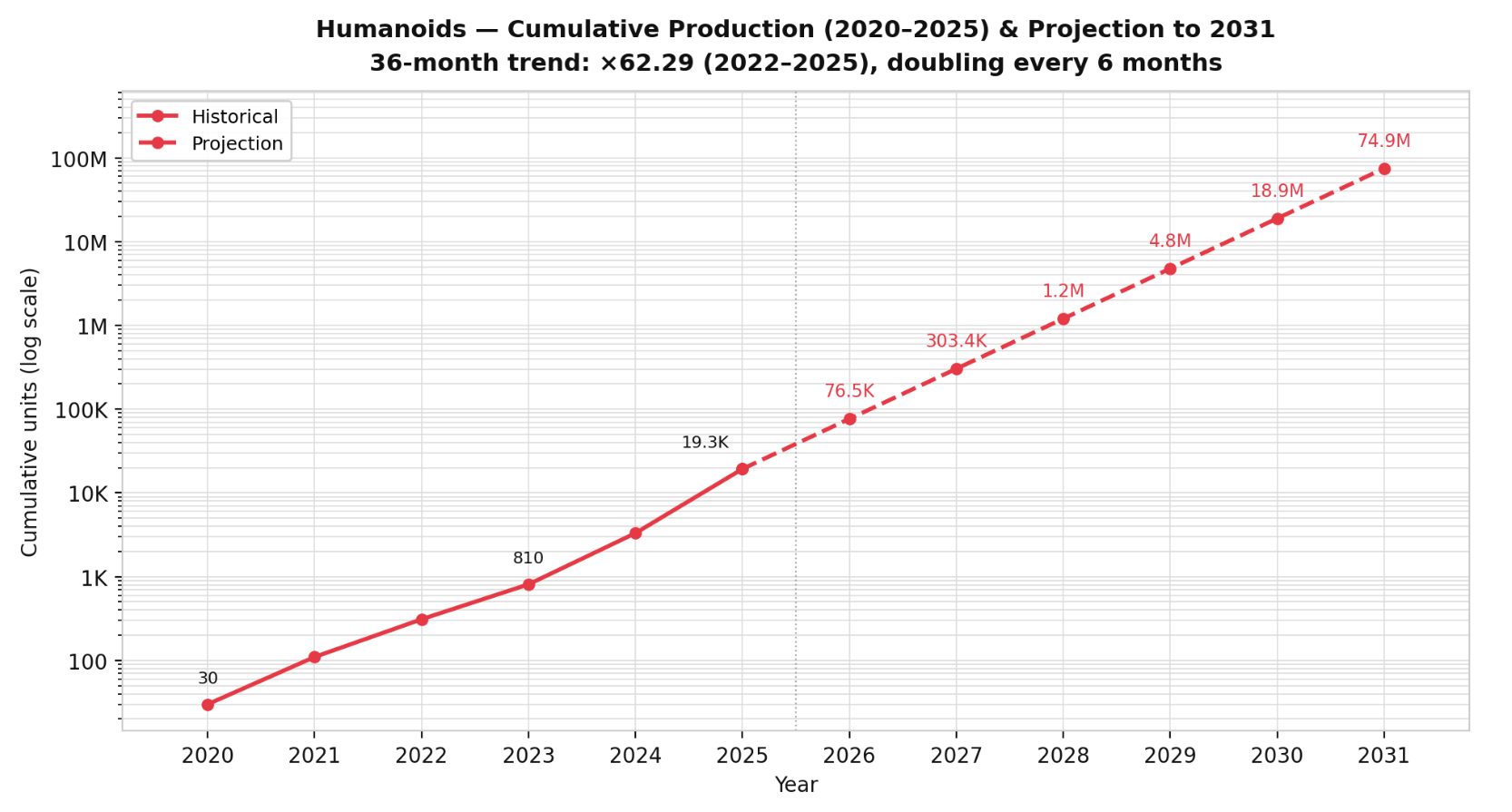
https://docs.google.com/document/d/1dWwBaP7karJq0gU-e_XtCCqiVExLTKVJEafi4w2Nl5M/edit?tab=t.0
https://epoch.ai/blog/how-fast-could-robot-production-scale-up
 1,000
1,000People are also trading
There are lots of edge cases here, as to what counts.
I'm thinking that the legs need to be able to rotate at the hip, even if only 1 dimensionally, but maybe knees are optional. That it needs to be able to stand up (balance) actively on its own, and needs to have a torso part and 2 arms that don't need to be able to move, but that maybe head is optional. Maybe it can have wheels on its feet, but the legs need to be doing a lot of the work, like a human on roller skates is using their legs a lot to move, one of the Unitree ones is like this.
I'm specifically thinking of another humanoid'ish robot, that's kind of like a pair of skateboard-like metal frames with powered wheels around them, that's then got what seems a lot like a mannequin on the top. It's soo much like cheating, the concept is just bizarre.
If a platform with powered wheels on all 4 corners, an inanimate mannequin stuck upright on top, and an accessory like lets say a speaker in the mannequins head is sufficient, then it might have some chance to change the calculation somewhat. Companies as a whole don't want machinery (robots) that have a wider variety of behaviours or are physically more capable (like stronger) than they need for a specific task, they want them to be able to just do that one specific task as cost effectively as possible. However super-cheap talking mannequin on wheels might be of some interest to some part of the service industry.