Resolves YES if, before January 1, 2035, the FDA approves (via CDER or CBER, any pathway including accelerated approval) a drug or biologic whose approved labeling names aging, biological aging, lifespan extension, healthspan extension, or the delay of multiple age-related diseases as such (rather than a specific disease) as an indication. Approval for a single age-related disease (for example Alzheimer's disease, osteoarthritis, sarcopenia) does not count. Otherwise NO. Background: No drug has been approved for aging as an indication in humans; aging is not a recognized indication at the FDA, which is why the proposed TAME trial of metformin targets a composite of age-related diseases (Barzilai et al., Cell Metabolism 2016). In dogs, by contrast, the FDA Center for Veterinary Medicine has accepted reasonable-expectation-of-effectiveness and target-animal-safety sections for lifespan-extension drugs under its expanded conditional approval pathway. See the companion question: Will the FDA conditionally approve a drug to extend lifespan or healthspan in dogs before January 1, 2028? Sources: https://doi.org/10.1016/j.cmet.2016.05.011 CVM Guidance for Industry #261 /w0lph/will-the-fda-conditionally-approve https://w0lph.github.io/k9/why-dogs.html

 1,000
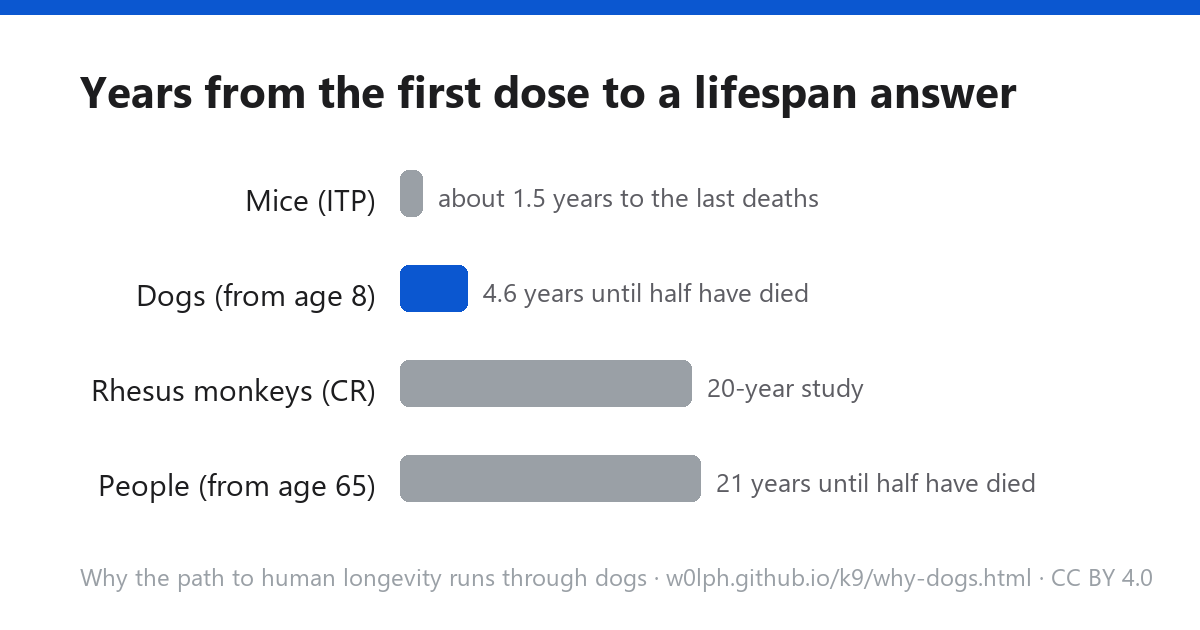
1,000Base rate: aging is not an indication at the FDA, and TAME, the most advanced proposal, uses a composite of age-related diseases rather than lifespan. The life-table arithmetic on why lifespan endpoints are out of reach in people, with the model stated: https://w0lph.github.io/k9/why-dogs.html?v=2