Market will resolve...
YES if a robot with the characteristics given below defeats the current olympic champion at their sport within the detailed time intervals.
NO if humans are still undefeated within the given time intervals.
OTHER if an unexpected situation happens.
The idea is for the robot to be physically similar to a human so the competition is fair. It must abide to the following limitations (which I'm open to changing, if given a good reason), as to make the competition fair.
-The robot must be approximately humanoid. Its design cannot grant it a notable advantage. Having hooks for hands is okay for 100m sprint, but not for boxing. If there's no consensus about its design being fair, then I'll decide.
-It's weight, height, proportions and other physical characteristics must have a precedent within the sport, or be otherwise reasonable. No 200kg boxing robots allowed. Longer-than-average arms for swimming are permited.
-It doesn't need to carry its own energy storage. It can be plugged into a cable.
-In the case of team sports, robots can't use "telepathy" (communicating to coordinate their actions as one).
-All real time processing must be done by a computer inside the robot. Having a supercomputer halfway around the world controlling it feels like cheating.
I may bet on this market.
 1,000
1,000People are also trading
I think this should resolve to 2025-2030: https://www.bastillepost.com/global/article/6102280-chinese-robot-shows-agility-speed-in-1500m-race-at-humanoid-robot-games
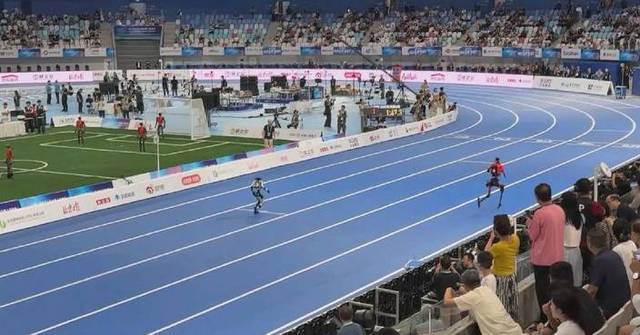
I asked Claude to judge whether it fit the criteria and it gave the following response:
Here's what I found. The robot is Tiangong Ultra (also transliterated "Tien Kung Ultra"), developed by the Beijing Humanoid Robot Innovation Center (a joint venture of UBTech, Xiaomi, and two state-owned Beijing investment entities), racing under the "Team Tianzhuo" entry. It won the 1,500m at the 2nd World Humanoid Robot Games in 2:21.63/64 on Aug 23, 2026 — the same robot line that also broke Usain Bolt's 100m world record (9.39s) at the same Games and won the world's first humanoid half-marathon back in April 2025.
Physical form: Standard bipedal humanoid — two legs, two arms, upright torso, 20 degrees of freedom. Stands ~1.8m tall, weighs ~52–55kg.
Going through your criteria:
1. Approximately humanoid, no notable design advantage — Basic form is unambiguously humanoid (biped, two arms, torso, head). One flag worth your attention: the robot's own CTO (Tang Jian) has publicly credited its "long legs" as a contributor to its running performance, and a competing team (Honor's "Lightning" robot) explicitly lengthened its legs by 10cm specifically to boost stride/sprint ability ahead of these Games. Coverage treats this as normal engineering iteration rather than a controversy — I found no reporting suggesting other teams or commentators consider it unfair. So there's no visible disagreement, but there's also no explicit consensus it's fine — it's more that nobody's raised it as an issue.
2. Weight/height/proportions have precedent — At 1.8m/~55kg, it's within human elite-athlete height range (Bolt is 1.95m) though notably lean for its height (BMI ~17, thin even for a sprinter). Nothing like your "200kg boxing robot" scenario — proportions are recognizably human-runner-shaped, just on the light end.
3. Doesn't need its own energy storage — Not directly at issue since your rule permits either; for reference, sprint/mid-distance events like this appear to run on the robot's onboard battery (unlike the half-marathon, which used battery swaps), but this doesn't affect eligibility either way per your criteria.
4. No "telepathy" in team events — N/A here; the 1,500m is an individual event. Would matter for the 4×100m relay or 5v5 soccer if you're evaluating those.
5. All real-time processing onboard — This is the most rule-relevant point I found: for 2026, organizers explicitly reclassified the 400m, 1,500m, and 4×100m relay as "fully autonomous" events requiring "zero human remote control or intervention throughout the whole race." I couldn't find a document stating in so many words "100% of compute happens on the chassis" for this specific race, but other autonomous events at the same Games (e.g., the table tennis) are explicitly reported as running on onboard hardware (Jetson Orin units carried by the robot), which is the pattern organizers seem to be enforcing generally. So this looks like it satisfies your criterion, with a small asterisk that I'm inferring from the broader autonomy framework rather than a robot-specific spec sheet confirming zero offboard compute.
Net: the clearest gray area is the leg-length/design-advantage question in #1 — everything else looks like a reasonably clean fit for your criteria.
@PeterF Not much agility, but a great deal of strength and coordination is required. I'm not convinced that current humanoid robots can lift 270kg above their heads.
@TiagoChamba Agreed, but only because "humanoid" is a pretty restrictive category. (And it's not a category that many robot-makers are incentivized to focus on. E.g. warehouse or assembly-line robots are much stronger than that, but aren't humanoid.)
@PeterF Yeah, there isn't much incentive to defeat humans at physical sports. Or at least not the same incentive as there was with chess.
I suspect that the first humanoid robot to satisfy all conditions will do so as a secondary rather than primary goal. A side project for the company, to show how capable its new model is.
From your description it sounds like it doesn't have to happen in an official competition -- unofficial (but impartially-witnessed) events are OK, right?
E.g. imagine Boston Dynamics decided to invite Usain Bolt to run against their latest-model robot, right there in the Boston Dynamics warehouse. Would that count?
@PeterF I feel better able to guess "when will robots be technically up to this challenge" than to guess "when will there exist some official competition that tests humans against robots"
@PeterF Yes, that's right. No official competition, but an event is alright.
In the case of an event like the 100m sprint, in which athletes don't interact with each other, it wouldn't be necessary for the robot to compete side to side against a human. If there is public proof of a robot besting a the world champion's record, then It'll resolve to YES.