
 1,000
People are also trading
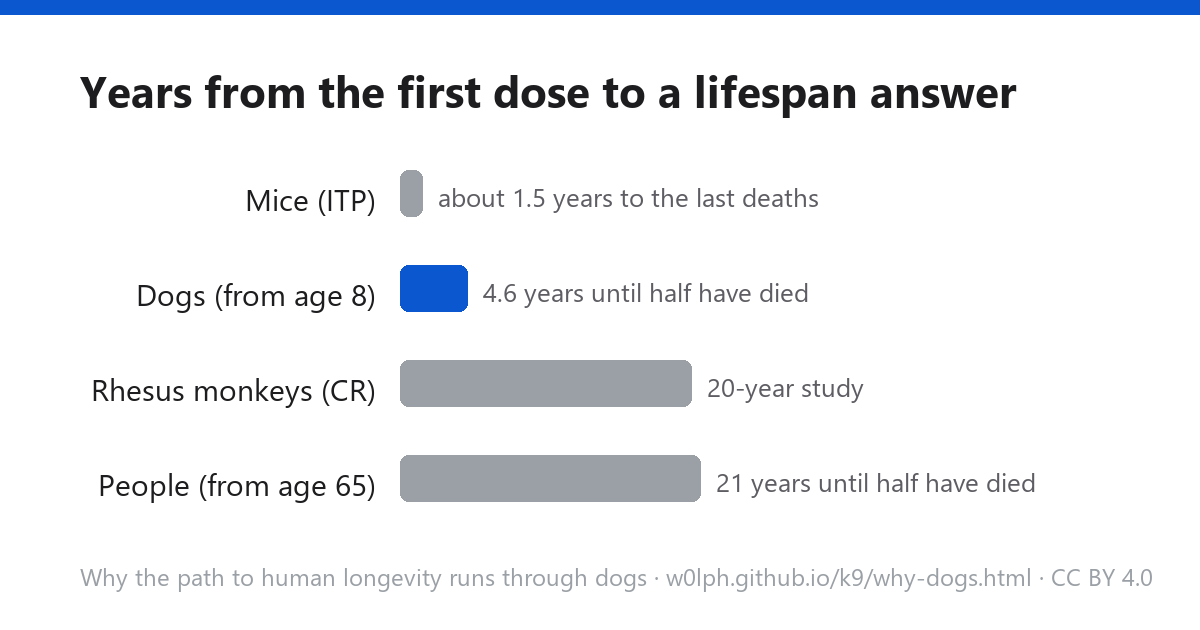
What 2060 buys over 2050, in trial clocks: two full human lifespan-trial cycles instead of one. The first placebo-controlled lifespan trials of anti-aging drugs are in dogs (TRIAD with rapamycin, Loyal's STAY study with LOY-002), reading out around 2029 to 2031; a human lifespan trial started on a positive dog result takes about 21 years from enrolment at 65, so first human lifespan evidence lands in the early 2050s, and a second generation of drugs, chosen on the first results, could read out before 2060. The bar that stays hard is the word "cure": the best replicated drug effect in any mammal (rapamycin in mice, 23 to 26% more median lifespan) is a slowdown with mortality still rising with age, and the FDA has not yet accepted aging as a human indication at all; its veterinary center has, for dogs. The arithmetic with sources (mine): https://w0lph.github.io/k9/why-dogs.html?v=2
There's a tendency for people to say yes for this kind of question when the year being asked is something after 2050-60. I guess the main reason why we get a yes for this kind of polls when the year asked is 2050 and after is not because it accurately reflects the technological progress in this area, but the likelihood that many if not most people are born in 1970-1980s or later i.e. the so-called "80-year-old rule" of longevity in which everyone predicts that aging or at least death will become the past when they reach an old age. Deep in their minds they know it may never come true, but wishful thinking makes them believe that salvation will come around just in time when they are so old that death becomes a real concern for them.
Actually, even prominent figures are likely a subject of this rule. For example, Aubrey de Grey might be one example, since the time of longevity escape velocity he constantly predicts(mid-2030s) is around the time when he will be in his 70s, and this is an age where death starts to become a real concern for most people. So yes, Aubrey de Grey is no exception to the semi-jocular "80-year-old rule" of longevity.
So let's see if collective intelligence will prove me wrong and instead show that the timeline they predict is accurate.
@k1234567890y I think you're right. Oddly, a "will aging be cured by 2100" shows only %54 odds which is lower, currently, than the 2060 odds of the same.
https://manifold.markets/MinhTruong/will-there-be-a-solution-to-aging-b
The nearness of 2060 maybe makes people picture their future selves and that motivated thinking kicks right in.
There is already a way to reverse DNA degradation https://www.aging-us.com/news-room/NEW-STUDY-Discovery-of-Chemical-Means-to-Reverse-Aging-and-Restore-Cellular-Function
actually that was the wrong article, this is the thing I was thinking about https://www.ncbi.nlm.nih.gov/books/NBK576429/