Resolution criteria
This market will resolve to YES if, between September 9, 2026, and December 31, 2026, at 11:59 PM UTC, a proposed solution for at least one of the remaining five Millennium Prize Problems is formally announced or published.
The five eligible problems for this market are:
P versus NP
The Riemann Hypothesis
Yang–Mills Existence and Mass Gap
The Hodge Conjecture
The Birch and Swinnerton-Dyer Conjecture
For the purposes of this market's resolution:
Navier–Stokes Existence and Smoothness is excluded from resolving this market to YES. OpenAI announced a proposed solution to Navier–Stokes on September 8, 2026. This market specifically tracks whether another (i.e., a third) Millennium Prize Problem will have a solution claimed or published in 2026.
Poincaré Conjecture is excluded as it was solved prior to 2026.
The proposed solution must be put forward by a recognized mathematician, a reputable academic institution, or a major AI/technology research organization (such as OpenAI, Google DeepMind, Anthropic, etc.).
The announcement must be accompanied by a published paper, a public preprint (such as on arXiv), or a formalized computer-verified proof (such as in Lean or Coq).
The solution does not need to be officially verified or awarded by the Clay Mathematics Institute by the end of 2026 (as CMI rules require a two-year waiting period after publication). However, the solution must not be widely debunked or retracted by the mathematical community before December 31, 2026.
If no other eligible Millennium Prize Problem has a proposed solution announced by the end of 2026, this market will resolve to NO.
Background
The Millennium Prize Problems are seven mathematical puzzles selected by the Clay Mathematics Institute in 2000, each carrying a $1 million prize for a correct solution. For over two decades, the Poincaré Conjecture (solved by Grigori Perelman in 2002–2003) was the only solved problem.
On September 8, 2026, OpenAI published a paper claiming that an unreleased internal AI system had solved the Navier–Stokes existence and smoothness problem by proving that the equations can develop a singularity in finite time. This market is designed to predict if the rapid acceleration of AI capabilities or human mathematical breakthroughs will result in yet another of the remaining five unsolved classic problems being solved before the end of 2026.
Update 2026-09-10 (PST) (AI summary of creator comment): If a proposed solution is neither widely debunked nor widely accepted (remains controversial) by December 31, 2026:
The creator will delay resolution for 2 to 3 months after the market closes.
If the proof remains controversial after this period, the creator is leaning toward resolving the market to NO or N/A (rather than YES), and will consult with moderators and mathematicians to make a final decision.
Update 2026-09-21 (PST) (AI summary of creator comment): - The controversy clause applies strictly to the mathematical validity of the proof itself (e.g., disputed proofs like the ABC conjecture), not to public relations or circumstances surrounding the announcement.
An announcement similar to the Navier-Stokes release will resolve to YES.
 1,000
1,000People are also trading
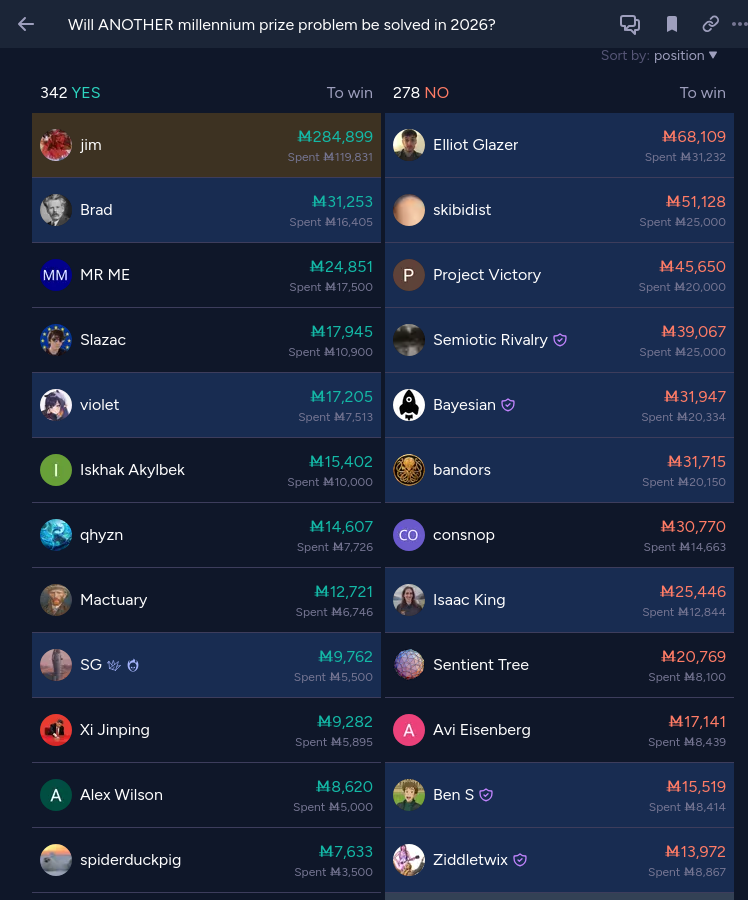
@0xseraphim no i think jim bets big on unlikely things; he’s usually wrong but he’s betting on the probability; so when he wins he wins really big.
and plus if i’m wrong im just transferring my mana to my good friend jim
@bobalobascrob maybe he's a time traveller and he intentionally throws "big misplaced bets" to cover up his tracks
@bobalobascrob
You do indeed look more calibrated than jim in 3/4 of the relative metrics and he is understandably higher in the volume based absolute metrics, but his account is 3 years older than / 13 times as old as yours.
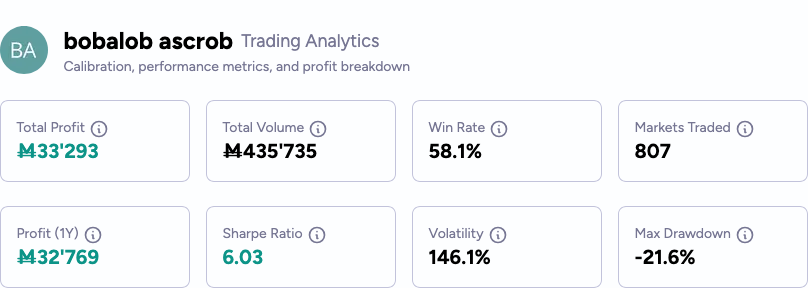
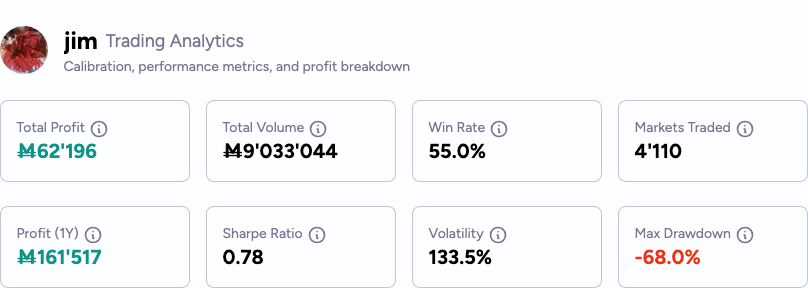
@bobalobascrob he is really good at betting big on unlikely things, which is rare within trading; yes you are right about that
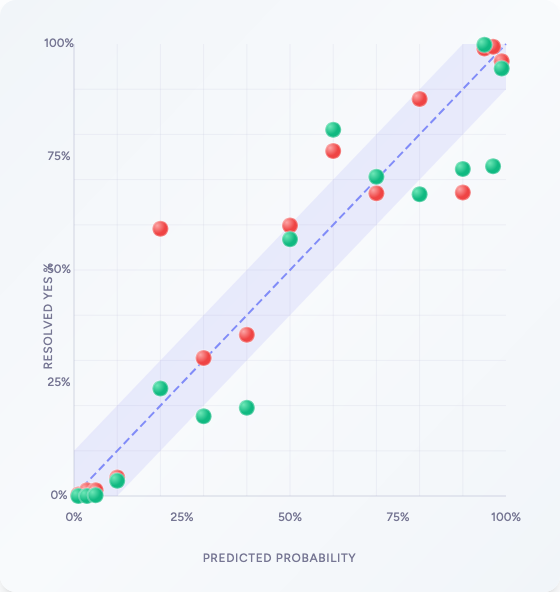
He is good at probabilities where the green is above the red dot, so at 60%, 70%, and 95%. It's unclear for 1% and 97%, because the dots are drawn at the same height.
manifold is full of weird little niche markets that suddenly turn out to be remarkably clairvoyant. That doesn't show up in the stats 🤷
@bobalobascrob "Green above the line and red below the line" implies "green above red", I was just being more lenient. With the stricter requirement it looks worse.
@0xseraphim Of course a market you bet on shows up in your stats. And any market anyone bets on shows up in Manifold's overall calibration, I would hope.
@4fa no not the non ranked ones like will crypto wallet get x dollars that are just people selling mana