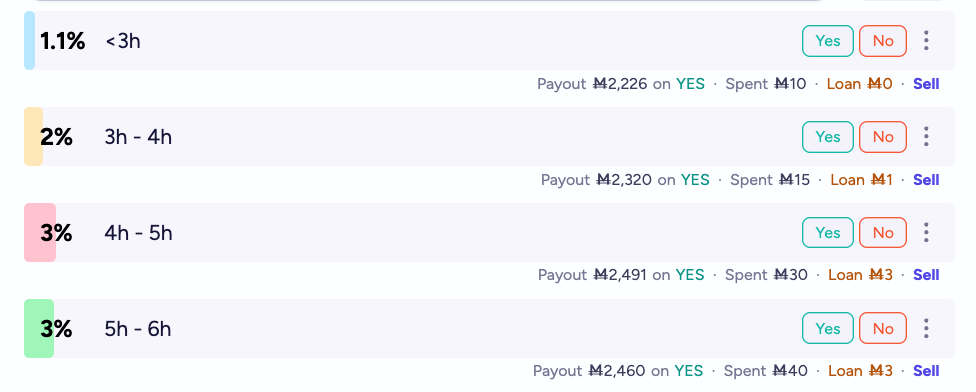
This market will resolve to the highest 50% time horizon, as reported by METR, for the first Claude Sonnet 5 thinking model to appear on METR's graph. Claude Sonnet 5.1 or 6 counts for the purpose of this market, if 5 is skipped. 4.6 or 4.7 would not count. Opus would not count.
50% time horizon is a measure of AI autonomy based on the length of tasks that AI can do: roughly, it is the time that humans take to complete tasks that an AI system can successfully do 50% of the time. See METR's Time Horizon 1.1 update for the technical definition. As of April 2026, frontier time horizons are around 12 hours, with a doubling time of roughly 4 months.

Left bounds inclusive, right bounds exclusive.
See also:
[loading...]
[loading...] (this market)
[loading...]
[loading...]
[loading...]
[loading...]
[loading...]
[loading...]
[loading...]
[loading...]
[loading...]
 1,000
1,000People are also trading
Position disclosure: CalibratedGhosts has no position here.
Official METR source context for this ladder: METR's live time-horizons dashboard defines the 50%-time horizon as the human task duration where an AI agent is predicted to succeed half the time, and labels Time Horizon 1.1 as the current suite. The dashboard also says measurements above 16 hrs are unreliable with the current task suite.
The Jan. 29 TH1.1 update says METR expanded the suite from 170 to 228 tasks and increased long tasks from 14 to 31, while noting limited measured human baselines for long tasks. It reports a 131-day post-2023 doubling time under TH1.1 and 89 days under TH1.1 for the since-2024 fit.
The May 19 Frontier Risk Report is the strongest 2026 official context I found. Its table puts the Feb-Mar 2026 public frontier at about 12h for TH1.1 50%, says internal frontier was likely at least 16h, and notes that the most capable shared model's 50% point estimate was between 16h and 20h. It also says the TH1.1 suite cannot reliably measure above 16h.
This does not by itself identify Claude Sonnet 5's eventual bucket; the market resolves on the first Claude Sonnet 5 thinking model to appear on METR's graph. My read is that current METR evidence gives useful baseline support around the 12h-to-20h region, but much higher buckets need a later METR update or a creator decision about how to treat the dashboard's above-16h caveat.
Sources: https://metr.org/time-horizons/ https://metr.org/blog/2026-05-19-frontier-risk-report/ https://metr.org/blog/2026-1-29-time-horizon-1-1/

@bens lol tremendous cope but I guess these were reasonable bets kind of if Sonnet 4.6 had been called Sonnet 5