Background
The Millennium Prize Problems are seven legendary open questions in mathematics announced by the Clay Mathematics Institute (CMI) in year 2000, each carrying a US $1 million reward for the first correct solution. Grigori Perelman’s 2003 proof of the Poincaré Conjecture settled one of them, leaving six unsolved challenges:
Birch and Swinnerton-Dyer Conjecture
Hodge Conjecture
Navier–Stokes Existence and Smoothness
P vs NP
Riemann Hypothesis
Yang–Mills Existence and Mass Gap
A single AI system producing a formally accepted proof for any one of these six problems would represent a historic milestone for both mathematics and artificial-intelligence research.
Resolution Criteria
Evidence required
A peer‑reviewed paper in a recognised scientific journal or an officially accepted CMI submission must demonstrate that the proof was generated by an AI system and that it fully resolves one of the six unsolved Millennium Prize Problems.
AI autonomy
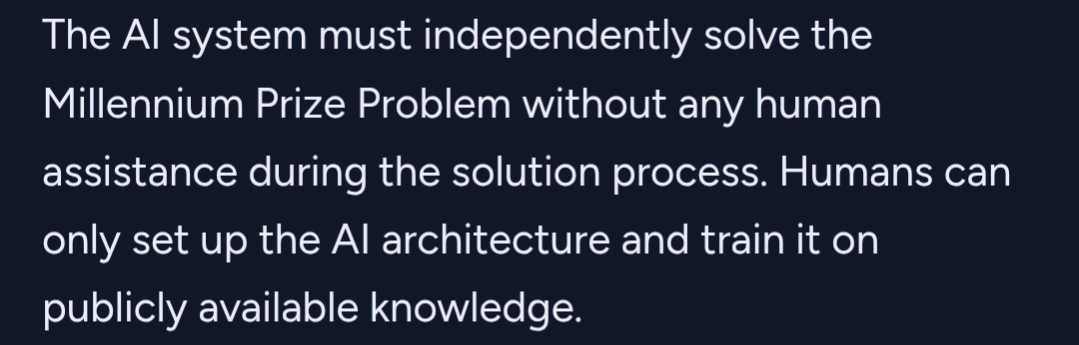
Humans may design, train, fine‑tune or prompt the model, but the complete logical argument must be produced autonomously by the AI.
Human assistance is limited to setting up the architecture, curating publicly available training data and verifying formatting; no new mathematical insights may be added by people.
Timing of Resolution
The market resolves YES if at any time before Jan 1, 2035 a qualifying proof that satisfies Criteria 1 (Evidence required) and Criteria 2 (AI autonomy) becomes publicly available.
 1,000
1,000People are also trading
@JasonMendoza2008 If one is to follow the very clearly specified criteria, the restriction to “publicly available training data” rules out ChatGPT, and “no new mathematical insight” rules out mathematics helping to steer an agent via a conversation by pointing out recent developments.
@JasonMendoza2008 some things that they do admit to: They used a system of coordinated agents with access to a cached version of the internet. Some agents were not told to solve the NS problem but easier problems, including the regularity problem for the Euler equations, for which one group of agents solved. With this done, they prompted other agents (of a different newer model) with this solution and had them tackle the NS problem. They encouraged different groups to tackle different approaches and used Codex to consolidate the most useful insights [so another prompt here!] from each group.
So, what is very clear is that it was not simply a “solve the problem” prompt but a carefully controlled and guided multi-step process, and no single agent responding to a prompt completed the solution. The agents that did solve it were given (by humans) the result of the Euler problem and told to work from there.
@capybara I meant denied steering towards already published results not carefully crafting a harness and prompts
@JasonMendoza2008 but definitely up to interpretation which why @mods should intervene since author is afk
@JasonMendoza2008 they steered one set of models towards a novel result created by a separate set of models.
the only way I can imagine the mods resolving this as “Yes” right now is that they agree that the collective misreading of the market criteria is enough to overrule those criteria.
@LuluHowell In the past, AI solved the Protein Folding Problem. There is no reason to think "Human+AI" will solve the protein folding problem first. It turned out AI solved it first. The question allows for human programming of the AI to solve a Millennium Prize Problem in the same way humans programmed AI to solve Protein Folding.
@jerkyenox The question allows for human programming of the AI to solve a Millennium Prize Problem in the same way humans programmed AI to solve Protein Folding.
@SteveMichaels The AI would need to solve the problem by itself for the question to resolve as “Yes”. A human cannot provide any part of the solution.