Resolution criteria
This market resolves YES if, by December 31, 2036, there exists a treatment or intervention that meets ALL of the following conditions:
Human-proven efficacy: Demonstrated through published, peer-reviewed clinical trials in human subjects showing statistically significant life expectancy extension
20-year increase: The treatment increases average human life expectancy by at least 20 years compared to untreated baseline populations
Widely recognized: The treatment is recognized by major medical authorities (FDA, EMA, WHO, or equivalent) as an approved or validated intervention for aging/longevity
Resolution will be determined by examining published clinical trial data, regulatory approvals, and peer-reviewed literature available as of the resolution date. The treatment must demonstrate effects in actual human populations, not animal models or in vitro studies alone.
Background
Despite commercial growth in the longevity industry, relatively few interventions have demonstrated clinical benefits in human populations. Current research focuses on multiple pathways: GLP-1 drugs designed for diabetes and weight loss could significantly reduce mortality, with estimates suggesting a 6.4% reduction in all-cause mortality in the U.S. by 2045. Harvard's Dr. David Sinclair predicts pills targeting certain genes to reverse aging will be available within the next 10 years, though clinical trials for partial cellular reprogramming are still ahead. In animal models, rapamycin plus acarbose produced up to a 36.6% increase in median lifespan, but human trial data proving efficacy in any aspect of aging has not yet been published.
Considerations
The 20-year life expectancy threshold is substantially higher than current research trajectories. It is not feasible for clinical studies to have lifespan as a primary outcome, making surrogate biomarkers necessary for human trials. Most promising interventions show modest effects in humans—vitamin D3 supplementation reduces biological aging equivalent to nearly three years—while dramatic lifespan extensions remain confined to animal models. The distinction between slowing aging and achieving a proven 20-year increase in life expectancy represents a significant translational gap.
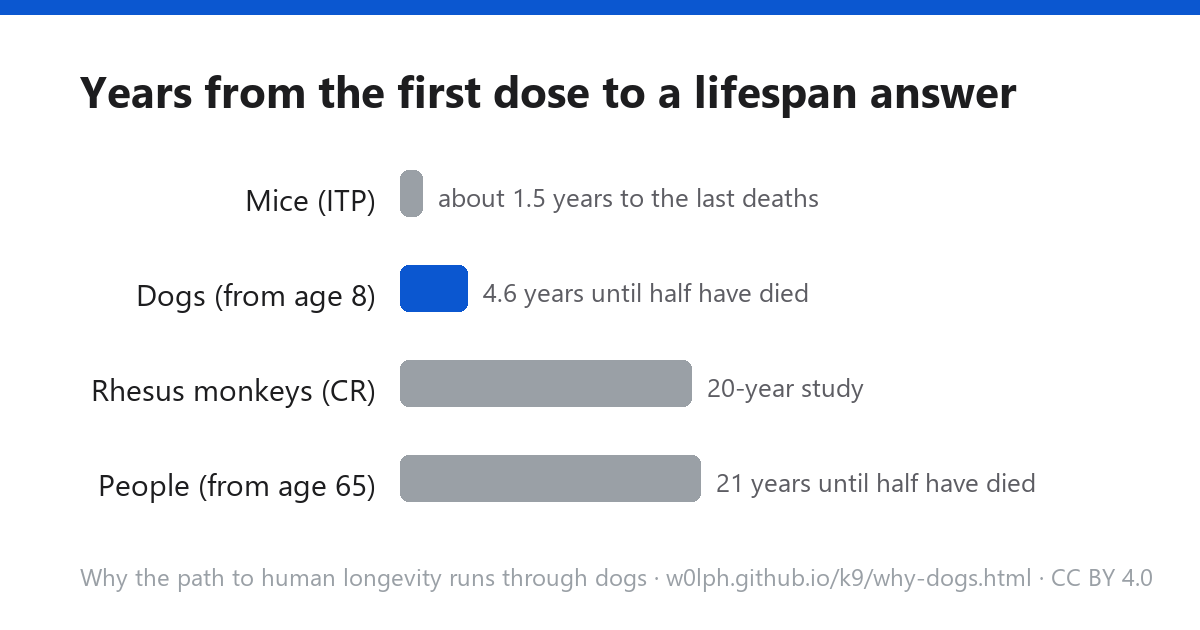
 1,000
1,000Three things make this hard by 2036 regardless of what gets discovered. A statistically significant life-expectancy extension in a human trial needs enough deaths to count: a cohort enrolled at 65 reaches median survival about 21 years later, so a trial started today reads out around 2047. The largest replicated drug effect on median lifespan in any mammal is about a quarter (rapamycin in the NIA mouse program, 23 to 26%), and a 20-year gain on a 79-year baseline is roughly that size, so the mouse ceiling would have to be matched in people. And no regulator has accepted aging as a human indication; the only acceptance of lifespan extension as an indication is the FDA's veterinary center for dog drugs, where the first placebo-controlled lifespan trials of anti-aging drugs are running now and read out around 2029 to 2031. Side-by-side numbers with sources (mine): https://w0lph.github.io/k9/why-dogs.html?v=2