tristanbuckmaster (@tristanbuckmaster@mastodon.social)
https://cims.nyu.edu/~tristanb/statement.pdf
Add anything that you think would be:
Fun to predict, might or might not happen
Reasonably simple to track whether it happened or not (nothing too hard to count)
I'll resolve everything I can. But any mods are welcome to resolve any options as well, as prop bet markets are hard for any one person to manage.
Markets will generally resolve according to the common sense expectation of how they were intended, not on technicalities.
See: /Sketchy/which-millennium-prize-problem-will-sO22AZgqn8
Update 2026-09-10 (PST) (AI summary of creator comment): - The prop bet "Buckmaster and/or Alpöge are awarded the Millenium Prize" will not resolve NO at the October 2026 market close.
This option will be held open past the scheduled close date until the actual outcome is clear.
 1,000
People are also trading
@nikki How is this resolved no? Valerio Capraro (@ValerioCapraro) on X

@AhronMaline I tend to agree with this but didn’t want to bring it up because it’s not needed for why the market resolved no
@Zeolite I think the resolution of this one is at least a little ambiguous? This whole "admits" thing is turning out to be quite the gray area. Here's some claudeslop with the ambiguity:
Sept 8, 16:56 UTC, Mastodon: Quoting OpenAI's "training since August 28" line, he said they were openly admitting to using training data from after his team's result, and asked whether it's ethical to use customer data to scoop the customer. This came after OpenAI's announcement text, but possibly before the proof PDF was public.
Sept 8, 21:32 UTC, Mastodon: This is the strongest candidate, posted with the proof clearly out. He said that as he understood it, OpenAI's training data already pointed toward their unpublished result, and called the citation omissions "absolute academic malpractice."
Later: WaPo framed him as questioning whether OpenAI's agents were fed on his work. NPR reported he believes OpenAI was tipped off to the approach, which is a tip-off claim rather than a data claim.
How others characterize it: Wikipedia calls the "scoop their customer" post an explicit accusation. Kingy calls it a renewed concern, backed by no records.
Thoughts on how this should resolve?
@Sketchy Let me do some of my own digging tonight and see what I find. Definitely seems a bit more subjective than I anticipated it would be.
@Sketchy I think based on my exact phrasing its probably a No resolution but I could see a strong argument otherwise. Reading some of his statements and the transcript from his interview with Numberphile he does almost everything except explicitly say they stole their work. He definitely heavily implies it. For instance he says, "I can't pinpoint exactly what was happening, but the circumstantial evidence is very clear." He then goes on to describe how the mechanisms in OpenAI's unforced Euler are identical to their unreleased version and also states that nothing important/original goes into Codex now.
Despite all that I cant find anywhere where he actually comes out and says what hes obviously implying which might be intentional.


@0xseraphim Idk how deeply to read into this metaphor, bu the US wanted to give the impression that they had unlimited bombs that they could just keep dropping, but in fact only had the two
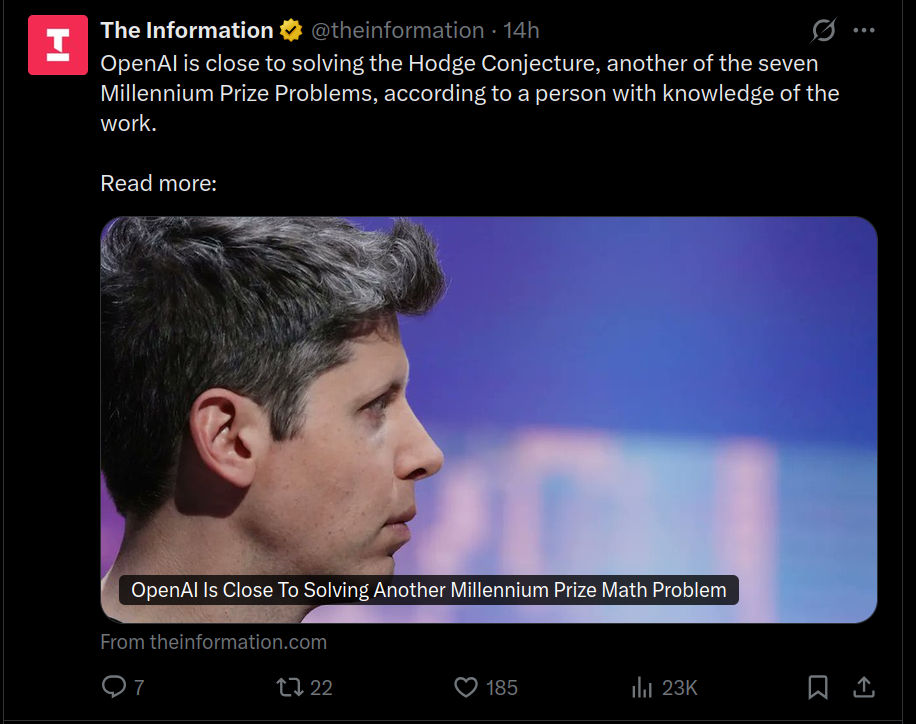
@JamesSully I can see the logic where navier stokes and hodge are the low hanging fruit. OpenAI may end up with two millenium prize problems on its belt while Anthropic turns up to its IPO with zero
@Xiphias Buckmaster has said that he indeed failed to opt out, in one of his three OAI accounts (I believe this was in an interview with Nature; but I can't check bc of their paywall). And much of their relevant work (although not the major breakthroughs) were before the last time OAI collected the data for training. So I think we can be fairly confident some of his work was in there. Is that enough?
@AhronMaline An OpenAI spokesperson also said: "We can say categorically that it is impossible for Dr. Buckmaster's Codex prompts over the last two months to have influenced the system in any way, including training."
@Xiphias Right, that's why I said the major breakthroughs weren't included. But there was plenty of relevant work done longer ago.
This? https://www.nature.com/articles/d41586-026-02910-w
"Buckmaster says he had used OpenAI tools to work on the problem for a year. He told Nature that he had three separate accounts on OpenAI’s ChatGPT, and that only on two had he opted out of the setting that gives permission to the company to use chatbot conversations in the training of its models.
Assuming that the OpenAI solution is independently confirmed, it remains to be seen how the maths community will choose to apportion credit — and who deserves the US$1-million award offered by the Clay Mathematics Institute for completing one of seven Millennium Prize Problems that it selected at the turn of the century."
@Xiphias Yes, this combined with Levent's statement (in the initial reaction Tweet) that OAI's proof resembles one that they had been working on well before the breakthroughs. As well as a source that I believe gave a date for the latest collection of training data, in June or July, which would be the reason for their confident statement about two months. But I don't know where that last one was.