https://x.com/NathanpmYoung/status/1435176381143470080
"the year when longevity finally takes off [...] will be just after AGI (if good) or never (if bad or Xrisk)"
For this market, AGI (Artificial General Intelligence) is defined as a system clearly surpassing human capabilities in most economically valuable tasks. Specifically, this must include all (or almost all) tasks related to aging research.
This is a follow-up to this market:
https://manifold.markets/Sinclair/will-nathanpmyoung-live-to-1000
 1,000
1,000People are also trading
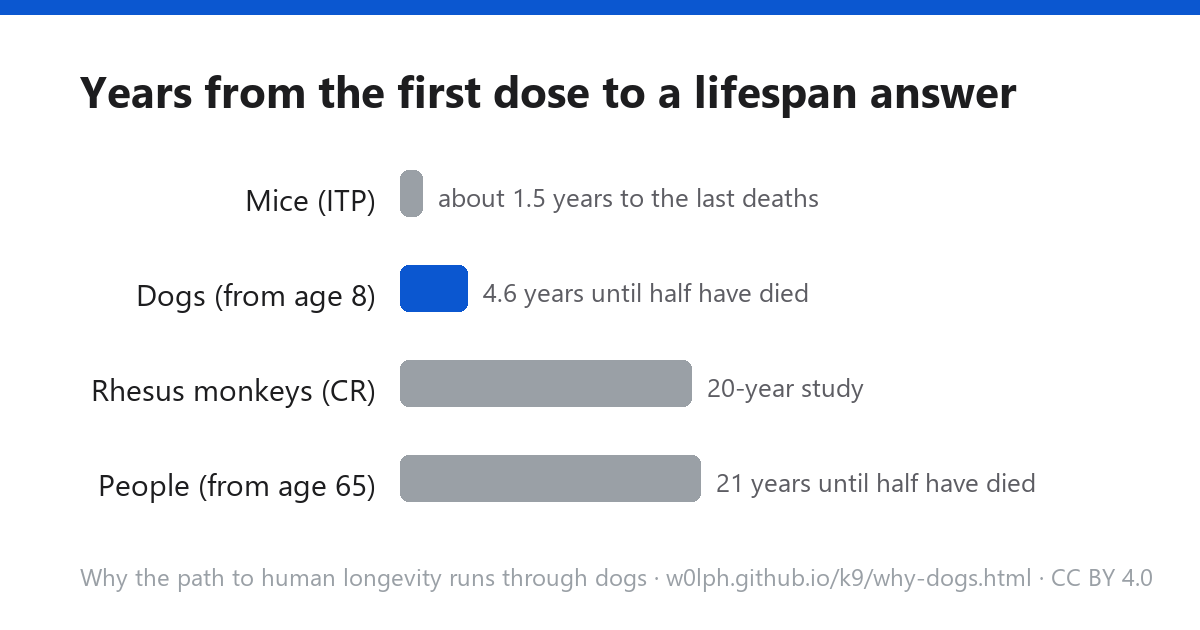
On the split between "natural death post-AGI" and "makes it to 1000": the step AGI does not compress is the in-vivo one. Even if an AGI handed over the right molecule tomorrow, showing that it changes a mortality curve takes a lifespan trial, and the clocks are fixed by biology: about 4.6 years in dogs enrolled at 8 (the first such trials, TRIAD and Loyal's STAY study, read out around 2029 to 2031), about 21 years in people enrolled at 65. Surrogate markers can be read faster but none has yet predicted lifespan in any species. So the realistic sequence is dog evidence in the early 2030s, human lifespan evidence from the 2050s, and a treatment that keeps the annual hazard under 0.07% for a millennium (today's floor is 0.01% at age 8 to 10, rising to 50% a year past 105) some unknown time after that. The arithmetic with sources (mine): https://w0lph.github.io/k9/why-dogs.html?v=2
According to this model, the probabilities should be:
Dies before AGI: 13%
Dies from AGI: ~35%
Natural death post-AGI / AGI does not solve aging quickly enough: ~3%
Everything else depends on cruxes around existential risk post agi and whether one would choose to live, but my guesses are:
Dies for other reason post AGI: ~14%
Chooses not to live: ~5%
Makes it to 1000: ~30%
@Aleph I think for edge cases like cryonics or mind uploading this market should follow the original market (https://manifold.markets/Sinclair/will-nathanpmyoung-live-to-1000), to keep the two markets comparable