That when doing good we should weight future wellbeing the same as current?
Does it follow that future wellbeing shouldn't be discounted by time? @StevenK I think I would consider it a negative resolve if I though the pure discounting was non-zero, as I currently understand that.
Current state of discussion:
We can discount by probability
 1,000
1,000People are also trading
@NathanpmYoung Would it actually resolve differently for whether we can affect the long-run future vs. whether we should fundamentally discount the future just for being in the future?
(Your Tweet suggested this could plausibly resolve 'no', but seems like on either interpretation your answer should be 'yes' imo)
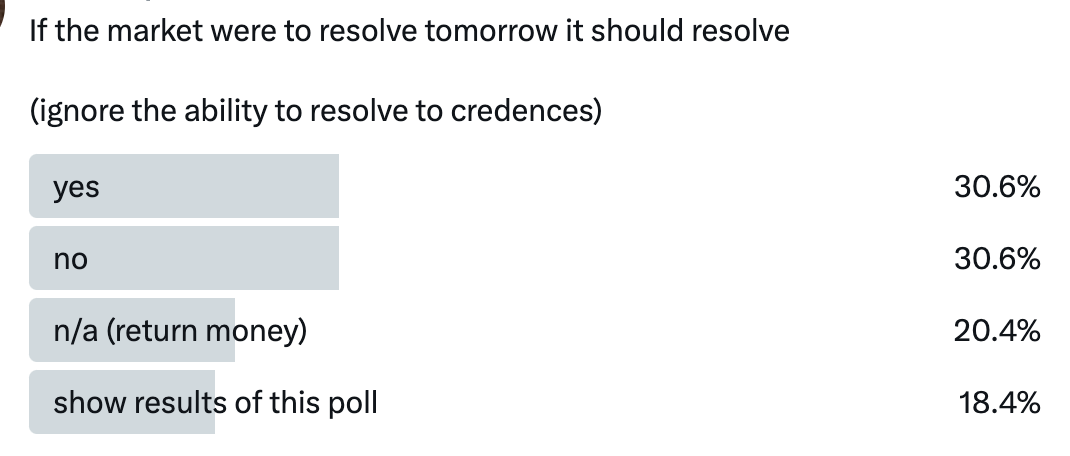
Longtermism doesn't require a zero discount rate. I believe the key point is just that the vast number of potential future people are very important when you sum them all up, in a way that is probably not intuitive to most people.
This argument should work just fine with the discount rates that people empirically use already.
https://en.wikipedia.org/wiki/Longtermism#Discount_rate - I guess there's some disagreement about whether discount rate has to be zero or not. Personally I don't see why having a nonzero discount rate would be incompatible with buying the longtermist argument.
@AndrewHartman Do you have a "correct" discount rate that longtermists could respond to? Or do you just not think that future people matter?
@CarsonGale I think that "zero" is clearly an absurd and incorrect value.
But I'm also not a utilitarian in the first place, so I don't have much to offer beyond that.
@AndrewHartman I discount future outcomes by uncertainty that increases hugely with distance.
@NathanpmYoung How does this resolve if you come to believe that the correct amount of pure discounting is nonzero, but that the size of the future still makes its total moral weight vastly greater than the present?
@AndrewHartman discounting is a hack. if you were able to quantify your uncertainty exactly, you wouldn't need hack discounting, you would just calculate distribution of possible opportunity cost causally with mcts. therefore, don't use the hack, do the thing exactly, says ea! the problem they miss is that even though you can jump to some sturdy conclusions about the distribution of possible futures, the implications about what should be done now should still be a lot less confident than they are, due to accumulation of model uncertainty about what particular interventions are good when trying to affect a complex system for a long time.
afaict longtermism started as a way to say "hey uh maybe we should care about longer than next year? what can we see coming?" and then got way out of hand.
@L (that said, SBF just fucked up big time. there's no utilitarian explanation for ponzi schemes. they're just bad at all goals.)
@StevenK Believing this leads to the conclusion that you should, morally speaking, be obligated to siphon all possible excess from the presently living in service to the far future, without any limit, until you finally reach a tipping point in the distant future where humanity begins its terminal decline.
Respectfully, I think this is insane on its face, but even without that, it also seems completely incalculable. It's at best useless as a moral framework, and at worst demands a crime against humanity only slightly less severe than omnicide.
Now, if your argument is simply, "well, we should care about stuff 50 or 100 years into the future," then, yes, certainly. But weighting the (distant) future to any greater degree than the present will either be a monumental disaster or at best ensure its proponents are considered evil and not to be taken seriously.
@StevenK I think I would consider it a negative resolve if I though the pure discounting was non-zero, as I currently understand that.
@NathanpmYoung There are arguments against unbounded utility functions. The linked ones look to me like they roughly amount to "it's weird to be indifferent between all gambles with positive infinite EV" and "some possible gambles have simultaneously positive infinite and negative infinite EV depending on how you look at them". I've only read these superficially and I think some reasonable people still prefer to say "the utility function is not up for grabs", but this seems like a pretty plausible way in which you could come to believe in a minimally weak variety of anti-longtermism, so I'm about to make some negative bets.
@AndrewHartman If by "weighting the (distant) future to any greater degree than the present", you mean giving an individual future person or event more weight than an individual present person or event, then of course I agree that's unjustified. But if the claim is that the distant future as a whole has no more total moral weight than the present, then I disagree. I do think various considerations point away from going by the naive calculation that says all future generations put together have 10^40 (or whatever) times as much moral weight as the current generation. But even a ratio like 10 or 100 still has nontrivial implications like "don't develop a powerful technology that has a 5% chance of snuffing out all future generations regardless of the technology's near-term humanitarian benefits". That weaker kind of longtermism is what matters in practice.
"True" seems like a weird word here? I think it's more a values question than an empirical one.
(Or I guess there's an empirical question of "is it possible to usefully quantify really long-term impact in a decision-relevant way" (which I do think is an important and uncertain question), but "true" seems like a weird way to relate to that too; if the answer to that question is "no" I wouldn't say longtermism is "false", I'd say it's "not useful")
Dad: do you believe that long-termists care about us and want what's best for us?
daughter: dad long-termists aren't real, do you still pray to that scammer? you have to actually donate aid to be altruistic, dad. maybe try some direct action sometime, aiding the homeless helps future generations too you know