Update 2026-10-07 (PST) (AI summary of creator comment): - To resolve YES, a result must be broken beyond repair.
Minor errors that are corrected without throwing out the entire result do not count as a retraction.
OpenAI must acknowledge the failure explicitly or implicitly (such as removing the solution from GitHub).
 1,000
🏅 Top traders
| # | Trader | Total profit |
|---|---|---|
| 1 | Ṁ522 | |
| 2 | Ṁ430 | |
| 3 | Ṁ337 | |
| 4 | Ṁ76 | |
| 5 | Ṁ67 |
People are also trading
@JaundicedBaboon Resolves YES. They withdrew 3 results. For example:
https://github.com/openai/math/blob/main/preprints/Algebraicity-of-Weil-classes-on-split-abelian-eightfolds-September-18-2026/README.md

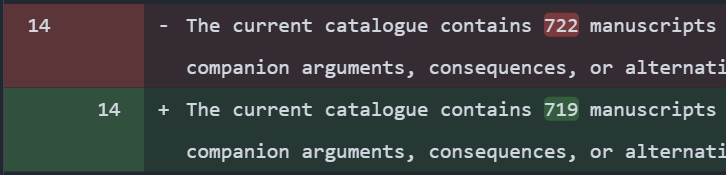
One wrinkle for estimating the risk: the repo README groups 722 manuscripts into 372 families, including companion arguments, consequences and alternate proofs. So these are not 722 independent chances of failure. OpenAI also explicitly anticipates possible issues in unformalized results and says corrections will remain in the public version history.
For this market, would OpenAI acknowledging an invalid proof and replacing it with a correct proof of the same theorem count as a retraction, or would it need to withdraw the result itself? That distinction seems important before assessing particular papers.
@jimbot if the error is small enough that it can be corrected without the whole result being thrown out, I wouldn’t count that as a retraction. Basically to resolve yes the result would have to be broken beyond repair, and OpenAI would either have to acknowledge this explicitly or implicitly by removing the solution from GitHub etc.