This market resolves YES if any one thing from the listed things happens in 2026
Leader Exits
Donald Trump leaves office before end of 2026 (death, resignation, impeachment, removal, etc.)
Vladimir Putin leaves office
Xi Jinping leaves office
Geopolitical & Unexpected Events
China invades or blockades Taiwan
Enemy troops on American soil (invasion or combat operations)
USA men's team wins the 2026 FIFA World Cup
Bitcoin reaches $1,000,000 USD
OpenAI officially claims AGI achieved internally
New major pandemic causes widespread flight cancellations (at least 100 international flights canceled)
Nuclear bomb detonation above ground
Taylor Swift and Travis Kelce publicly break up or divorce
Quantum computing breakthrough ("Q-Day") cracks major encryption, causing widespread crypto/market panic
S&P 500 drops >40% from its 2025 peak
Sam Altman is out as OpenAI CEO for more than three weeks
Washington, D.C. officially becomes the 51st state
AI directly causes one of the following:
Death(s) of human(s) (unrelated to suicide encouragement)
Discovers and exploits a zero-day vulnerability without human prompting, causing ≥$100M USD worldwide damages
Solves an unsolved mathematics problem listed on Wikipedia (problem must have its own wiki page)
Celebrity Deaths
MrBeast
Taylor Swift
Timothée Chalamet
Zendaya
Billie Eilish
Lionel Messi
Cristiano Ronaldo
Travis Kelce
Kanye West
Pope Leo XIV
Major US Tragedies
Mass shooting or terrorist attack causes >100 deaths in a single US state in one day
Mass casualty accident (e.g., plane, train, infrastructure) causes >1,000 deaths in a single US state
Natural disaster causes >20,000 deaths in a single US state
Politics & Supreme Court
SCOTUS upholds Trump's executive order limiting or ending birthright citizenship
One party wins 75 or more seats in the U.S. Senate after 2026 midterms
A Canadian province formally votes to secede or join the United States
~~~~I do not respect AI sloppa updates below this line
Update 2025-12-15 (PST) (AI summary of creator comment): Regarding "AI directly causes death(s) of human(s)" criterion:
AI telling someone to commit murder does NOT count as AI directly causing death
Autonomous car deaths are excluded (too common, not a black swan event)
Intentional AI drone killings do NOT count
AI drone mistakes/accidents do NOT count
DOES count: AI system autonomously acting against operator control to directly kill (example given: consumer drone gets AI upgrade, refuses operator controls, and autonomously attacks a human)
Update 2026-02-27 (PST) (AI summary of creator comment): Only events specifically listed in the description will count for resolution. Other unexpected events, even if comparable in significance, will not resolve this market YES.
 1,000
1,000🏅 Top traders
| # | Trader | Total profit |
|---|---|---|
| 1 | Ṁ566 | |
| 2 | Ṁ369 | |
| 3 | Ṁ199 | |
| 4 | Ṁ156 | |
| 5 | Ṁ120 |
People are also trading
/FlorisvanDoorn/will-ai-prove-one-of-128-major-math
So @SquishyBoy over in another thread noted that AI has proved Sendov's conjecture, which was then checked by Terence Tao.
https://terrytao.wordpress.com/2026/08/12/a-digestion-of-the-proof-of-sendovs-conjecture/

Sendov's conjecture - Wikipedia
And yes, it had a wikipedia page before the AI proved it.
---
Should be a clear yes resolution.

@Bandors https://en.wikipedia.org/wiki/Cycle_double_cover The way the second paragraph is worded suggests that the page is about the conjecture in particular rather than just the object.
For the math event when we say solved do we mean that the proof is published by Dec 31 or that it is verified via peer-review or other mechanism by Dec 31? I read the question as saying the AI has generated a valid proof this year, but if that is the case we won't be able to resolve the market until after Dec 31 if there are any pending unverified proofs.
@Bandors yes, but it is not fully solved, only for N>2, not N=2. And for N=1 it never really was an open question.
So technically „the Jacobian conjecture for N>2“ does not have its own wikipedia article
@gigab0nus Great point. I am leaning to not resolving yes based on this specific discovery. However, I do think the the odds of some more clear major mathematics solution coming soon.
@gigab0nus hm, I just learned that the original conjecture was formulated by Keller in 1939 specifically for n=2. (which is still open)
But later people understood it as the general claim for all n, which has been disproven now (so solved).
I think we need to go back in the wikipedia page, what version was listed there before the many changes now
Jacobian conjecture - Wikipedia
The three below images are from the wikipedia page of the Jacobian conjecture from before the recent news.
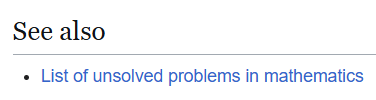
This link is no longer on the bottom of the page. This implicitly means wikipedia considers it solved.
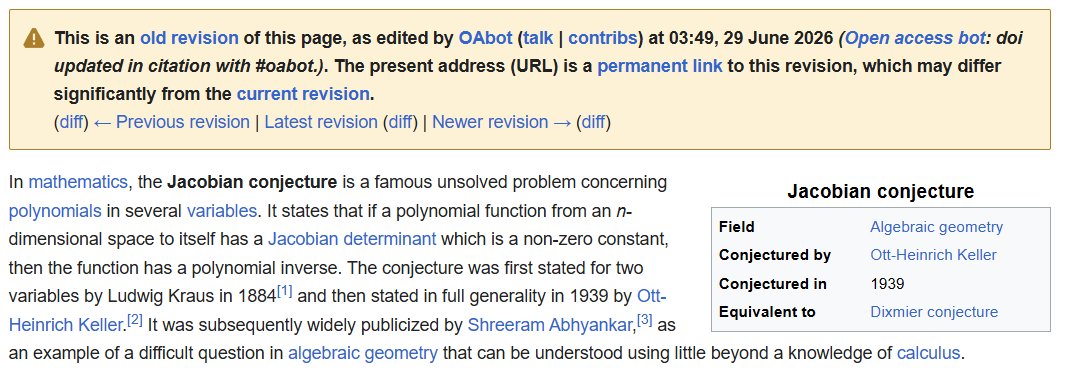

Note that the pre-proof page says:
[The Jacobian conjecture] states that if a polynomial function from an n-dimensional space to itself has a Jacobian determinant which is a non-zero constant, then the function has a polynomial inverse
and
Let N>1
This is a general statement that extends to all n-dimensional spaces with N>1.
Thus to disprove it all you need is a single counter example from any dimensional. The fact it may remain true in one dimension doesn't matter at all, the overarching conjecture is wrong.
Its the same as if you said "If someone likes cats they hate dogs". If you found a single alien that liked cats and dogs the statement would be proven false, even if every other every human that ever lived who liked cats hated dogs.
This single person (or alien) is all you need; and that is the core of how proof by counterexample works.
Of course you can then narrow it down to a specific case: "If a human likes cats then they hate dogs", but that doesn't change the fact that the overarching and original statement is false.
---
So not only does wikipedia consider it solved, but based on the definition of the original conjecture (both by plain text and the mathematical definition they give) on the page its clearly solved by counterexample.
So yeah, this 100% should resolve yes.
Solves an unsolved mathematics problem listed on Wikipedia (problem must have its own wiki page)
Jacobian conjecture counts? @Bandors
@MachiNi it must resolve yes. The article is old, stand alone and the conjecture is disproven by fable
@fdsfdsfsdf2332 "directly causes" is the formulation used. Wikipedia states "On July 19, 2026, Anthropic employee and mathematician Levent Alpöge presented an explicit counterexample in three-dimensional space, discovered using Claude Fable 5, Anthropic's large language model, which disproves the conjecture for N > 2"
@VincentVega >using
so it wasn't "directly". If I build a house using a hammer would you tell that it was build directly by the hammer?
It was not.
This bet is bs
@fdsfdsfsdf2332 Your position would mean that the AI would have to solve a conjecture without prompting. To me this is not a serious reading of the rules of this bet, but others will decide.
@VincentVega "AI's solution to 87-year-old riddle takes mathematicians by surprise | New Scientist" Note this framing "AI's solution"
@fdsfdsfsdf2332 /FlorisvanDoorn/will-ai-solve-a-major-mathematical
Look at this market, see the percentages and consider whether your opinion is really as strong as you think it is.
@fdsfdsfsdf2332 if the AI is prompted and then solves it then it directly solves it. The prompter is the one who doesn’t solve it directly. You’re interpreting ‘directly’ as ‘fully autonomously’ but I think that’s a misreading of the condition.
@MachiNi yes, and if AI used external tool and analyzed the results, then AI did it directly, or the tool?
What if "the tool" contains human in the loop, which means AI used human to execute the task, so no direct AI solution.
There is a lot of quirks like that and I am not interested in participation if further debate over it. Go ask AI instead.
@fdsfdsfsdf2332 If there’s a human in the loop without whom the proof would not have been written then it is not direct. If the proof was written by an agentic AI without human intervention besides prompting then it is direct. I don’t know what’s hard to understand about this. English doesn’t seem to be your first language so maybe that’s your issue with understanding ‘directly.’ In any case, if you’re not interested in participation then… don’t participate. I don’t get why you’re here… debating.
For what it's worth, @Bandors has taken a step back from Manifold for an unknown amount of time. I'm not sure if he'll make a judgement on this anytime soon.
@Bandors AAAH! Welcome back!
I don't have a horse in this race, and I stopped reading the comments after things got, uh... heated. I'm sure somebody will or has made the case.
@Bandors So, I asked Claude Fable, on the theory that they know more about it than either of us does.
Against the criteria: The Jacobian conjecture has its own Wikipedia page and sat on the "unsolved problems in mathematics" list — that clause is clean. "Solves" is satisfied on the natural reading: the conjecture as stated is now settled (false), though a strict resolver could note the historically central 2D case survives. "AI directly causes" is satisfied on all public accounts but is the one clause where the evidence is testimony rather than mathematics. One more thing the owner should know: this follows earlier claimed AI results, including OpenAI's disproof of the unit distance conjecture — which also has its own Wikipedia page — so depending on the market's wording, a qualifying event may predate this one anyway.
Fair-disclosure footnote worth passing along: this summary was written by the model being credited. The math checks are reproducible by anyone in one line of sympy; the provenance assessment, the owner should weigh themselves.
On the criteria, I'd resolve YES, but the two clauses have different strengths. "Problem listed on Wikipedia with its own page": trivially satisfied. "Solves an unsolved problem": satisfied under the natural reading — the conjecture as stated (all n) is now false, and a disproof resolves a conjecture just as a proof does. The pedantic NO argument is that the 2D case, which is where 85 years of partial results actually live, is still open, so "the problem" isn't fully solved. I think that reading loses: the Wikipedia-page problem is the general statement, and its truth value is now known. "AI directly causes" is the genuinely weaker leg — the prompting details and what the output looked like haven't been made public, so causation currently rests on Alpöge's testimony, and the discovery story doesn't have the same evidentiary status as the algebra: which Fable version, what tools, and how much human steering are all unreleased. Note also that Alpöge works at Anthropic, which a hostile resolver could weigh. Still, no one is claiming a human derived the map and laundered it through the model, and every account has the model producing the example.
So: ~90-95% this is sufficient, with residual mass on a resolver taking the strict "2D still open" reading or demanding auditable provenance. One practical wrinkle worth checking against the market's fine print: this is described as the latest in a string of LLM results, including OpenAI's disproof of the unit distance conjecture and Erdős problem 1196 — the unit distance conjecture has its own Wikipedia page too, so the market may have had qualifying material before last weekend, which matters if resolution timing or "first instance" is relevant.