Resolution criteria
This market will resolve to the option that best explains the events that unfolded in Poland on 9 and 10 September 2025 (local time).
All options are intended to be mutually exclusive. Nonetheless, in the unlikely event that two or more options are correct, each correct option will resolve to a percentage.
If, at the close date, it is still unclear what happened, each option will resolve to a percentage that reflects its plausibility.
If no option correctly describes what occurred, this market will be voided.
Close date
This market will close at 22:00:00 UTC on 7 September 2026.
Interpretation principles
The resolution criteria will be interpreted in accordance with their apparent meaning, without regard to any intention of the market creator that is not evident in the text.
No clause, sentence or word in the resolution criteria will be considered superfluous, void or insignificant if by any other interpretation they may all be made useful and pertinent.
Further information
I will not trade in this market.
Update 2025-09-09 (PST) (AI summary of creator comment): - Russia carried out an intentional act of war against Poland
Resolves YES if it becomes clear Russia considered itself at war with Poland prior to any retaliation by Poland/NATO.
Also resolves YES if Russia used drones in a way that should obviously have been expected to trigger war (e.g., hitting a particularly valuable/significant target in Poland).
Russia deliberately violated Polish airspace, but did not intend it as an act of war
Covers cases where Russia knowingly entered Polish airspace without seeking serious harm.
Includes “testing the waters” or an unusual maneuver undertaken to attack Ukraine.
 1,000
1,000🏅 Top traders
| # | Trader | Total profit |
|---|---|---|
| 1 | Ṁ258 | |
| 2 | Ṁ128 | |
| 3 | Ṁ115 | |
| 4 | Ṁ105 | |
| 5 | Ṁ70 |
The close date has passed and, as I'll discuss below, there's still some uncertainty surrounding the exact cause of the Russian drone incursion. Pursuant to the resolution criteria, I'm resolving each option to a percentage that reflects its plausibility.
Given the amount of interest in this market, I feel I owe a detailed explanation for the percentages I've chosen. But first, I want to address a couple of criticisms of the market design, and why I don't believe they warrant voiding the market.
One criticism was that the phrase "intentional act of war" is tautological, as an act of war is intentional by definition. I accept this is true, but it clearly doesn't affect the market's functionality. At worst, the word 'intentional' is merely superfluous.
Another argument was that violating another country's airspace is automatically an act of war. If this were true, option 2 would indeed be redundant. Fortunately, as I'll discuss below, it isn't.
I'll begin with the least plausible explanations.
Options 5 and 7
There's ample evidence that 19 to 24 drones entered Polish airspace and were Russian, not Ukrainian. These options receive 0%.
Option 6 (false flag)
Extraordinary claims require extraordinary evidence, and I see none whatsoever for this. Option 6 receives 0%.
Option 1 (act of war against Poland)
Oxford Dictionary defines an act of war as "an act by one nation intended to initiate or provoke a war with another nation" or "an act considered sufficient cause for war." In the early stages of this market, I clarified that this could include an attack against "a particularly valuable/significant target" but not a manoeuvre that "didn't seek to do any serious harm."
President Zelenskiy (and certain traders in this market) initially claimed that eight to 19 Shahed drones had entered Polish airspace. It now seems that the vast majority of the drones were Gerberas, although there may have been as many as three Shaheds. Polish PM Donald Tusk clarified that none of the drones found on Polish territory were armed with explosives, contradicting some of the early arguments for option 1 in this market.
One building was damaged in the incident, a house in Wyryki-Wola. Contrary to what Poland claimed at the UNSC, the house wasn't hit by a drone, but by a missile fired by a NATO aircraft. Of course, the drone incursion was still indirectly responsible for the damage, but the house seemingly wasn't targeted.
In response to the incursion, Poland invoked Article 4 of the North Atlantic Treaty, but not Article 5.
As no targets were attacked and Poland evidently didn't consider the Russian incursion a sufficient cause for war, option 1 receives 0%.
Option 2 (deliberate violation)
Notably, NATO Secretary General Mark Rutte declined the opportunity to say the incursion was deliberate, instead calling it "reckless".
Polish and Ukrainian officials were more confident. Polish deputy PM Radoslaw Sikorski, a long-time Russia hawk, said "the preponderance of evidence suggests that it was deliberate," implying a probability over 50%. Another Polish official, Cezary Tomczyk, said "with certainty" that it was no accident, implying 100%. Although the Polish government's claims about Wyryki-Wola proved to be false, I still give its opinions on this issue some weight.
Shortly after the incursion, CNN surveyed "a dozen senior US and Western military, intelligence, diplomatic and congressional officials" and found there was "no consensus" about whether it was deliberate. The evidence was "mixed and difficult to interpret" and it was a "nearly impossible case to adjudicate with high confidence".
The article mentions two US officials who said the incursion appeared intentional, a "senior US military official in the region" who put the odds at "50-50", a senior Western intelligence official who was "leaning" toward it being unintentional and a "US source familiar with the intelligence" who agreed.
As Western military and intelligence officials would presumably have no incentive to understate the probability of the incursion being deliberate, and nor would CNN, the split opinions in this article led me to believe option 2 should resolve within the ballpark of 50%.
Since the CNN article was published, however, there have been many more alleged Russian incursions (especially with drones) in NATO airspace. One could argue that these establish a pattern of behaviour that make the incursion into Poland appear deliberate in retrospect.
A November 2025 analysis by Dronewatch and Dutch newspaper Trouw found that many of these subsequent incidents were later confirmed as false alarms, while most were inconclusive. They suggest the increase in supposed drone sightings was driven in part by heightened vigilance. A possible exception is an alleged attempted drone attack at Leipzig Airport, which Germany recently claimed was linked to Russia.
Although these subsequent incidents don't necessarily prove that the incursion in question was deliberate, they do arguably raise the probability somewhat, and this is reflected in the resolution.
Finally, if I were to allocate a high probability to option 2, it would help to have at least one convincing theory of why Russia would choose to send drones into NATO airspace.
Polish officials have put forward two rather contradictory theories. The first was that the incursion was part of a manoeuvre to skirt Ukraine's air defences during an attack on Lviv. While possible, this theory alone doesn't explain why some of the drones strayed so far from the Polish-Ukrainian border, with one reportedly landing in Lodz province.
The second theory was that the incursion was intended to test NATO's defence capabilities or gauge its reaction. This would make a great deal of sense if a large-scale Russian attack on NATO had been imminent. But otherwise, as retired US Marine Corps Col Mark Cancian told the BBC, "I don't see what advantage Russia would gain by purposely tweaking NATO at a time when it wants passivity from Europe." I have to agree.
With all of this considered, I'm giving option 2 a 60% share. This is consistent with the range of opinions and uncertainty expressed by Western military experts in the media, and compatible with assessments that the incursion was likely deliberate.
Options 3 and 4
In the immediate aftermath of the incident, it was claimed that an incursion of approximately 20 drones could only have been deliberate.
But this is seemingly untrue. According to CNN, Russian drones "are often programmed in bulk". Mark Cancian, who believed the incursion was likely unintentional, argued that "they might have been launched by the same unit, which made a similar mistake in all of its launches."
CNN also noted that the drones that entered Poland were vulnerable to electronic interference, and a batch of drones "might encounter Ukrainian electronic war defenses and respond identically." In the same article, a senior Western intelligence official claimed that the drones' flight pattern indicated they had been knocked off course by Ukrainian jamming.
The fact that most or all of the drones were unarmed could therefore be coincidental, per CNN. Many of the drones normally used by Russia are decoys, and these are typically more vulnerable to interference than other models. Indeed, Dr Marina Miron told the BBC that the drones could "easily be interfered with" through GPS jamming. The BBC also interviewed the former head of the Irish defence forces, who suggested that a deliberate violation, systems failure and jamming were all real possibilities.
To clarify, there's no suggestion that Ukraine used EW to intentionally send the drones toward Poland, only that it used EW to defend potential targets on its own territory. Russia also uses EW to repel drones from its airspace, which has resulted in several EW-affected Ukrainian drones crashing in the Baltics.
Although the drones that entered Poland accounted for only ~5% of the drones launched by Russia that night, this was still a relatively large number to be so severely affected by EW, which leads me to view this explanation as no more likely than a bulk technical error. I'm therefore allocating 20% each to options 3 and 4. Each explanation is unlikely, but plausible enough to warrant a 1 in 5 share.
Apologies if this was a long read. There was even more I could've discussed! But I hope it explains how I reached this decision.
Estonia claims Russian fighter jets violated its airspace yesterday... if true, it could point to a pattern of behaviour suggesting Russia is, at least, indifferent to violating NATO airspace (i.e. these are not accidents)
This CNN article suggests Russia is becoming more reckless in this regard, but also says (regarding the Poland incident):
One senior US military official in the region put the odds that Russia intentionally entered NATO airspace at “50-50.”
On option 2, the article says "the fact that many of the Russian drones were unarmed dummies" could point to the incursion being deliberate, but acknowledges that it could be a coincidence too. It also notes that it could have been a deliberate incursion designed to look like an accident
On options 3 and 4 (citing unnamed experts/officials):
[...] the drones flight pattern suggested that the drones were lost and attempting to reacquire a GPS signal — suggesting they had simply been knocked off course by Ukrainian jamming [...]
And the sheer number of drones that veered into Poland is hardly dispositive [...] because the drones are often programmed in bulk and in attacks of this size, it’s logical that 19 or 20 might encounter Ukrainian electronic war defenses and respond identically.
Kyiv deploys electronic warfare and jamming during Russian aerial attacks, which can cause enemy drones to go off their programmed course [...] But a senior official added that he had “never witnessed such huge deviations” in more than three years of war.
According to the article, a "senior Western intelligence official" said they were "leaning" toward the incident being unintentional, but two other US officials said it appeared intentional
Meanwhile, Polish media are reporting that the damaged house in Wyryki was hit by a Polish missile rather than a drone. Probably the final nail in the coffin for option 1 if the drones didn't directly cause any damage
Seems Like they die it again in Romania:
Romania Reports Drone Breach as NATO Scrambles Jets
Dropping some info here:
Polish outlet RMF24 reports that one of the drones crashed on the grounds of a Polish military base. If it did hit a military target, that would point to option 1. On the other hand, the article also says it was an unarmed Gerbera drone and it caused no damage.
The Wall Street Journal reports that most of the drones were likely the Gerbera model, which can be used as decoys or for reconnaissance. Ukrainian electronic warfare expert Serhiy Beskrestnov favours the "testing the waters" theory and doubts the GPS jamming theory, as the zone of Ukrainian spoofing "usually stretches to around 15 miles" and the drones went beyond that radius:
Gerbera drones are more vulnerable to spoofing than the explosive Shahed drones that Russia normally uses to strike targets in Ukraine, Beskrestnov said. But he added that it is unlikely the drones could have veered far into Polish airspace as a result of Ukrainian spoofing, both because of their sheer number and because their satellite navigation and autonomous inertial systems would have corrected their trajectory once they were pushed off course.
The Financial Times suggests that it may have been a deliberate manoeuvre in the attack on Lviv, which would fall under option 2:
Polish officials suspect that a subsequent wave of armed Shaheds was headed to Ukraine’s western city of Lviv, and that the Gerbera decoys were deliberately flown into Poland to skirt Ukrainian air defences around Lviv.
This article from BBC Verify suggests that options 2, 3 and 4 are all possible (though not necessarily probable)
On option 2:
Vice-Admiral Mark Mellett, the former head of the Irish defence forces, suggested that Russia may have been “checking the integrity” of Polish and Nato defence capabilities.
He added that the use of non-lethal capabilities [...] may have been an attempt by Russia to ensure that nobody was injured in the incursion.
On option 3:
"It's unlikely that they were sent into Poland intentionally, given their poor guidance,” retired US Marine Corps Col Mark Cancian of the Centre for Strategic and International Studies (CSIS) said.
“Nineteen is a lot, but they might have been launched by the same unit, which made a similar mistake in all of its launches. I don't see what advantage Russia would gain by purposely tweaking Nato at a time when it wants passivity from Europe."
Ukrainian media are circulating a claim made in this Telegram post:
All Gerbera UAVs from Poland had additional fuel tanks in the nose section
Among the Gerberas found in Ukraine, there were never additional fuel tanks in the nose section, so this was a special version designed to fly as far as possible - for example, to the territory of Poland.
If confirmed, this would lend a good deal of weight to options 1 and 2.
This article claims that the number of drones approaching Poland was ~50, with 21 crossing the border and the rest turning around. This might be compatible with the theory that it was a deliberate attempt to skirt Ukraine's air defence. (But then why did one drone venture all the way to northern Poland?)
@MaxA I think the dictionary definition of the term is clear enough for the market to function well.
If I were creating the market again, I would probably change the focus from 'what Russia intended' to 'how Poland perceived it'. This wouldn't be a huge change in practice, but it would've avoided people getting riled up by the phrasing
In case anyone is confused by that, er, interesting thread, I'm going to summarise my thoughts here:
I think option 1 is possible and should absolutely not be ruled out yet. I just don't see why it should resolve YES right now when even the injured party is yet to declare it an act of war (as far as I'm aware)
Options 2, 3 and 4 seem the most plausible to me, for reasons I've already explained
I agree with the market that options 5, 6 and 7 seem extremely unlikely
@a_l_e_x the question of "intent to commit an act of war" is nonsensical. Russia intentionally sent attack drones into Poland, which is unambiguously an act of war.
@a_l_e_x it's like if you were to throw molotov cocktails on your neighbor's house and then attempt to claim that it wasn't an intentional act of arson.
@Dulaman I get your point here and acknowledge I could've designed the market better. I was trying to capture the distinction between an attack that could only be the first shot in a war and a violation that may theoretically be an act of war but realistically isn't going to lead to one. In hindsight I could've done that differently or not at all
@Dulaman I don’t think that is necessary. The details are still being investigated and I’d imagine Article 5 would be triggered if the event is interpreted as an “armed attack.” NATO/Poland may conclude that it was only a “violation of sovereignty” and decide against invoking Article 5. I think that determination would be a good proxy for deciding whether this was an act of war.
@Dulaman N/A is a bit extreme. I'll take your comment on board and if there's a consensus that this market is unworkable, I'll definitely consider voiding it. (Personally, I don't think it is, but obviously I would say that.)
In the meantime, if you believe the market is flawed, you are free to not participate in it and even create your own market if you wish
@Dulaman In addition to what the other replies said, there's a huge gulf between "Russia is trying to start a war with Poland" and "Russia is trying to provoke NATO without starting an outright war". For me at least this distinction has a much bigger impact on my life than the drones getting shot down to begin with. The market has the issue of being subjective, but I think it was clear this would be the case from the start, so all the traders should know this before participating
@Dulaman Russia has been intruding into NATO space with planes and subs for years. Those were armed which isn't clear with these drones yet. Do you think all those incursions were acts of war?
Russia can conduct a deliberate act of war without announcing it as such, you dingus. Sending drones into a foreign country is an actor of war against that country.
@Lorelai is this directed at me?
If so, I don't dispute your first point at all. Russia declaring that this was a deliberate act of war is sufficient but not necessary to resolve the first option YES. I thought this was implied by my clarification but I'm happy to clarify again.
But if you're suggesting that it can only have been a deliberate act of war, I don't think there is enough evidence to be sure of that yet. You are welcome to present some if you wish, and I will give it due consideration. Or, if you think I'm a dingus, you are also welcome to divest from my market and go on with your day.
@a_l_e_x do you know what a shahed drone is? It's basically a missile.
https://en.wikipedia.org/wiki/HESA_Shahed_136
19 of them is not an accident. You are either a dingus or deliberately furthering russian propaganda claims.
@Chumchulum they entered Poland, 19 kamikaze drones entered Poland. If you think that is a mistake, you are not a smart person.
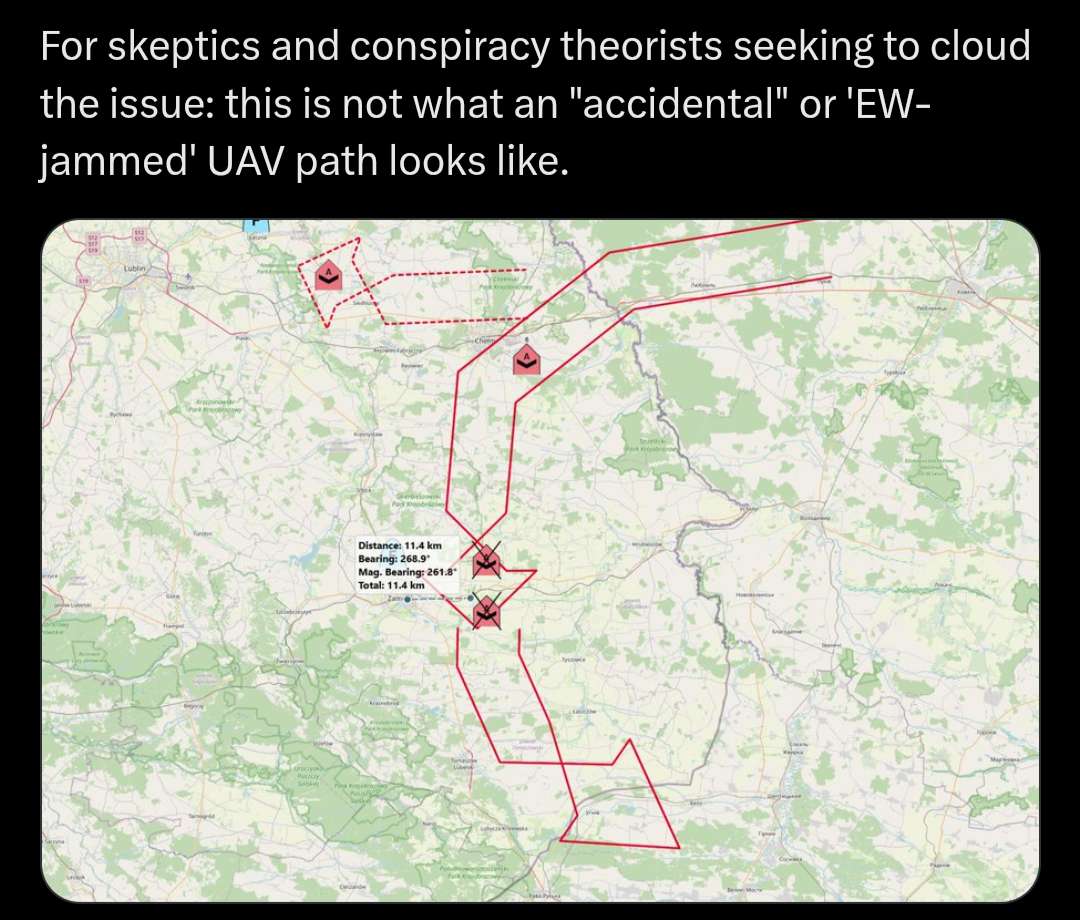
@Lorelai From your graphic, it appears some went on towards Lublin while the rest turned back towards Ukraine. Were the drones flying towards Lublin aimed at Polish targets, or did they too turn back?
I'm sure we must agree on the meaning of "aimed."
@Lorelai I agree that ~20 drones is unlikely to be an accident. Pending more information, though, I'm not convinced that it's implausible. It is less than 5% of the total number of drones deployed in the attack (although, in my opinion, ~5% is still significant and shouldn't be underestimated). But as you know, this market is not a binary choice between 'act of war' and 'complete accident' anyway.
Tell me, did Ukraine commit an act of war against Estonia the other week when one of its drones crashed into a field there? Of course not. The drone was likely diverted by Russian GPS jamming. Ukraine uses similar technology to disorient Russian drones. Of course, I wouldn't draw a full equivalence between the two incidents – nor am I saying that electronic warfare is the most likely explanation here – but this is an example of how an event like this could happen without being a deliberate act of war.
Again, if you want me to resolve this now, I'd have to be quite sure about it.
@Lorelai by the way, it is one thing to throw insults at me, but please do not be rude to other traders. I don't want people to feel like you're going to attack them if they ask a question or make a constructive comment here. You are welcome to express your opinion respectfully, but if I have to block you to stop you from insulting other traders, I will.
@a_l_e_x if they're being equally stupid I am going to tell them as such. Obviously everything Ukraine does is in self defence at the moment, Ukraine and Estonia are allies and that would not have happened if not for Russia. Another very unintelligent comparison.
Looking at your post history, I have to ask, are you Russian? Your comments are starting to sound very Russian. I'm sure there are Russians active on here whose job it is to spread disinformation and pretend obvious acts of war are "mistakes".
Edit: lmao he blocked me, Russian detected.
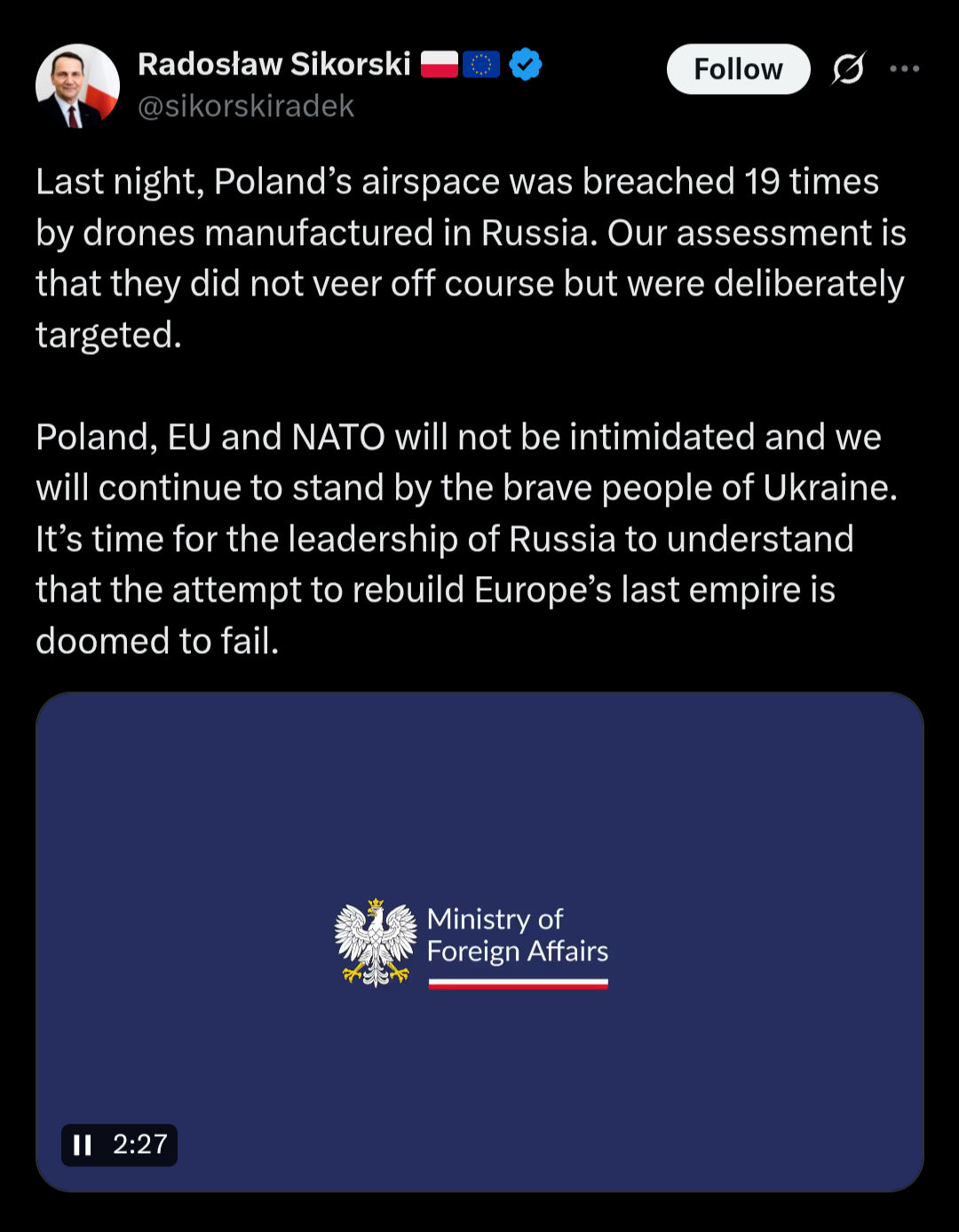
Edit 2: Poland's FM says Russia "deliberately targeted" Poland.
@Lorelai I've tried to interact with you in good faith but it's clear that you won't do the same. If you have nothing of substance to contribute, and you're going to continue insulting other traders, the logical decision is to block you. And if you're really spending your time combing through my profile, you should use this opportunity to touch grass. Bye
@Lorelai if you feel so strongly, you can always serve with a volunteer legion in Ukraine rather than fire at other Manifold users.
@Chumchulum why do you Putin’s cocksuckers think this is a strong argument and always use it whenever you feel like you’re losing on substance?
@Chumchulum Of course not. It's because of this dumb comment that only Putin's cocksuckers use. It's most typical for some random срач (look it up, it's a useful word) somewhere like VK or OK, coming from dumb Russian housewives living in half-forgotten villages in rural Russia where they have mobile internet but still shit in latrines.