Given the absence of consistently verified annual fatality data for Balochistan alone, is it appropriate to use nationwide all-over Pakistan conflict-related death totals as a proxy for estimating casualties specifically in Balochistan?
The Wikipedia page “List of ongoing armed conflicts” https://en.wikipedia.org/wiki/List_of_ongoing_armed_conflicts covers all active insurgencies in Pakistan.
Pakistan is a federation composed of several diverse regions, many of which experience different forms of unrest, including insurgencies, militancy, sectarian violence, and border incidents with Afghanistan and India.
Despite this, some market creators such as @Panfilo appear to focus heavily on the conflict in Balochistan while lacking reliable data on annual fatalities specific to groups like the Balochistan Liberation Army (BLA).
Available long-term estimates suggest roughly 2,000 militant deaths over two decades (not a year), in addition to civilian casualties. That makes it a local conflict, not a minor war.
Meanwhile, Pakistan faces multiple other insurgencies and terrorist incidents across Khyber Pakhtunkhwa, Punjab, Sindh, and nationwide, which collectively may exceed 1,000 deaths in some years.
https://manifold.markets/Panfilo/which-of-these-military-conflicts-w-qZOApZpQCU
Is it fair to use nationwide conflict data to represent Balochistan specifically?
Short answer: No - using whole-country casualty numbers to describe one province is not methodologically sound or fair.
Here’s the poll, please vote.
1. Different conflicts ≠ one conflict
Pakistan has multiple, distinct forms of violence:
Balochistan insurgency
TTP and ISIS-affiliated militancy
Sectarian violence across several provinces
Tribal, ethnic, and political clashes
Border skirmishes with Afghanistan and India
Aggregating all deaths ignores the location, actors, and causes of each incident.
2. Misrepresentation risk
Using nationwide totals to describe Balochistan:
Overstates the scale of the conflict there
Misleads bettors into thinking the province accounts for all violence
Distorts analysis and public understanding
3. Data uncertainty requires caution
If no reliable Balochistan-specific yearly data exists, the correct approach is:
avoid filling them with unrelated national statistics
acknowledge that Balochistan Liberation Army conflict isn't the global scale minor war (the term related to wars with over 1000 deaths per year)
4. Fairness requires accuracy. Misleading estimates should not be accepted, even if someone attempts to overstate the scale of the conflict in Balochistan. https://manifold.markets/Panfilo/which-of-these-military-conflicts-w-qZOApZpQCU

 1,000
1,000People are also trading
@mods This market should be deleted.
Created by a network of fake alt accounts for the purpose of influencing another market. Later some other legitimate users joined the market, but the initial voters belong to a network of bots.
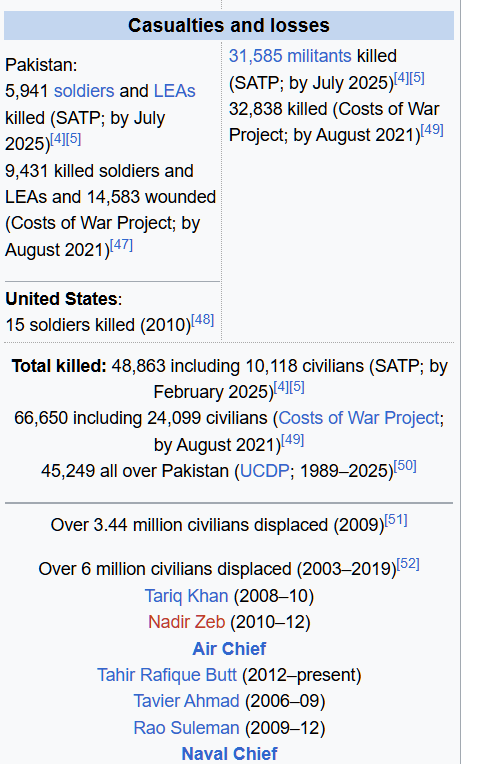
https://en.wikipedia.org/wiki/Insurgency_in_Khyber_Pakhtunkhwa
this is much more deadly, with magnitude of many times of Balochistan

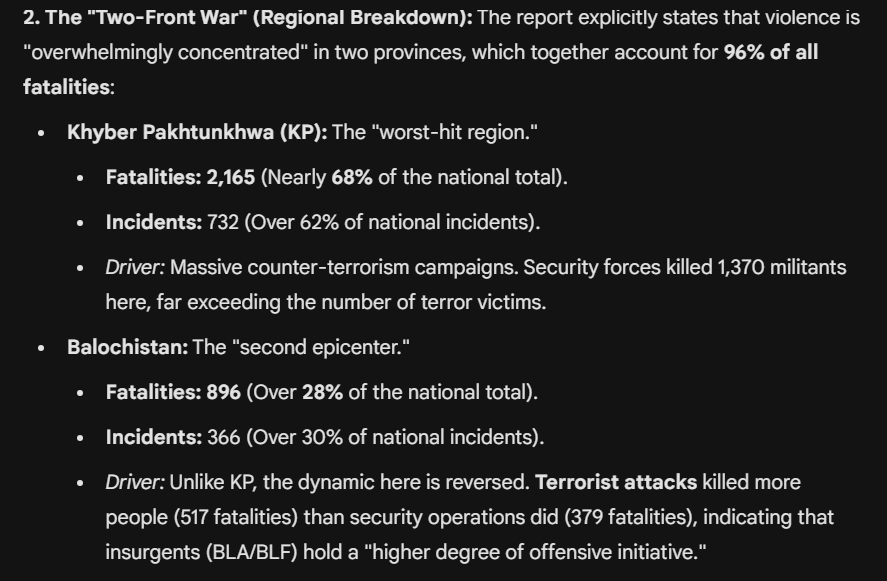
https://crss.pk/first-11-months-of-2025-over-25-more-violent-than-entire-2024/
The violence was overwhelmingly concentrated in the country’s northwestern Khyber Pakhtunkhwa (KP) and southwestern Balochistan provinces, where both these regions, together, accounted for over 96% of all fatalities and 92% of all incidents of violence recorded through January to November 2025.
KP was the worst-hit region, suffering nearly 68% (2165) of the total violence-linked fatalities, and over 62% (732) of the incidents of violence, followed by Balochistan, accounting for over 28% of the total fatalities (896) and over 30% of the incidents (366) of violence.
The remaining regions – Sindh, Punjab, Azad Jammu and Kashmir (AJK), Islamabad Capital Territory (ICT), and Gilgit-Baltistan (GB) – collectively experienced 90 incidents, with 126 lives lost, constituting just 4% of all fatalities.

@1bets gemini thinking: Python
import pandas as pd

# Load data
df = pd.read_csv('Asia-Pacific_aggregated_data_up_to-2025-11-22 (2).xlsx - Sheet1.csv')
df['WEEK'] = pd.to_datetime(df['WEEK'])

# Filter for Balochistan
balochistan = df[df['ADMIN1'].str.contains('Balochistan', case=False)]

# Calculate average fatalities for December in previous years (excluding 2025 as we don't have full Dec)
previous_years = balochistan[balochistan['WEEK'].dt.year < 2025]
dec_stats = previous_years[previous_years['WEEK'].dt.month == 12].groupby(previous_years['WEEK'].dt.year)['FATALITIES'].sum()
avg_dec_fatalities = dec_stats.mean()

# Calculate average monthly fatalities for Jan-Nov in previous years
jan_nov_stats = previous_years[previous_years['WEEK'].dt.month < 12].groupby(previous_years['WEEK'].dt.year)['FATALITIES'].sum()
avg_jan_nov_fatalities = jan_nov_stats.mean() / 11

print(f"Average December Fatalities (Historical): {avg_dec_fatalities}")
print(f"Average Monthly Fatalities (Jan-Nov Historical): {avg_jan_nov_fatalities}")

# Calculate ratio of Dec to Average Month to see if Dec is usually higher/lower
seasonality_factor = avg_dec_fatalities / avg_jan_nov_fatalities
print(f"December Seasonality Factor: {seasonality_factor}")

# Current CRSS rate
crss_total = 896
crss_daily_rate = crss_total / 334 # Approx days in Jan-Nov
print(f"CRSS Daily Rate (2025): {crss_daily_rate}")

# Estimate for Dec 2025 using simple rate
est_simple = crss_total + (crss_daily_rate * 30)
print(f"Estimate (Simple Daily Rate): {est_simple}")

# Estimate using seasonality
# Projected Dec = (CRSS Avg Monthly) * Seasonality
crss_avg_monthly = 896 / 11
est_seasonal_dec = crss_avg_monthly * seasonality_factor
total_est_seasonal = crss_total + est_seasonal_dec
print(f"Estimate (Seasonal Adjustment): {total_est_seasonal}")
Code output
Average December Fatalities (Historical): 39.8125
Average Monthly Fatalities (Jan-Nov Historical): 52.157575757575756
December Seasonality Factor: 0.7633119335347432
CRSS Daily Rate (2025): 2.682634730538922
Estimate (Simple Daily Rate): 976.4790419161677
Estimate (Seasonal Adjustment): 958.1752265861028
Based on the CRSS verified count of 896 fatalities (Jan–Nov), here is the estimation for the end of 2025 and details on the next report.
1. Estimating for December 30, 2025
Using the current daily fatality rate and historical trends, the estimated total for Balochistan by year-end will be between 958 and 980 verified fatalities.
The Calculation (Linear Projection):
Daily Rate: 896 deaths / 334 days ≈ 2.68 deaths per day.
Remaining Days: 30 days (Dec 1 – Dec 30).
Projected Increase: 2.68 × 30 ≈ 80 additional deaths.
Total Estimate: 896 + 80 = 976 fatalities.
The "Seasonality" Adjustment (Historical Check):
Historically (2010–2024), December is often a quieter month for combat in Balochistan (about 24% less violent than the annual average) due to winter conditions in the mountainous insurgent hideouts.
Adjusted Estimate: If December follows this "winter lull," the count might only rise by ~62 deaths.
Conservative Total: ~958 fatalities.
Final Projection: Expect the final CRSS verified count for Balochistan in 2025 to land around 960–980.
2. Where to Find the Next CRSS Report
The Center for Research and Security Studies (CRSS) typically releases its comprehensive Annual Security Report in the first week of the new year.
Expected Release Date: January 3–7, 2026.
Note: They often release a press release summary (like the one you saw) a few days before the full PDF.
Where to Check:
Official Reports Page: https://crss.pk/security-reports/ (Look for "Annual Security Report 2025")
Twitter/X: They often drop the infographic summary first on their handle @CRSS_Pak.
Newsletter: You can subscribe on their homepage to get the PDF emailed directly upon release.
Strategy: The "Annual Report" will be the definitive source that replaces the "Jan–Nov" update you are currently using. It will contain the final, verified "December 30" number you are looking for.
@mods is there any limit of Tonnes of LLM noise allowed per hour?
The Manifold user experience deteriorates a lot when human input is reduced to a tiny fraction of the total content
> The creator bought heaps of cheap Balochistan shares and is now trying to rig the market by inventing a “war in Balochistan.”
It looks like they’re passing wishful Indian bloggers videos as reality - relying solely on Indian bloggers, not real facts. It's not the prediction.
And now creator wants go shenanigans to cash out by making up a war that doesn’t even exist and pulling the MANA from us, who simply do not trust those bloggers
The attacks were concentrated in Khyber Pakhtunkhwa (six incidents) and Balochistan (five), followed by two each in erstwhile FATA, Gilgit-Baltistan, and Sindh. The incidents included tactical assaults, kidnappings, IED blasts, targeted attacks, and a mortar strike. In response, security forces intensified operations, conducting eight intelligence- based operations that killed 42 militants and captured nine others, though 12 security personnel—including a lieutenant colonel and two majors—were also martyred, reflecting continued militant resistance. Major operations in Orakzai, Dera Ismail Khan, and Khuzdar resulted in the neutralization of key militant elements from TTP and BLA factions.
Wiki quote: "The issue is not over the reliability of ACLED, which is used by some commentators. ACLED publishes pure data (as admitted here by an editor using it) apparently by country (despite repeated requests I have yet to be given specific instructions as to how any of the claimed totals have been obtained, forcing me to make educated guesses) not by conflict. Attempting to match up countries with conflicts is a clear case of WP:SYN, as I will show.
At #Korean conflict numbers don't match it was pointed out by a temporary account that there have been no recent deaths in the Korean conflict, despite our article claiming 30 deaths in 2024 and 1 death in 2025. I speculated that these figures had come from Number of reported fatalities by country-year (registration required, but see directly below). This is a spreadsheet in the following format for the relevant years/country."
@24norwayElimSolberg
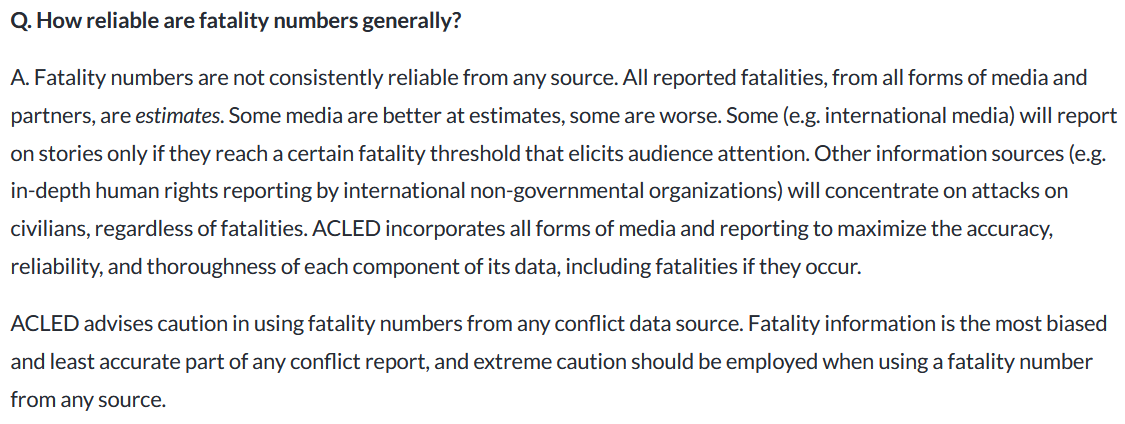
No one really know the exact number of deaths in a big conflict, but ACLED is probably the best we can get.
Wikipedians rely on ACLED, and I don't think they will change this criteria before 2026.
The market will resolve as per the Wikipedia article, as specified in the description and clarified many times by the market creator.
Wikipedia has tens of thousands of articles about wars and conflicts, and a very healthy culture of open discussions when something is unclear. The talk section of the articles is full of questions, clarifications and flaws identified and fixed. No surprise you can find them.
But in the particular case of the https://en.wikipedia.org/wiki/List_of_ongoing_armed_conflicts I don't see any open discussion for the Pakistani insurgencies.
@MiguelLM we can both agree on that Pakistan Institute for Conflict and Security Studies (PICSS) is considered a credible and legitimate resource for security data in Pakistan. Let's rely on their data
@MiguelLM but in that wiki link there is not any exact numbers for Balochistan,.. That is a reason for using CRSS reports, looks solid, and give exact combat fatalities for each province
@AlvaLindqvist ACELD Asia-Pacific update. Filter Battles + Balochistan + 2025
More info in the comments of the original market: https://manifold.markets/Panfilo/which-of-these-military-conflicts-w-qZOApZpQCU
@MiguelLM ACELD data reflects the total number of all reports we were able to find online. Wikipedia’s classification, however, only counts confirmed deaths , not every reported case that are not confirmed.
That’s why the numbers may look different
@24norwayElimSolberg thanks for the input
Where do you distinguish in the data set the “yet to be verified” vs the “proven” fatalities? I didn’t get this column in the public access file.
@MiguelLM The provided list shows a severe loss of combatant's lifes, reporting over 2,200 deaths in Balochistan alone (if you feed the list to gemini app and ask to calculate), and also several thousand across Pakistan during only 2025.
In Wikipedia's classification, those figures are not used; instead, the numbers are adjusted by consensus for greater accuracy and reliability.
If you try to ask any chat bot for how Wikipedia shows the data usually:
Resulting Adjusted Figures (2025): By applying this adjusted methodology, the total number of deaths attributed to all Pakistani insurgencies across the country in 2025 is shown as fewer than 1,000.
Balochistan Specifics: For Balochistan this year, the adjusted figure is estimated to be around 300 deaths.
We must proceed with great care and scrutiny when analyzing this sensitive data, relying on consensus-based figures rather than raw tallies.