N/A: Leaves academia outright (retirement), hybrid part-time academic and industry, leaves academia for some other non-(AI math) related industry (pedagogy, etc.)
 1,000
1,000🏅 Top traders
| # | Trader | Total profit |
|---|---|---|
| 1 | Ṁ2,582 | |
| 2 | Ṁ1,142 | |
| 3 | Ṁ527 | |
| 4 | Ṁ349 | |
| 5 | Ṁ163 |
People are also trading
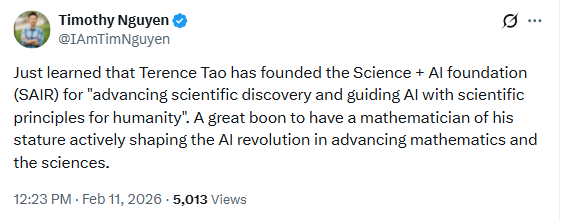
https://x.com/SAIRfoundation
https://sair.foundation/
https://www.linkedin.com/company/sairfoundation/
https://www.reddit.com/r/mathematics/comments/1r1of07/terence_tao_why_i_cofounded_sair/
Surely this resolves as N/A? Under "hybrid part-time academic and industry".
@CraigDemel I'm happy to discuss this further. It seems like a tough call to me.
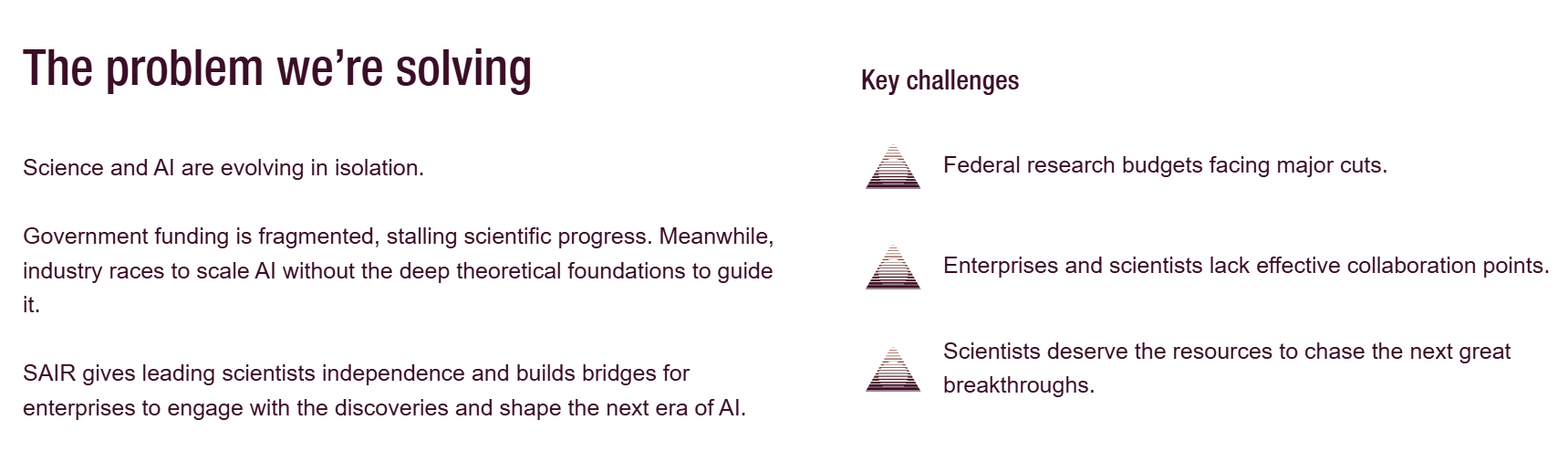

What is it precisely that demarcates foundation from industry? Is it the non-profiteering aspect? (If so, I fear that's a rather blurry criterion-- insofar as there are mental gymnastics that can be done to claim OpenAI is a "foundation").
Moreover, the very morale of SAIR is "academia isn't getting the job done, so we need to take it into private hands"; I see that as a rather industrial flavor, insofar as it takes to funding fortune 500 companies and AI industries, I certainly don't see that as an academic venture...
I hardly think the ability to give grants makes them quintessentially academic; I mean, inasmuch as any VC fund is in some ways a "foundation" of this very same way, modulo the profiteering aspect.
Can you please clarify why you don't see foundation and industry with intersection? Interested in what the semantics here are.
@Neilssciencejournal Industry makes things. "Academia isn't getting the job done" doesn't matter. There are many foundations outside of academia. But they are also not industrial.
@CraigDemel I see what you're getting at but I hardly think that falls precise outside of semantics either.
I mean, even as foundations go, this one stands more on the corporate side than it does on the saving-rainforests side. I had taken it colloquially, as many do-- though maybe that was my error-- in my mind, when I wrote "industry" I had it with the semantic charge that it simply referred to the antipode of academia; I certainly think that the moral of this one stands directly antipodal.
In my mind, the axis of the market to me was about "will Terry Tao get sick of academia". "Industry makes things" doesn't quite satisfy me insofar as YComb is a funding agency of the same nature, doesn't 'make things', and certainly has a rather corporate/industrial charge to it.
@Neilssciencejournal YC is not similar. They are for-profit, and take equity positions in (mostly) for-profit startups, exhorting them to ship fast and expecting massive growth.
SAIR is a non-profit, funding frontier research. This is not an "antipode of academia".
@CraigDemel Which brings me back to my first comment "...I mean, inasmuch as any VC fund is in some ways a "foundation" of this very same way, modulo the profiteering aspect."
And if profiteering is the characterizing definition of industry, then, again: "I fear that's a rather blurry criterion-- insofar as there are mental gymnastics that can be done to claim OpenAI is a foundation [and therefore would give you the argument that Terry Tao joining OpenAI would not even qualify as industry]"
I'm happy to concede that "industry as antipode to academia" is not a satisfactory definition, but then what is?
@Neilssciencejournal The definition is that stuff gets made and sold.
Mental gymnastics around OpenAI's tortured path needn't be done. There's a very for-profit company which makes things, and there's a non-profit which funds research and other non-profits through grants. The first is industry, the second isn't.
@Neilssciencejournal It is highly inaccurate to compare SAIR to a VC firm or YC. The latter do not give grants, they buy equity in startups with the goal of achieving large returns. As a grant-giving institution, SAIR is much more similar to something like the Simons Foundation, which nobody would consider to be part of industry.
@netherfiel I mostly concede to that, perhaps it was a poor analogy. The point I was trying to isolate was: I'm not sure profiteering is necessary nor sufficient for something to be considered "industry"; there are a great number of "non-profits" which still feel to fall under the industry umbrella (much of biotech certainly speaks to mind). The reason I brought up VC was as a point that "makes stuff" isn't quite a good definition for industry either, hence my conception that the term "industry" was simply taken to be the set-complement of academia.
It's definitely a lot closer to the Simons foundation like you said, but I don't quite think it's the same either. If academia and corp/ind were a spectrum, this one falls more to the latter I feel.
On account of:

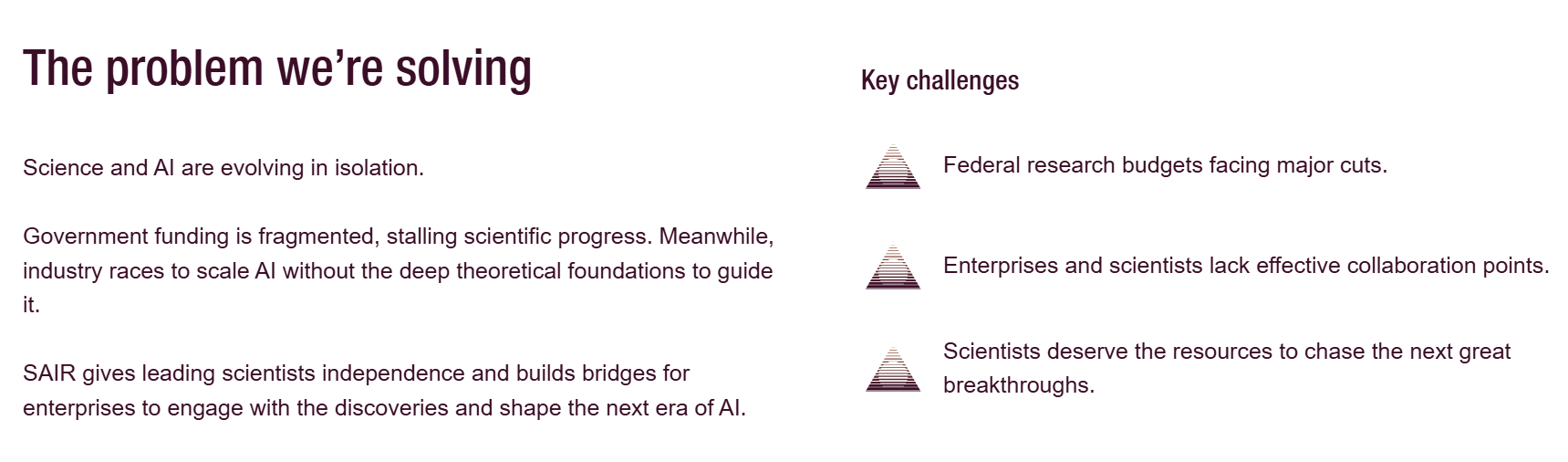
certainly feels like it leans more on the enterprise/corporate side than any of the usual academic foundations (simons, howard hughes, etc)
@Neilssciencejournal CSAIL at MIT is part of academia: "CSAIL has eagerly engaged in collaborative research partnerships with government agencies and leading technology companies for more than fifty years"
https://www.csail.mit.edu/sponsors/strategic-partners
Note that no one considers CSAIL part of "industry".
@CraigDemel @traders Ok, so OP made M2500 off this and no one else is supporting the resolution, one star.
@CraigDemel I like that counter-example.
I still feel like it's not quite the same, insofar as one is a research lab and the other more of a funding agency-- but I digress, I won't bore you with the argument. In the end I fear this ends up at a "know it when you see it" cul-de-sac.
Nevertheless, it's out of my hands. I will concede to my own error of not defining it more strictly in the description, didn't realize or anticipate rather that it's actually not so trivial to demarcate. Maybe I also made the wrong call, I can't say-- I suppose that is up to the mods whether or not they'd like to unresolve.
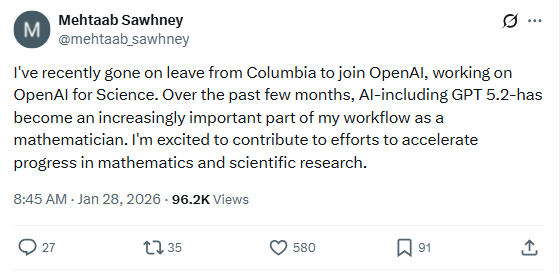
@strutheo The downside at the moment is that it's hard to bet on "leaves for startup, given no n/a", but that's a UI/UX problem that could be fixed on the front end. API support for that could be improved, but is adequate. So right now the two approaches fill different niches with respect to what they make easy to do, but I think the ternary market approach is underutilized :)
This paper suggests that the annual attrition rate for a man 30 years past his PhD (which is how old Tao is; he got his degree way back in 1996!) is about 4%
@duck_master Nice find!
Still holding onto my black swan... 🤣 the paper is from 2023, it doesn't account for the-- well, you know, the tail of the Gaussian that is the current academic climate (unfortunately).
@ArtimisFowl Broadly agree; though with the Black Swan caveat amidst the obvious academic-bureaucratic elephants in the room... who knows? Seeing as to his Lean-advocacy, and the obvious attention auto-formalization is getting in the AI-Math space, who knows?
It has, after all, been somewhat of a 202X zeitgeist for intellectual freedom to move into private yet retaining the academic spirit of publishing open-source whitepapers for all (Biotech, QuantFinance, ML, ... , etc).
All that to say, I do hope you are right