Manifold's calibration chart may be found here: https://manifold.markets/calibration
At the time of writing, predictions display a clear bias on YES. For example, markets with prediction 20% on average resolve YES only 15% of the time. In fact, all of the 10%, 20%, ... , 80%, 90% prediction bins exhibit a similar YES-bias.
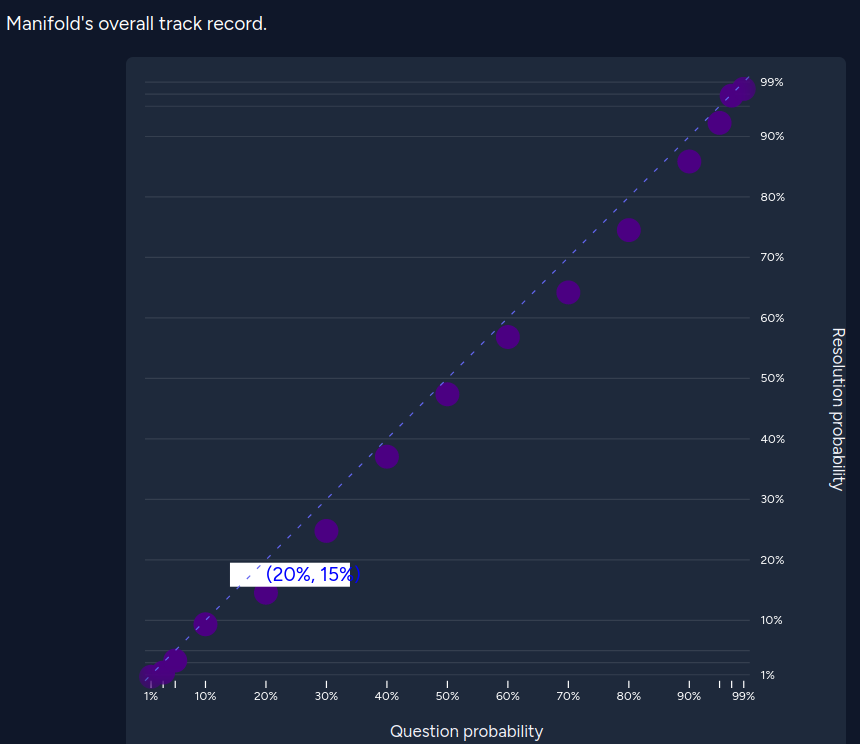
The market will resolve YES if, when the first time I check the calibration chart on or after Sep. 1st, at least 8 of the 10%, 20%, ... , 80%, 90% bins still exhibit such a YES-bias. Bias is defined as the resolution frequence being strictly less than the market probability - e.g. the pair (20%, 19%) would count as exhibiting YES-bias but the pairs (20%, 20%) and (20%, 21%) would not.
The market resolves NO if at least 2 of the categories do not exhibit such a YES-bias. I may resolve the market N/A if the calibration chart is taken down and I cannot check the result soon on or after Sep. 1st.
I will rely on the numbers displayed on https://manifold.markets/calibration, and use just one sample. I will not be trading in this market. Trading closes on Aug. 25th.
 1,000
1,000🏅 Top traders
| # | Trader | Total profit |
|---|---|---|
| 1 | Ṁ22 | |
| 2 | Ṁ17 | |
| 3 | Ṁ10 | |
| 4 | Ṁ10 | |
| 5 | Ṁ8 |
People are also trading
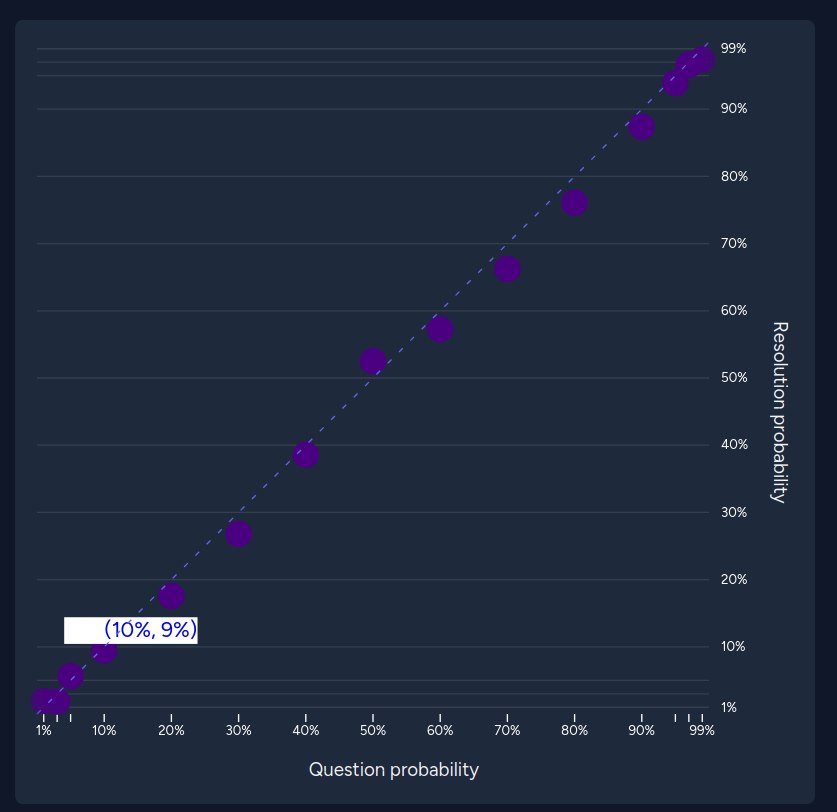
This was the calibration chart I got by loading the page at the same minute as the leagues clock ended. I recalled that the charts updated at XY:05 or something and waited, but no other chart came, so this is it. There's just the 50% bin that does not show a YES-bias, so it's precisely 8/9 categories that do, and the market resolves YES!
On a separate note, I think the market was a tad overconfident. There were some charts earlier this week that had just 7/9 YES-bias bins - 91% seems too high. But you win this time! :)
As a brief retrospective: I think the idea behind this market is good (namely: predict how biased Manifold predictions are in the future), but the implementation could have been better.
Most clearly, I wish I'd have specified that I'll take more than 1 sample. I decided on that due to laziness / not being able to draw many such samples programmatically, but I could have easily extended it to 3 or 5 samples. This would have made the market more about the underlying phenomenon by reducing noise.
I also think that the operationalization could have been better. As the market demonstrates, there's a strong belief that the resolution will be YES (not a single person traded NO), so there's not actually much gained with this market. Asking about the sizes of the biases and with a longer time horizon (3 months? 6 months? 12 months?) could have been more interesting. I'll think about it and possibly create better markets on this topic.