New most-distant galaxy (z>14.4) by EOY 2027
8
Ṁ100Ṁ712027
63%
chance
1H
6H
1D
1W
1M
ALL
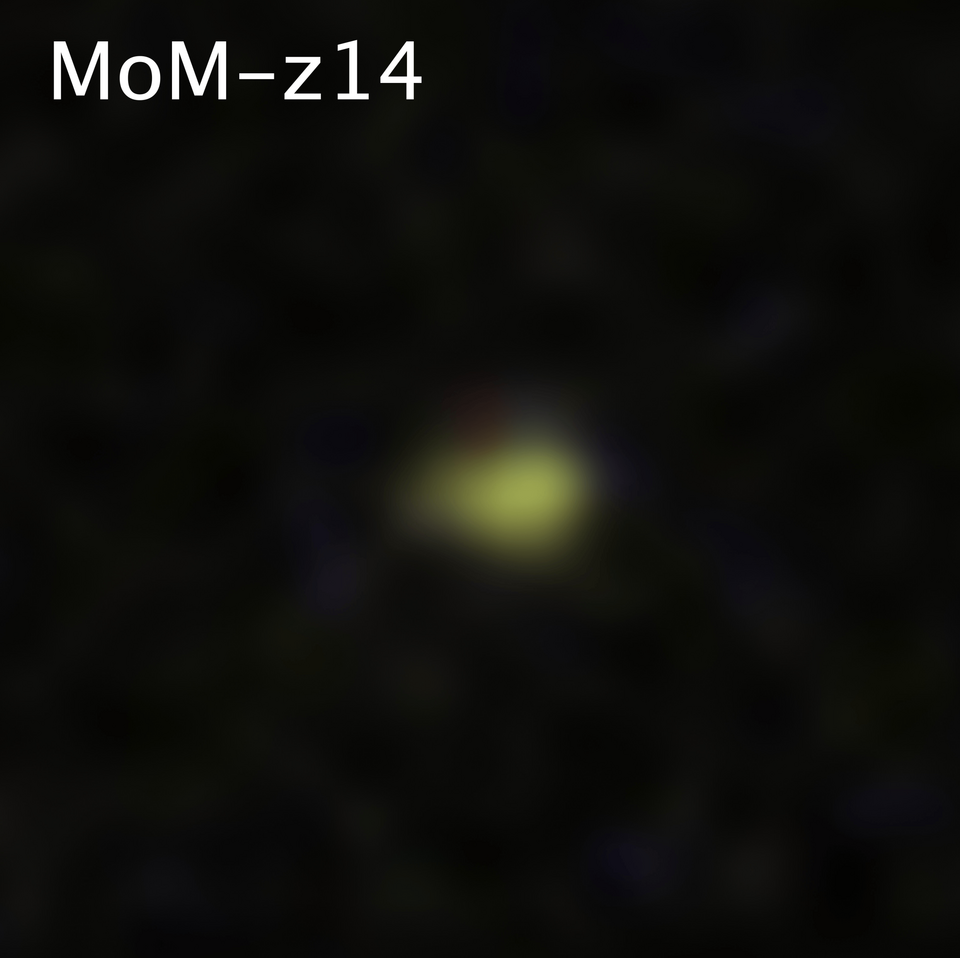
The current record is MoM-z14, a galaxy at redshift z=14.44.
Its light traveled 13.5 billion years to reach us, and is now 33.8 billion light years away (space expands)
It appears as it was 280 million years after the big bang
Resolves YES if a galaxy with a spectroscopic redshift above 14.44 is reported before Jan 1, 2028.
Resolution follows the List of the most distant astronomical objects - Wikipedia - confirmed objects section. If that entry shows z>14.44 and cites a published paper or preprint, this resolves YES.
Photometric candidates don't count, even if listed. If the Wikipedia entry is disputed or looks edited without a source, I go by the cited paper.
This question is managed and resolved by Manifold.
Get  1,000 to start trading!
1,000People are also trading
Related questions
Will the estimated lower bound of the Hubble constant include values under 65 (km/s)/Mpc by EOY2033?
48% chance
Solar gravitational lens at 542 AU to image exoplanets by EOY 2055?
27% chance
Which number model will Anthropic be on by EOY?
59% chance
Will LSST Supernovae Ia survey find evidence of a local void with |δ|>20% at z<0.1 by EOY 2030?
39% chance
Will any astronomical object with redshift >= 20 be observed before 2030?
45% chance
Will time-dependant dark energy be proved by EOY 2030 ?
41% chance
Detection of cosmological primordial tensor-to-scalar ratio r>0.003 by EOY 2030?
18% chance
Leading dark matter explanation by January 2045
Will the Extremely Large Telescope be the world's largest single optical telescope at the end of 2050
55% chance
What will be the distance in light years to the nearest known black hole in 2030?