Resolution criteria
This market resolves to YES if, before January 1, 2030, there is a clear consensus or official declaration in the scientific and medical communities that humans (or a specific human cohort) have achieved longevity escape velocity (LEV) (also known as "actuarial escape velocity").
To resolve YES, at least one of the following conditions must be met before the cutoff date:
Scientific Publication: A major, peer-reviewed scientific journal (such as Nature, Science, Cell, or Nature Aging) publishes a study or review concluding that a newly developed medical therapy (or suite of therapies) has successfully achieved longevity escape velocity for humans—defined as extending remaining life expectancy by more than one year for every calendar year that passes.
Global Health Body Recognition: A major health organization (such as the World Health Organization) or regulatory body (such as the US FDA) officially approves or recognizes a class of rejuvenation therapies with the explicit statement that they enable longevity escape velocity in humans.
Expert Consensus: A reputable, large-scale survey of biogerontologists or a recognized forecasting platform (such as Metaculus) officially resolves a corresponding question establishing that LEV has been achieved for humans.
If no such consensus, publication, or declaration occurs by December 31, 2029, this market will resolve to NO.
Note: Individual self-experiments, N=1 trials (such as Bryan Johnson's Project Blueprint), or general lifestyle/dietary optimization will not qualify for a YES resolution. Proof of LEV must be established via widely recognized medical or scientific consensus.
Background
Longevity escape velocity (LEV) is a hypothetical threshold where life expectancy is extended faster than the passage of time. For example, if medical science adds 13 months of remaining life expectancy for every 12 months that pass, a cohort's remaining lifespan would theoretically increase rather than decrease.
Futurists like Ray Kurzweil have famously predicted that LEV could be reached by 2030, heavily driven by advancements in artificial intelligence and biotechnology. Biogerontologists like Aubrey de Grey have historically estimated a 50% chance of reaching LEV by the mid-to-late 2030s. However, the broader medical community remains highly skeptical. Because verifying LEV through raw demographic data requires decades of observation, this market relies on official scientific, regulatory, or expert consensus declarations.
 1,000
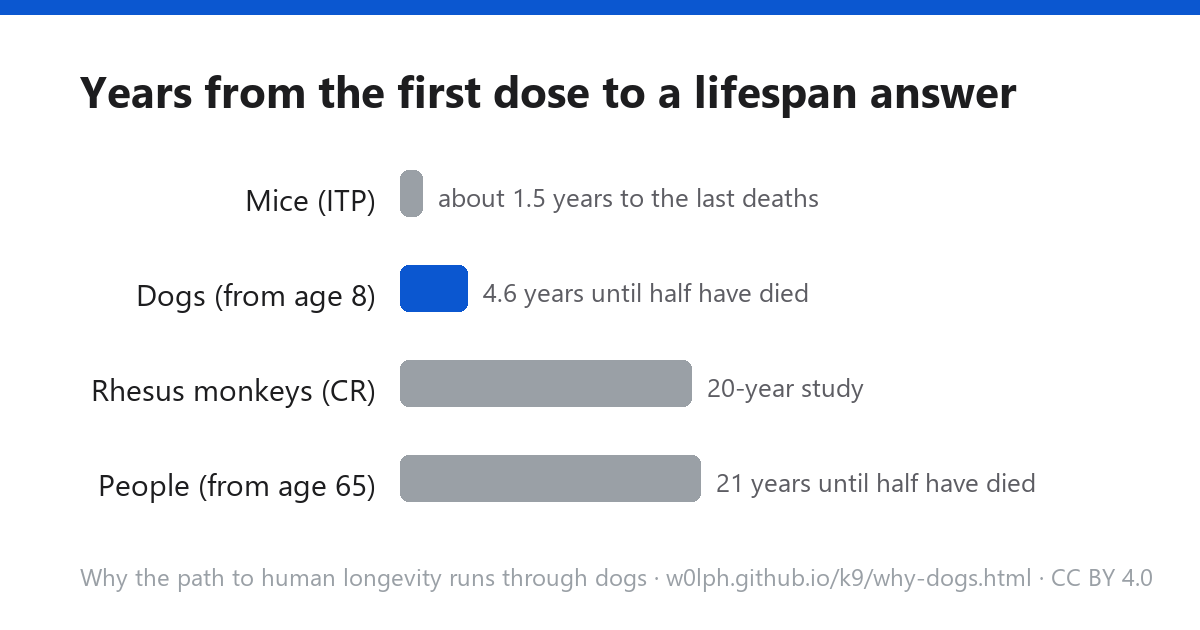
1,000Longevity escape velocity needs life expectancy to rise by more than one year per year. The US figure rose 0.6 years in 2024, to 79.0, and that was a rebound from the COVID years rather than a new trend (CDC, January 2026). More to the point for a 2030 deadline: no drug has yet produced a lifespan result in any animal outside the lab. The first such trials are in dogs (TRIAD, NIH-funded through 2029, and Loyal's STAY study), and the human arithmetic is slower still, with a cohort enrolled at 65 reaching median survival about 21 years later. So by 2030 the live question is whether dogs will have shown it, not people. Side-by-side numbers with sources (mine): https://w0lph.github.io/k9/why-dogs.html?v=2