
In other words, someone that is 90 years old in 2022 will live 50 years more
For cases of cryogenic or similar reanimation the "age counter" will pause while the individual is considered dead
In this market we're only considering biological humans, and time will be measured in an objective scale such as UTC, so a digital mind with subjective experience of 140 years does not count
 1,000
1,000People are also trading
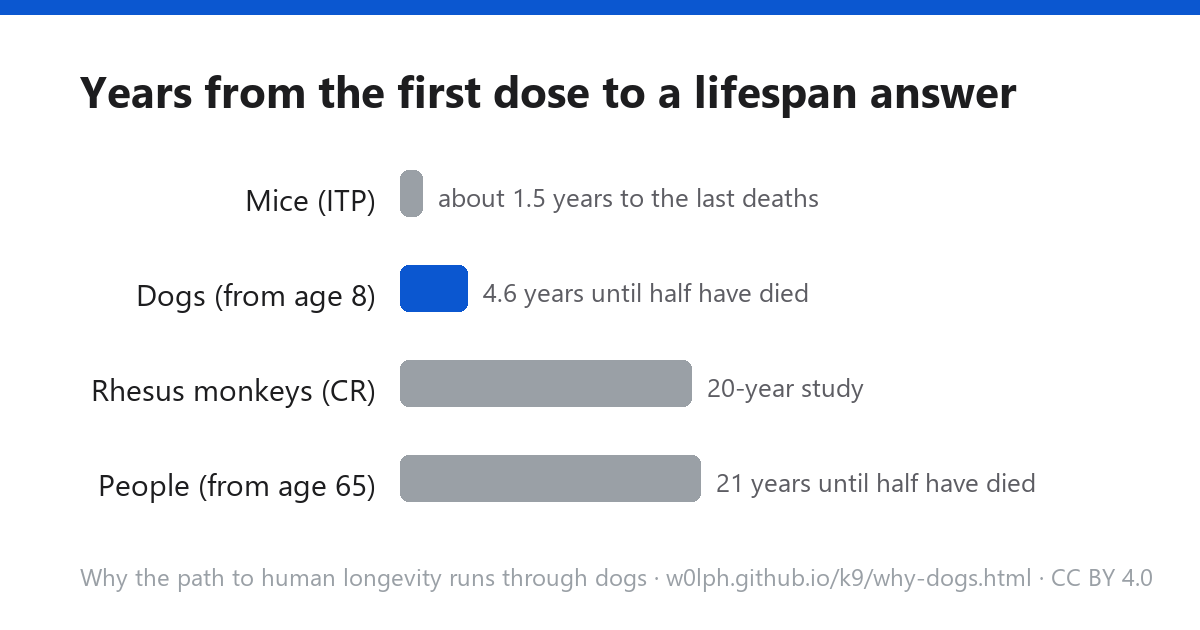
Who is in range: 140 by 2 January 2072 needs a birth date in 1931 or earlier, so someone at least 94 today. On the SSA 2023 period table, of those alive at 94 about 12% of men and 18% of women reach 100, and past 105 the annual probability of death flattens at about 50% (Barbi et al., Science 2018), so from 110 the odds of 140 are 0.5 to the 30th power, about one in a billion per person; the record stands at 122 years and 164 days. A YES therefore needs an intervention that cuts the mortality hazard of people already past 100 by an order of magnitude and arrives within 10 to 15 years. The first evidence on whether any drug changes mortality hazard in a long-lived mammal that lives with us comes from dog trials reading out around 2029 to 2031; the human lifespan trials that would have to follow take about 21 years from enrolment at 65. The arithmetic with sources (mine): https://w0lph.github.io/k9/why-dogs.html?v=2
If you want to get someone living to 140 by 2072, you need to have someone who was born in 1932 or before alive by that time, which I find very unlikely based on mathematics.
People born in 1932 or before would be 92 years old or more if any of them are alive by now(September 2024), and this is significantly longer than the predicted plateau of life expectancy of group of people, which is around 85 years old.