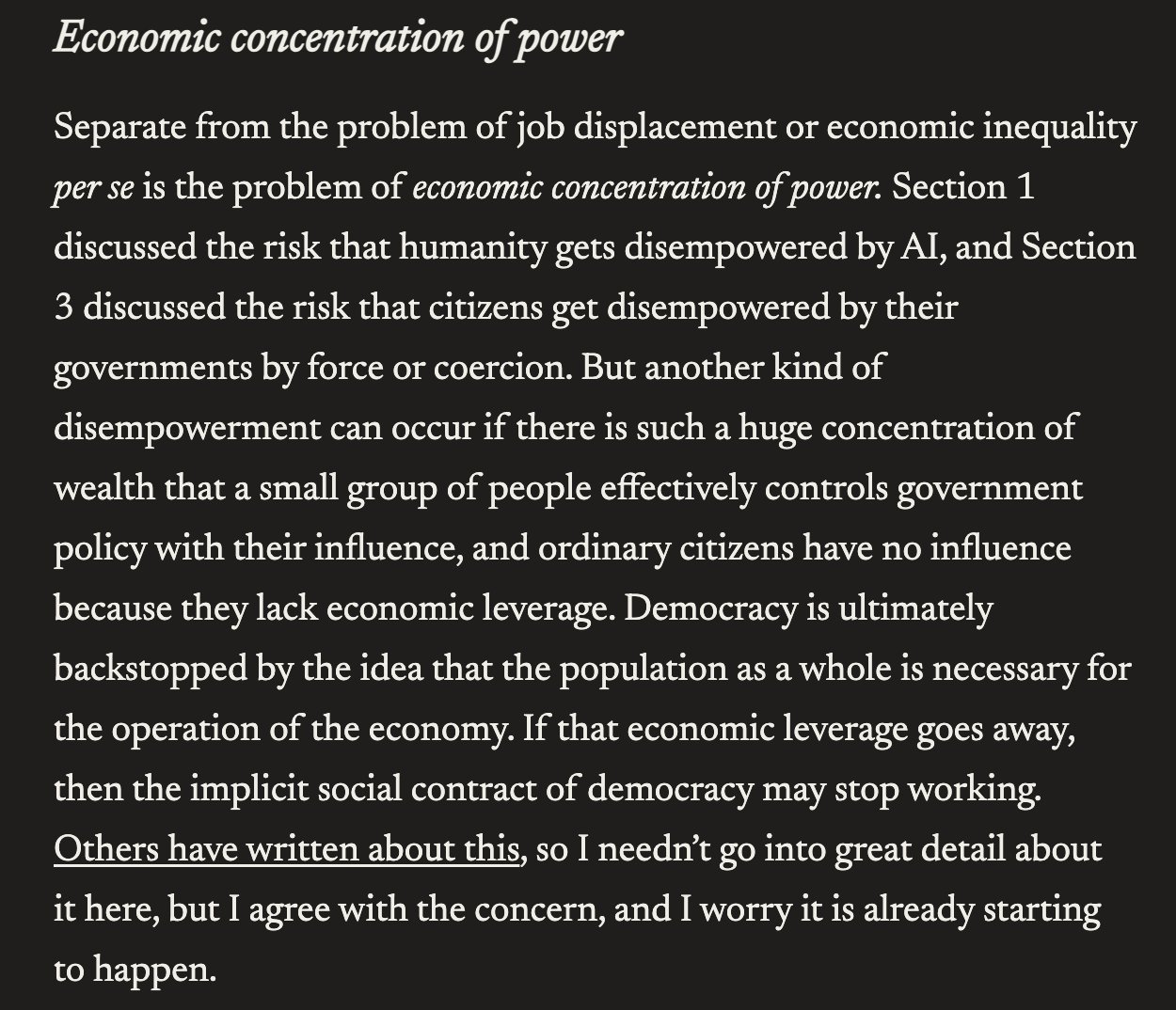
This question concerns a hypothetical political-economic transition involving advanced AI at any point between the creation of this market and January 1, 2050.
For the purposes of this market, an “AGI insider class” means a relatively small group of people who, because of their ownership, employment, institutional position, technical expertise, political connections, or privileged access to advanced AI systems, have a credible expectation of retaining substantially greater wealth, power, access, or security than the general population as AI becomes increasingly economically and politically important.
The underlying hypothesis is that such a group could form an implicit coalition: its members tolerate, support, or materially facilitate a broader loss of political or economic power by the rest of society because remaining an “insider” gives them a sufficiently valuable position in the emerging order.
### Resolution
This market resolves YES if, at any point before January 1, 2050, at least 4 of the following conditions are simultaneously or substantially true:
1. A recognizable AGI insider class exists.
A relatively small and identifiable group has privileged ownership of, control over, or access to advanced AI systems or the capital and infrastructure surrounding them, and membership in this group provides substantial economic or political advantages unavailable to most people.
2. The insider class materially benefits from a decline in the bargaining power of the broader population.
Large numbers of people experience a substantial reduction in their economic or political leverage due to AI-driven automation, concentration of ownership, reduced dependence on human labor, or similar developments, while members of the insider class remain substantially protected through ownership, privileged access, institutional position, or accumulated wealth.
3. A significant portion of the insider class supports or accepts highly concentrated control of advanced AI.
Important members of the relevant technical, corporate, financial, governmental, or professional elite publicly advocate, institutionally support, or knowingly participate in arrangements that keep control or ownership of the most powerful AI systems concentrated among a relatively small number of actors.
4. Insiders oppose meaningful attempts to broaden ownership or control when doing so would materially dilute their position.
For example, influential insiders substantially resist policies such as public ownership, broad-based capital ownership, mandatory distribution of AI-generated wealth, strong democratic oversight, forced decentralization, or other serious proposals that would transfer meaningful power from AI insiders to the wider population.
5. Political decision-making concerning advanced AI becomes substantially less accountable to the general public.
Important decisions about the ownership, deployment, governance, or use of advanced AI are effectively made by a narrow group of corporate, technical, financial, security, or governmental actors, with ordinary democratic mechanisms having little practical ability to reverse those decisions.
6. Membership in the insider class functions as a credible “golden ticket.”
There is substantial evidence that people in strategically important positions—such as AI researchers, engineers, executives, investors, senior officials, or other key participants—have strong incentives to cooperate with the emerging system because doing so provides them with ownership, wealth, privileged AI access, institutional protection, or another durable advantage over those outside the coalition.
7. There is substantial evidence of an explicit or implicit political bargain between concentrated AI power and key supporting groups.
This does not require a formal agreement. It is sufficient if credible reporting, public statements, institutional behavior, or economic arrangements indicate a pattern roughly equivalent to: key groups continue supporting or facilitating concentrated AI control in exchange for privileged participation in the resulting economic or political order.
### What does not automatically qualify
The following alone are not sufficient for a YES resolution:
* AI companies becoming extremely valuable.
* High salaries for AI researchers or engineers.
* Large increases in wealth inequality.
* Significant technological unemployment.
* A small number of companies dominating the AI industry.
* Unpopular AI regulation.
* Political corruption involving technology companies.
These developments may contribute to the criteria above, but the question specifically concerns the emergence of an insider coalition that benefits from, accepts, or helps sustain the relative political disempowerment of those outside it.
“Political disempowerment” does not require the formal abolition of democracy or voting rights. It can also mean that the broader population retains formal political rights while losing much of its practical ability to influence the ownership, governance, or deployment of the technologies upon which economic and political power increasingly depends.
The market resolves NO on January 1, 2050 if fewer than four of the above conditions have been met.
Resolution should be based on the preponderance of credible public evidence available at the time, with particular weight given to observable institutional arrangements, ownership structures, laws and regulations, public statements, and well-supported investigative reporting rather than speculation about private motives.
 1,000
1,000