I will not bet on this market as I will be resolving these to the best of my ability, in the spirit of the questions.
Update 2026-03-18 (PST) (AI summary of creator comment): For the option referencing "magnifica humanitas" (or similar phrasing), the encyclical's title will be determined by whatever title the press/Wikipedia refers to it as.
Update 2026-05-18 (PST) (AI summary of creator comment): For the 'Released by May 15th' option: the encyclical being signed on May 15th is not sufficient — it must be publicly accessible and readable by May 15th, 11:59pm Rome time to resolve YES.
Update 2026-06-04 (PST) (AI summary of creator comment): The remaining options (not previously addressed) will resolve NO unless specific evidence is provided to support a YES resolution.
Update 2026-06-05 (PST) (AI summary of creator comment): For the 'Mentions Deepfakes' option: the encyclical does not use the term 'deepfakes' explicitly, but references manipulated imagery/videos in relevant contexts. The creator is considering a ~20% (PARTIAL) resolution given the ambiguity.
 1,000
1,000🏅 Top traders
| # | Trader | Total profit |
|---|---|---|
| 1 | Ṁ58 | |
| 2 | Ṁ53 | |
| 3 | Ṁ37 | |
| 4 | Ṁ29 | |
| 5 | Ṁ26 |
People are also trading
Regarding “Mentions Deepfakes”, the term isn’t used but paragraph 142 talks about manipulated imagery in the context of misinformation and paragraph one talks about fake profiles and manipulated imagery in the context of blackmail and sexual exploitation.
I have a small YES position on this but I admit it’s subjective whether this counts as a “mention”. I’d argue 141 in particular is discussing situations where deepfake could be used to describe the images or videos.
Disinformation did not begin with AI, yet today it finds a powerful amplifier in AI. The ability to manipulate content, images and videos exposes people to biased or misleading perspectives.
- Paragraph 132
Online phenomena such as grooming, blackmail and the sexual exploitation of minors are not uncommon, and are made more insidious by the use of fake profiles, algorithms that facilitate dangerous contact, and AI tools capable of manipulating images and videos.
- Paragraph 141
@bens "The ability to manipulate content, images and videos" is what deepfakes are. That's 100% a "mention."
@ChurlishGambit @CraigIM hmmm, this isn't really the case. A "deepfake" is something more specific than just manipulating content, images, and video. The term wasn't mentioned specifically, but also the specific meaning of deepfake wasn't really captured in paragraphs 132 or 141.
I feel like the externalities-dignity option should resolve YES based on the overall message of the text, but in particular this passage seems relevant. Is anyone unhappy with this?
"237. Let us remain faithful to the truth! Living amid incessant flows of information, opinions and images, we know how easy it can be to influence decisions and preferences through increasingly sophisticated algorithms. [218] In this context, it is imperative to cultivate hearts that love the truth, prefer what is right despite the most appealing content and pursue wisdom rather than immediate results. We must always keep before us the truth about God and humanity, just as Christ has revealed them to us. We must lay aside an individualistic and technical view of humanity, as if reality were mere matter to be shaped according to selfish interests, whether individual or collective. [219] Instead, let us cultivate what Pope Francis called a “situated anthropocentrism,” [220] which recognizes the human being as a creature embedded in a network of relationships with other living beings and with all of creation. Fidelity to the truth requires integrating the possibilities offered by technology within a framework marked by wisdom, which is capable of safeguarding both the dignity of each person and the future of our common home."
@bens I think the encyclical does not take that stance, it seems to say that it's possible that AI could be used in a framework that does not undermine the dignity of the human person
@bens I’d say it takes the position that irresponsible use of AI undermines human dignity, so I agree with @TiredCliche that it leaves open the possibility of responsible use.
I still interpret it in a way that I think would make it a YES, that the uses, or misuses, that the encyclical takes issue with would fall under “the externalities of AI”. I don’t hold any position on this one.
@CraigIM ya I think all in all, a YES resolution makes the most sense to me here after my cursory read of the encyclical.
I think Vance responded within 24 hours? If someone has more detailed timestamps to dispute this, you're welcome to change my mind but:
"Vance, the second Catholic to hold the office of vice president and a proponent of AI technology, told NBC News in an interview published May 26 that so far he has read “bits and pieces” of the encyclical and some coverage of the document."
https://www.americamagazine.org/news/2026/05/27/magnifica-humanitas-jd-vance-pope-leo/
Resolving romantic/sexual relationship mention to 50% because of this section (which incidentally might have been one of the AI-generated sections, lol):
"The artificial imitation of positive human communication — words of advice, empathy, friendship and even love — can be engaging and at times genuinely helpful. However, for less discerning users, it can also be misleading, creating the illusion of a relationship with a real personal subject. When words are simulated, they do not build genuine relationships, but only their appearance. The artificial imitation of care or support can become particularly risky when it enters contexts where real relationships and emotional bonds are lacking. Here, the danger is not so much that a person may believe they are communicating with another person, but rather that they may gradually lose the very desire to form genuine human connections."
@bens I think that's a yes resolution, but the more important question is on what basis are you calling this section AI-generated? What evidence do you have of this?
@TiredCliche it's extremely well-established at this point. Read this for more details:
Claude, Author of the Humanitas
@bens I hesitate between: we have eternity so take your time, and hurry up, we might all be dead tomorrow
@blackle I think this has to resolve NO. The encyclical takes a more modest position, warning about bad externalities.
I did bet no, but my bet was only 3 mana.
"When business models thrive on human weakness, the person is treated as a means rather than as an end; those who design or finance such systems bear a moral responsibility that cannot be ignored. There is an urgent need to promote technologies that strengthen interior freedom by fostering education in digital sobriety and the protection of minors, thus countering models that exploit vulnerability."
This passage seems to be about romantic infatuations with AI...
@bens While its possible to mention others' concerns, we have to remember that under Catholic dogma, human extinction is not possible. We already know how the world will end, and it isn't that way.
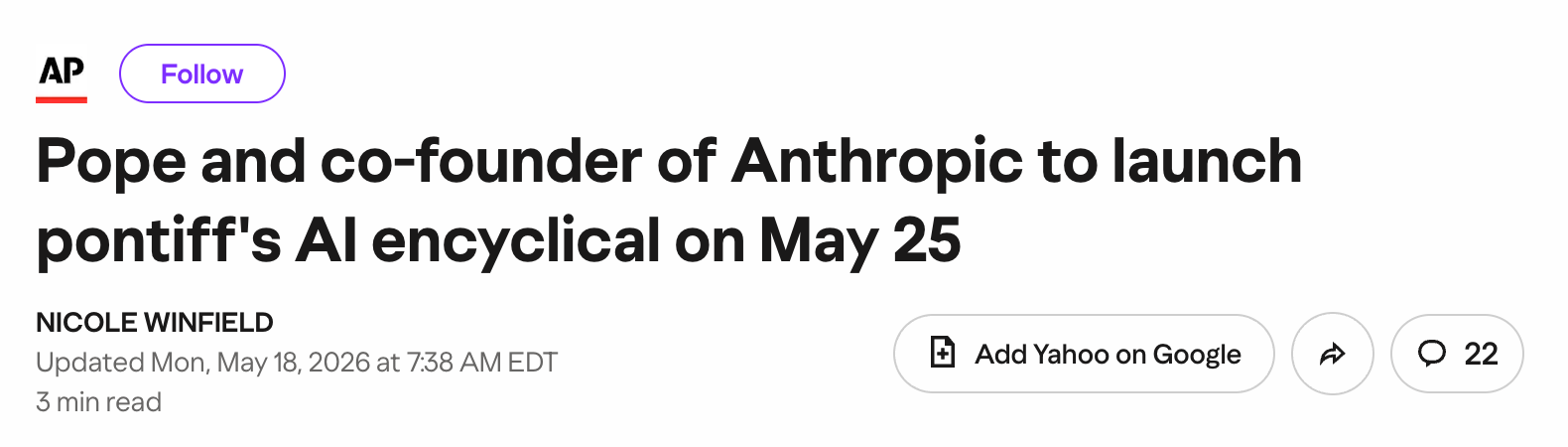
@bens the encyclical was signed on May 15 but will be ‘launched’ on May 25.
https://www.yahoo.com/news/articles/pope-co-founder-anthropic-launch-113813646.html