The upcoming Dutch municipal elections (gemeenteraadsverkiezingen) will be the first electoral test for the newly forming government.
Voters will be able to express what they think about the outcome of the 2025 general election and the progress of the cabinet formation.
We would like to compare the local election outcome to the general election outcome to see which parties improved their vote share, but that is difficult, because there are a few differences.
Firstly, in local elections, local parties participate, which don't participate in general elections. These local parties take a significant chunk of the electorate, lowering vote margins.
Secondly, local elections feature alliances between parties to compete for a seat, such as CU/SGP, even if these alliances don't exist at a national level.
In this question I will make some adjustments to the local election outcome, to make it comparable to the general election outcome.
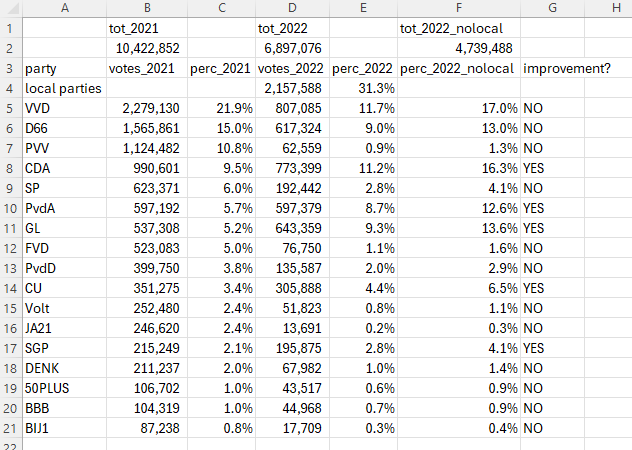
The first adjustment is that we ignore local parties in this question, so their vote share is subtracted from the total vote count, and then for the remaining parties their share of the remaining vote is computed.
Also, for alliances between parties at the local level, their vote share is divided evenly between the allied parties.
The question is then, which parties will get a better adjusted vote percentage in the 2026 municipal election, compared to the 2025 parliament election?
We can use the 2021 parliament election and subsequent 2022 municipal election as an example.
Consult the table below to see this procedure in action for the last municipal election.
Figures come from the kiesraad:
https://www.verkiezingsuitslagen.nl/verkiezingen/detail/TK20210317
https://www.verkiezingsuitslagen.nl/verkiezingen/detail/GR20220316
Despite these adjustments, there may still be some distortions in the election results compared to the parliament election because some parties have higher turnout in local elections or some parties bleed more support to local parties. Traders will have to factor this in.
Figures for the 2025 general election were obtained from the kiesraad: https://www.verkiezingsuitslagen.nl/verkiezingen/detail/TK20251029
These figures are included in the answers, these are the scores which the parties will have to beat to resolve to YES.
For the purposes of this question, GL-PvdA is considered one single party.
In some local elections GL and PvdA might run independently, but those votes will be counted towards GL-PvdA.
Trading on this market will close on election night before the first exit polls are released, to prevent last-minute trading based on breaking news.
The market will resolve once the kiesraad publishes the full results.
 1,000
1,000🏅 Top traders
| # | Trader | Total profit |
|---|---|---|
| 1 | Ṁ45 | |
| 2 | Ṁ8 | |
| 3 | Ṁ4 |
People are also trading
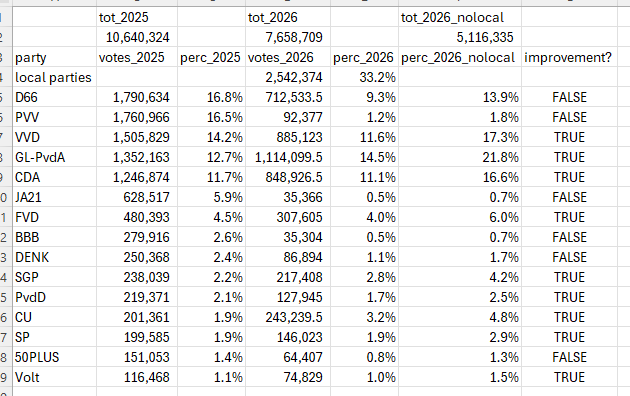
A month after the election, the results were published just now: https://www.verkiezingsuitslagen.nl/verkiezingen/detail/GR20260318
These are my calculations for the resolution:
I don't see the results yet: https://www.verkiezingsuitslagen.nl/verkiezingen
Don't know when they will come
Man, this election is really going under the radar.
I feared there would be no polling, but it looks like we just got a poll: https://www.ipsos-publiek.nl/actueel/gemeenteraadsverkiezingen-lokale-partijen-kunnen-doorgroeien/