
This market resolves to 0.5 * sin(sqrt(a + b)) + 0.5, where a is equal to the number of YES shares held by the largest YES holder at market close, and b is equal to the number of NO shares held by the largest NO holder at market close.
Out of necessity, it will be rounded to the nearest whole percent. For example, 0.481 rounds to 48%, 0.398 rounds to 40%, 0.998 rounds to YES, and 0.002 rounds to NO.
For example, if this market closed with these positions:
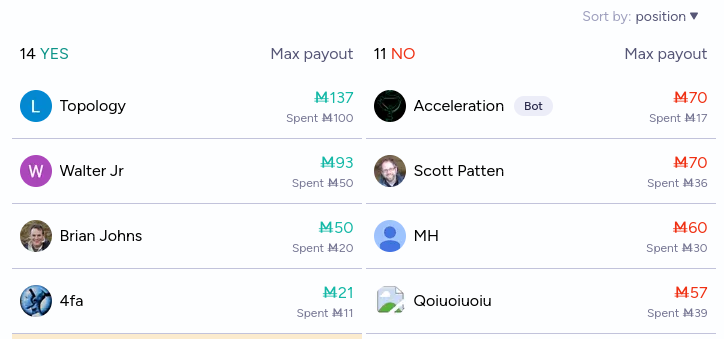
this market would resolve to 98%, because 0.5 * sin(sqrt(137 + 70)) + 0.5 = 0.9844..., which rounds to 98%.
 1,000
1,000🏅 Top traders
| # | Trader | Total profit |
|---|---|---|
| 1 | Ṁ154 | |
| 2 | Ṁ24 | |
| 3 | Ṁ17 | |
| 4 | Ṁ10 | |
| 5 | Ṁ0 |
People are also trading
not my sinusoidal ass buying a \in {((1 + 4n)*pi/2)^2 - b | n \in\mathbb{N}} shares
gonna win 😎 (EDIT: never mind, YES voters have it now!)
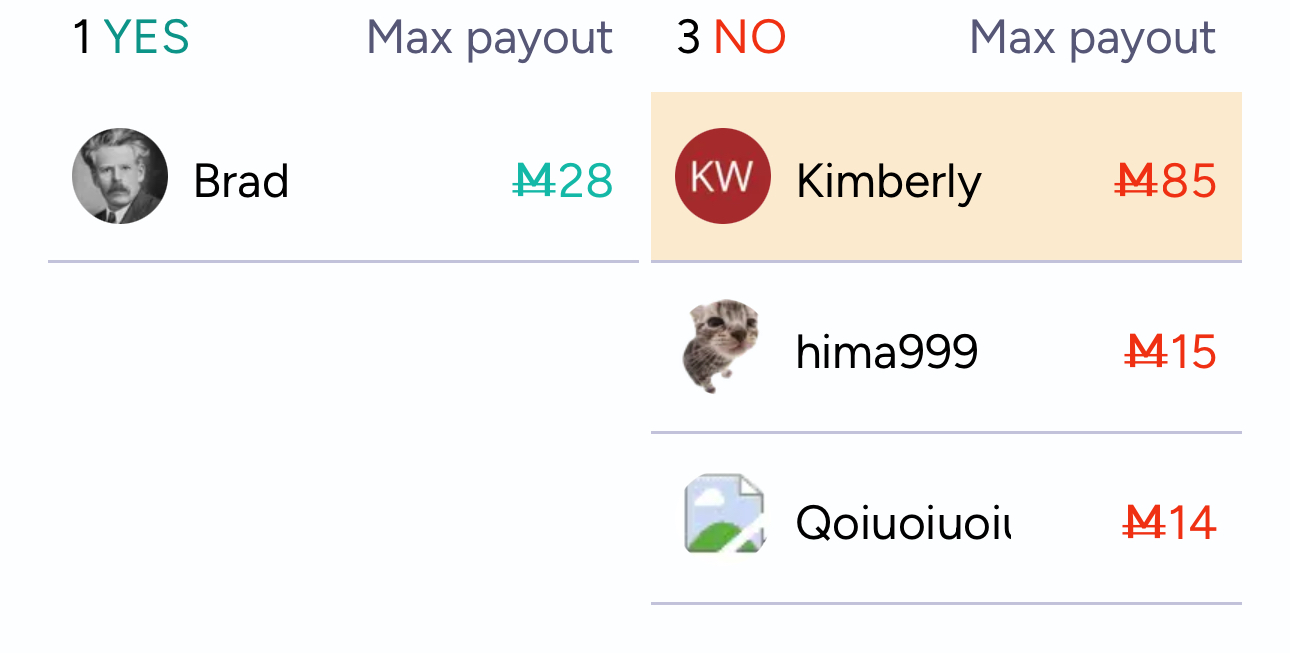

as a side note, encouraging this sort of back-and-forth tug of war makes for a really fun market concept! are the YES voters gonna sweep us?
One problem is that because of the sqrt, this will incentivize big fish to bet because larger bids are harder to reverse the outcome of than smaller ones. A liquid whale has the advantage here.
@KimberlyWilberLIgt Well, a liquid whale with good timing anyway. There's not much YES voters can do if some NO whale snipes the market at the last second
Guide for the prospective trader:
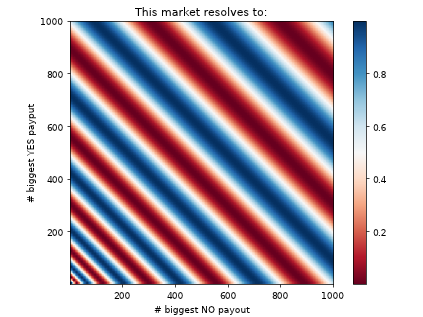
Is this right?
@Gameknight Nope I'm stupid I forgot sine functions can be negative
Please disregard the above comment