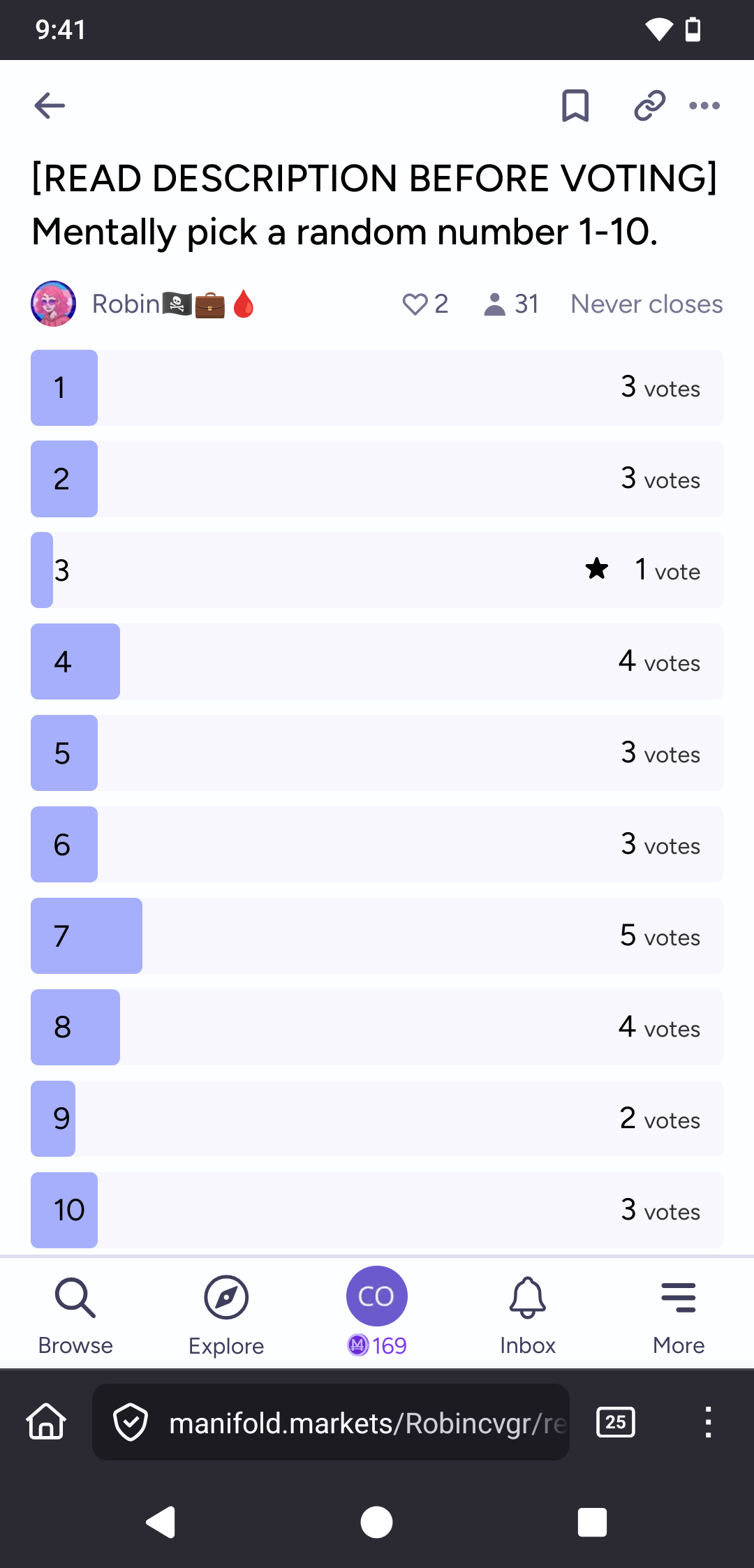
Read the description before voting. Do not read the comments or anything else before voting.
Using just your mind, make your best attempt to come up with a number between 1-10 as randomly as possible. Do not use any external data: don't roll dice, don't look at the clock, don't look around the room. Use only what's already in your mind. Feel free to close your eyes and take some time if you like. Then go ahead and vote.
After you vote, if you would like, please share the strategy you used to select a random number in the comments.
.
.
.
.
.
.
.
.
.
.
.
.
.
.
.
.
.
.
.
.
.
.
.
.
.
.
.
.
.
.
.
 1,000
1,000People are also trading
I decided to take a digit from the decimal representation of pi at the 20th place. (I have ~50 digits memorized from a competition with a friend many years ago.)
I did not internalize the question very carefully before closing my eyes to think, so if you'd been asking for a selection out of eleven options (0-10) my method wouldn't have been very good!
I just thought some numbers that felt random that added up to ~50 and took the ones place. I usually do mod 3 if I can find a way to involve it because it's hard to figure out what numbers are mod 3 but easy to verify in your head
@JussiVilleHeiskanen doesnt benfords law only apply to datasets with large variation over orders of magnitude
I initially thought about visualizing dice rolls or something, but instead I decided to take as many meaningful numbers as I could think of (my birthday, other important dates, my apartment number, references to things, etc), add all the digits up, and pick the last digit + 1 (to make the range 1-10) as my random number.
I got 7 by doing this which felt unsatisfyingly unrandom but oh well, I'm not overriding my method after completing it