Resolves "yes" if any of the six remaining Millenium Prize Problems are solved before Jan. 1, 2030, and the solution is accepted by the Clay Mathematics Institute.
 1,000
1,000People are also trading
I have 0 mana left to bet YES on this market. It's looking more and more plausible that OpenAI has a solution just sitting in a server right now today.
Scott Armstrong (@scottnarmstrong) on X
https://mathstodon.xyz/@tao/117233527638291447

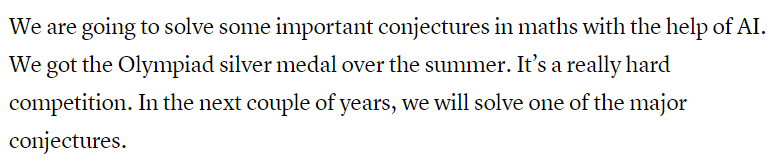
@MalachiteEagle Going from "they will solve some important conjectures" to "they will solve a millenium prize problem" is peak availability heuristic
@0xseraphim Not really? It was availability heuristic to say that in Oct 2024. (And as we saw, models solved MANY problems that were not millennium prize problems.)
I have been saying for a long time, here and in other fora, that of all the MPPs, Navier-Stokes is the one that is plausibly solvable by AI, or as it should be called, computer search.
@pietrokc ah ok fair play, fair play
Then if one of the other problems get solved (say in the next three years) by AI, what would you infer is the flaw in this worldview?
@0xseraphim It depends on what problem gets solved and what the solution looks like. I don't believe "low-resolution" thinking is likely to be accurate. I mean this in the sense of "AI solved a millennium prize problem" (lo-res) vs "building on an approach conceived by humans, a model finished some hard but in some sense routine calculations and built a counterexample to Navier-Stokes" (hi-res).
For instance, there have been a number of model-solved problems, especially in late 2025 - early 2026, where the update was just "this problem was a lot easier than people thought".
For me, the major update was actually IMO 2025 gold, because the hi-res version was "a pure language model, operating only on tokens, solved 5 of the 6 problems". I had not expected this to be doable in practice (though of course it was in theory, as LLMs with CoT are known to be Turing-complete). I had NOT regarded the previous year, IMO 2024 silver by DeepMind using automated theorem provers, as a big update. IMO seems exactly suited for this kind of approach. Especially the geometry questions, which DeepMind could always solve perfectly. I think however that it was notable that no AI lab solved IMO 2025 Q6, not even partially, and none made any comment on the failed runs. It's not clear to me that even these models today, which helped with Navier-Stokes, could solve that one, because it has such a strong visual component. Of course Q6 is now in the training set so we'll never know.
Regarding the MPPs, I wouldn't be THAT surprised if something like what happened with Navier-Stokes also happens with Hodge (caveat that I know much less about this area). IF the answer to Hodge is negative (ie there exists a non-singular complex manifold X and a Hodge class on X which is not a rational linear combination of complex subvarieties of X), then it seems to me plausible that such a thing could be found by computer search, as the counterexample to N-S was -- and indeed computer search might be our best shot at finding it.
I don't understand even what Yang-Mills is asking, so I wouldn't know how to update if AI solved it.
For Riemann and Birch-Swinnerton-Dyer, there could conceivably be counterexamples, but they seem much harder to construct. They would be very "delicate". For Navier-Stokes (and maybe Hodge) there is a notion of starting with an almost-counterexample and then gradually refining it. Whereas for RH and BSD I feel like there is no such notion; slightly changing an almost-counterexample ruins it and makes it a not-even-close-to-counterexample. This is all conjectural of course.
So, if positive Hodge, RH, BSD, or P vs NP were solved by AI, really solved and not just finishing the calculations suggested by humans, I would have to revise my view of how much of math is conveyed in writing versus stored in our heads.
See, I don't think there's necessarily anything special about humans (though there is def much we don't understand). But math happens in humans' heads. They write some of it down but it's impossible to write ALL of it down. A lot of math communication relies on our shared "inductive biases" as humans. I write "between any two points there is a line" and you immediately picture a line in your head, with a lot more information than could possibly be conveyed by those 8 words. The main reason to expect AI to be bad at (human) math is this: that it can only see what is written down and shares none of our inductive biases. If it turns out that computers can do math as well as the best humans, then it must be that writing it down provides way more constraints than I previously thought.
@pietrokc I kind of think of it less as "writing it down provides way more constraints" and more "we live in a universe where intelligence can generalise between domains". And that there's nothing special about language per se, it's just something that developed in human culture over the past tens of thousands of years to efficiently compress this joining of dots between domains.
I like what Cedric Villani said about mathematics along the lines of "physical phenomenon → intuition/problem → mathematical abstraction → autonomous mathematics → sometimes back to physics". But I'm not sure this says anything specific about "inductive biases" in the human brain. It may do! But, on the other hand, maybe the real answer to all this says more about the universe we live in than it does about neuroscience.
In the future we'll have much better framings for these questions and we'll be able to run granular experiments to see if AI can generalise between maths and physics without observations or language. Maybe there's some keystone we don't know about yet that holds it all together 🤷
@pietrokc Similar to how no matter what new physics we come up with, it always eventually boils down so a few core formulas. There's something about the structure of the universe that results in intelligence being able to understand it. I think this is related in some way to this principle of intelligence being able to generalise between domains. And if the latter wasn't the case, we wouldn't be around to have this conversation.
That is why, in my framing, it would not seem surprising to me at all that AI soon reaches the level of top human expert mathematical ability. Humans are the existence proof that general intelligence can discover new mathematics and solve Millenium-tier problems. I think current AI is general in a sufficiently similar way to human brains that it will be able to make this leap very soon.