I’ve been using smartphones for about sixteen years now. I use one every day for several hours. But times change and I love new tech. At market close, will I still be daily driving a smartphone of some kind?
There’s obviously a lot of vagueness around what might come next, so here’s a woolly definition of a smartphone that my future devices will be judged against:
a discrete device
Fits in my pocket
Fulfills personal compute tasks
Things that would not be a smartphone:
any implanted device that fulfills the same functions as a smartphone
Compute installed in e.g. the structures I live and work in
Smart Watch
Smart glasses
A drone that follows me round
Brain-computer interface
Things that might be a smartphone:
a tablet computer that can still fit in my pocket
An implant that requires me to make the “call me” hand gesture to make calls.
As this is something I will presumably have some sway over, I will not bet on this.
 1,000
1,000People are also trading
Close date -8y update: I'm still using a smartphone. If it broke, I would replace it with another one.
The smartphone I'm currently using is an iPhone 13 Pro, which I've been driving for four full years now, and I'm starting to get some slight pressure to upgrade. This suggests I'll be approaching an upgrade point around market closure; if I upgrade in the next year and then again around 2030-2031, I'd have a two-to-three-year-old smartphone at the end of 2033.
Since last year we've seen AI pins fade away, and it seems unlikely they're the future. I am very curious as to what the OpenAI / Jony Ive device is, because they were talking a big talk about getting people away from smartphones, but as we don't know what that might actually look like it's hard to say anything more.
Smart glasses seem to be coming along nicely. I've heard several good things about the latest Meta Rayban Display. Right now they depend on a smartphone, but I think there's a chance that they might have sufficient internal compute by market close. I would definitely consider ditching a smartphone for smart glasses.
I did think of one other off-ramp from smartphones that hasn't been raised yet: returning to a dumbphone. I have done a digital detox as described in Cal Newport's Digital Minimalism and can imagine myself doing another in the future. In that detox I did not go back to a classic dumbphone but I was tempted. If this market ends while I am digital detoxing, I will resolve YES if I return to a smartphone within a month of market close. It wouldn't feel fair that I could bait and switch the market like that.
I'm not sure how I feel about the current price of this market. The OpenAI device and smart glasses have made significant inroads into making a non-smartphone future feel plausible. But one of those hasn't been unveiled yet, and the other is not something I would buy today, and possibly not something I would consider for several years. If everyone is bullish on those technologies then maybe the correct price would be more like 60-70%. But there's still plenty of runway for both to be false starts. In that case, 80% or maybe a little higher feels about right.
If you use laplace's rule of succession here you only get a 62.7% chance the iphone is around in a decade
@GarrettBaker I've never seen it used like that.
It's essentially a non informative prior that gives a 10% chance of there being 18 straight years of iPhone in 2007.
You'd have to incorporate the evidence that phones have near 100% market share
and try to project the growth of alternatives
smartglasses (Meta, Snapchat
smart AR goggles (Apple, Meta)
smart watch (Apple, Samsung, Google)
smart pins/projectors (humane AI, rabbit)
and the general improvement of AI (ChatGPT voice mode)
I'd imagine the benefits of having a <200 gram phone that has a ~6 inch UltraHD screen and portable camera will have a life expectancy of 50+ years (landlines lasted for ~100+)
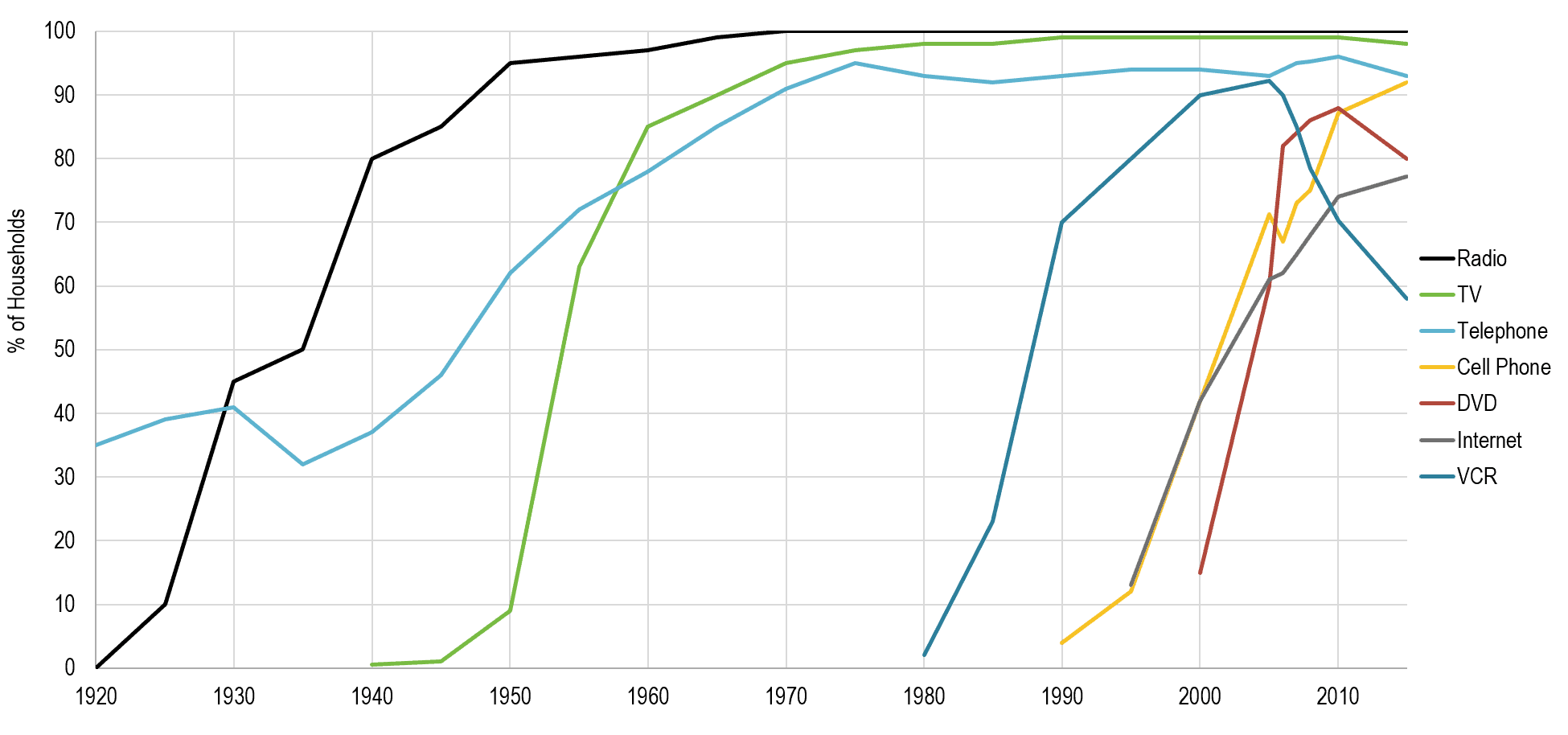
The market is asking if it will last ~25 years.
Essentially I'm just saying the naive approach of Laplace succession implies a type III survivorship curve (i.e. given this market is NO, the switch would be most likely in 2025 and least likely in 2033) whereas it should be a type I survivorship curve (a switch is most likely at the end of the range)
Cal Newport claims that "within the next decade, AR glasses will replace essentially every screen currently in our lives — phones, laptops, tablets, computer monitors, and televisions."
@TimothyJohnson5c16 if the question was “will I own an AR headset” I feel like a YES would be almost guaranteed. Given nine more years I’d be surprised if something Vision Pro-like wasn’t good enough to make me ditch the PC I use for occasional gaming and browsing. But I have trouble believing I’d leave the house to walk the dog with glasses and not a phone. The good end of devices are too bulky and are I am unconvinced they’re going to get significantly lighter.
And the Google Glass lightweight types always seem to just suck.
Close date -9y update: I am still daily driving a smartphone today. If it broke today, I would replace it with something very similar. Right now I think this market is fairly well priced.
There have been a few devices in the past year that have made me consider this question, but they're both fairly long shots.
The first is the AI pin / badge / box form factor like Humane's AI pin and the Rabbit R1. Those are, in my mind, clearly not smartphones, but I struggle to draw a precise delineator between them and a smartphone. So if I ended up daily driving something more like a Humane AI Pin than an iPhone, this would resolve NO. However, I cannot see these devices having much of a future and suspect that AI will be interacted with through smartphone apps for a good while yet.
The other thing that has made me think "maybe NO" is the Apple Vision Pro. This is also clearly not a smartphone but the functionality overlaps a lot. Right now it's too expensive and dorky looking for me to consider. But if it were to become more affordable and Apple were to release a version small enough for more consistent wear and it were to be socially acceptable to wear in public then I can see a world in which I one day considered having something like that and not having a smartphone as well. But the odds of that happening on a timescale of nine years feel low to me right now.
Since this is vague, can you tighten up your definitions? A smart watch technically meets the requirements.
Also, imagine smartphones transition into becoming 'computing nodes' for an AR system, and although they can still double as smartphones, they become mostly used in tandem with smart glasses. How would you categorize that?
@troops_h8r I am deliberately vague on specifics, because I don’t want to accidentally rule out $future_smartphone based on something I don’t today associate with smartphones but isn’t necessarily incompatible.
I do already rule out smartwatches as they’re an existing product category today that are separate and identifiable.
In your circumstance of a compute node that drives smart glasses (or headphones, or a watch), I would resolve YES because the glasses are a companion tech to the phone, which remains a discrete unit of compute.
I”m hesitant to require, as examples, “must have a screen” because what if the smart glasses become the default interface? Or holograms? Or we ditch screens and speak directly to an AI in/through the phone? Ditto for “runs apps” because what if AI replaces apps? In all those cases I still have a phone, IMO.
If I thought it was really contentious then I would be open to running a poll showing my current devices at time of resolution along the lines of “is this a smartphone as would have been understood by a 2023 person?”