Resolves as YES if there is strong evidence that OpenAI discovered the first valid proof of the Riemann Hypothesis before January 1st 2027. Only proofs made public before 2027 are considered, and the public release date determines which proof is deemed the “first.” If at least one candidate proof from OpenAI is made public before the end date but its validity remains uncertain, the end date can be extended until the proof’s validity is resolved. Both proofs that demonstrate the hypothesis or demonstrate that it's undecidable are acceptable in the context of this question. Proofs that the hypothesis is false are also acceptable.
If another entity makes a proof public first and that proof is considered valid, this question automatically resolves as NO. Similarly, if no publicly known OpenAI proof emerges before January 1st 2027, the question resolves as NO.
Examples of what qualifies as a "proof from OpenAI” include, but are not limited to:
Papers published to arXiv (or other preprint servers) with OpenAI researchers listed as authors.
Peer-reviewed journal or conference publications with (strongly) OpenAI-affiliated authors.
White papers or technical reports released on official OpenAI channels (e.g., blogs, GitHub, or websites).
Work using proprietary OpenAI models (not publicly available), where the researchers have privileged access and rely on OpenAI’s own compute resources or those provided through partnerships (e.g., Microsoft). Proofs discovered by running on third-party servers outside such partnerships (e.g., a university cluster) do not qualify under this condition.
A public release of any document or presentation that claims to prove the Riemann Hypothesis—produced (or co-produced) by OpenAI researchers and using OpenAI resources—will be sufficient to trigger a YES resolution if no other valid proof has been released prior to it. If the validity of an OpenAI proof remains uncertain by January 1st 2027, the resolution date may be postponed until its validity is established.
 1,000
People are also trading
@0xseraphim Like I said before, better to park mana in the market about all MPs. Was just waiting for enough NO to pile on here that I could exit without too much loss
@0xseraphim Yeah of course, since this is a subset of that. But that market is currently >33% and the difference between that and the true probability is much higher than here.
I freely admit I got wrong the question of whether a MP would be solved in 2026 "by AI". But I worry people outside of math are taking the wrong lesson away from it. At least half my error was to not be up to date on human developments in Navier-Stokes. (PDE was never my field.) Everyone in the field of PDE agrees that AI did something amazing but at the same time it was a "last few bricks in a castle" type thing.
I've researched the remaining 5 problems and my takeaway is there is no castle to add the last few bricks to. Nobody has any idea how to start. You know OpenAI tried all of them really hard for the 8 Sep release, and all they got was extremely narrow cases of BSD and Hodge; nothing towards Y-M or P vs NP; and a small advancement towards RH which was a combination of already-existing human ideas.
@0xseraphim If AI does it, I'm almost certain it will be by combining existing ideas, because in every example I've been able to verify for myself so far, and all examples which I heard about from professional mathematicians, that's what it was doing. I'm not saying this out of some disdain for AI; it's just what you should expect from knowing how current AI works.
So, I believe current AI can only solve one the remaining MPs if a solution exists which "just" combines existing ideas. Moreover, even if it does, there is the question of how long it is; and the fact that none appeared in the 6 Oct drop means that, even if such a solution does exist, it must be very long indeed.
@pietrokc how would you qualify the famous proofs of Fermat's last theorem and the Poincaré conjecture in that framing?
@AleisterCrowley I don't enough algebraic number theory to credibly comment on Wiles's proof of FLT. From reading popularizations, it seems to revolve around a connection between two kinds of objects ("elliptic curves" and "modular forms") which appear quite different at first. I find it easy to believe that the idea to relate these two things, whoever it is due to, was fundamentally new.
As for Poincaré, I believe the program proposed by Hamilton -- define a metric on the manifold that evolves via a heat diffusion type PDE and follow it to the end -- was based on a fundamentally new idea. Perelman was the one to finish this program, and I don't know enough about his proof to say whether other fundamentally new ideas were needed.
I don't know whether Hamilton was the first one to introduce this idea; chatbots suggest there were precursors in some form. But there is, I believe, an irreducible kernel of novelty somewhere, which I can explain with the following analogy. Imagine you spent years studying euclidean geometry. You become master of points, lines, and circles, you know all the theorems and proof techniques in The Elements. Well, the thing is that all the figures and ideas in Euclid are static. The circles and lines are fixed in place. Then one day someone solves a major open question in euclidean geometry by making the circles and lines move according to some equation. That's kind of (very roughly) what happened with Poincaré.
Of course, to us, the idea that geometric objects can move and evolve is very obvious. We get the very idea of geometry from the real world, and stuff in the real world moves constantly. But if, in a supreme exercise of empathy and "putting yourself in someone else's shoes", you imagine you are a machine, and you have no notion of the real world, or space, or time, and you are simply RLed on a billion facts about static lines and circles -- I don't think you would ever conceive of moving them around.
@pietrokc then how do you interpret move 37 (from alphago)? Where did it come from? What is your thinking on what something similar would look like in mathematics?
@pietrokc because alphago didn't know anything about physics or military strategy or whatever else human players derive their intuition from. And yet it figured out unique styles of play that people then spent years studying and imitating


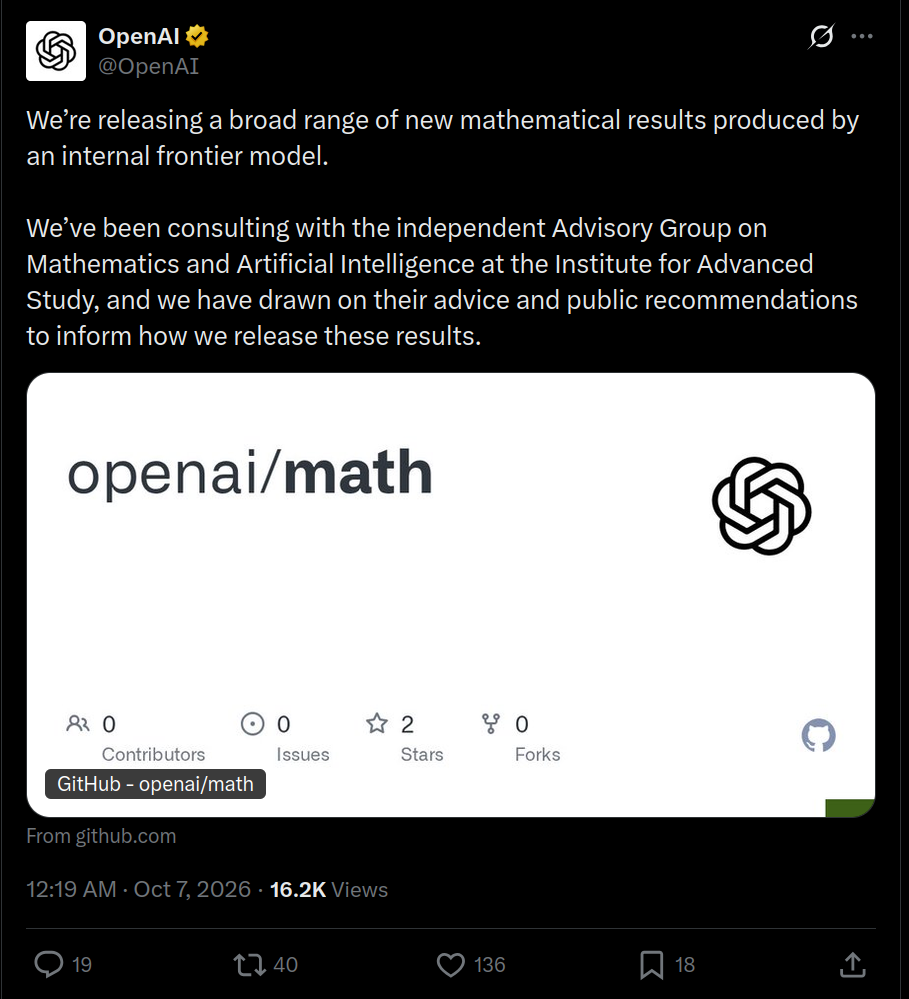
There's a quasi-riemann hypothesis 😂
math/preprints/The-Quasi-Riemann-Hypothesis-October-5-2026/paper2.pdf at adc7f1241b42e322a6451854ab7e4b4c146bf78a · openai/math
@0xseraphim That seems like a real advance (unlike the 67% result from earlier this year) but still quite far from full RH.