Creator note: Feel free to add options, resolves according to OFFICIAL Spanish sources, each option resolves independently whenever is announced or ruled out.
Resolution criteria:
Each option will resolve as follows:
"It's declared a cyber attack": Resolves "Yes" if Spanish authorities officially declare that the power outage was caused by a cyber attack.
"Cyber attack & Russia-funded": Resolves "Yes" if the cyber attack is officially attributed to a group funded by Russia.
"Cyber attack & USA-funded": Resolves "Yes" if the cyber attack is officially attributed to a group funded by the USA.
"Cyber attack & independent group": Resolves "Yes" if the cyber attack is officially attributed to an independent group with no state funding.
"Intern plugged wrong cable": Resolves "Yes" if the outage is officially attributed to human error, such as an intern misconnecting cables.
"Never found root cause": Resolves "Yes" if, after a reasonable period (e.g., six months), no official cause for the outage is determined.
"Bad weather": Resolves "Yes" if the outage is officially attributed to adverse weather conditions.
"Accidental infrastructure damage (fallen tower, wildlife, etc)": Resolves "Yes" if the outage is officially attributed to unintentional physical damage to infrastructure, such as a fallen tower or wildlife interference.
"Intended infrastructure damage (cable cut, bomb, etc)": Resolves "Yes" if the outage is officially attributed to deliberate physical damage to infrastructure, such as sabotage.
If multiple causes are officially identified, each relevant option will resolve "Yes." If none of the listed causes are officially identified, all options will resolve "No."
Background:
On April 28, 2025, Spain and Portugal experienced a massive power outage that disrupted essential services across the Iberian Peninsula. Spanish Prime Minister Pedro Sánchez reported a sudden loss of 15 gigawatts—about 60% of Spain's demand—in just five seconds. By April 29, 2025, power was nearly fully restored, but the exact cause remained unidentified. Authorities ruled out cyberattacks and meteorological causes, and investigations are ongoing. (apnews.com)
Considerations:
Given the unprecedented nature of the outage and the ongoing investigations, traders should monitor official statements from Spanish authorities for updates on the cause. Historical incidents, such as the 2024 cyberattack on Orange Spain due to weak passwords, highlight the potential for cyber vulnerabilities in critical infrastructure. (theregister.com)
Spain and Portugal Investigate Massive Power Outage:
Spain, Portugal hunt for cause of power outage as electricity returns
Spain and Portugal's power is almost fully restored, but the huge blackout's cause remains a mystery
Update 2025-11-15 (PST) (AI summary of creator comment): If no root cause is officially communicated by the market close date (December 31, 2025), the market will resolve:
"Never found root cause": YES
All other options: NO
The creator will not extend the closing date in this scenario.
Update 2026-01-27 (PST) (AI summary of creator comment): The creator has identified an official Spanish government source (Moncloa website) that provides details about the power outage cause. Based on this official information, the outage was caused by:
Insufficient dynamic voltage control capacity
Oscillations that conditioned the system
Successive disconnections leading to escalating voltage
As a result, only the "cascading failure" option would resolve to YES. The creator is allowing a couple weeks for trader discussion before final resolution.
Update 2026-02-04 (PST) (AI summary of creator comment): The creator has clarified resolution for specific options based on the official Spanish government source:
"Renewables made the grid less stable": Will resolve NO (not part of official resolution; government and Red Eléctrica stated the problem was not related to renewables)
"Low or insufficient inertia": Will resolve YES (creator is willing to accept this despite it being poorly defined)
Important: Only official Spanish government sources are valid for resolution. Sources like Endesa are not accepted as they are not government entities and may be biased.
 1,000
1,000People are also trading
Participants in this market might be interested to know the final report came out:
https://www.entsoe.eu/publications/blackout/28-april-2025-iberian-blackout/#Publications_&_Documents
see especially p332 (root cause tree and descriptions) and the summary p. 451
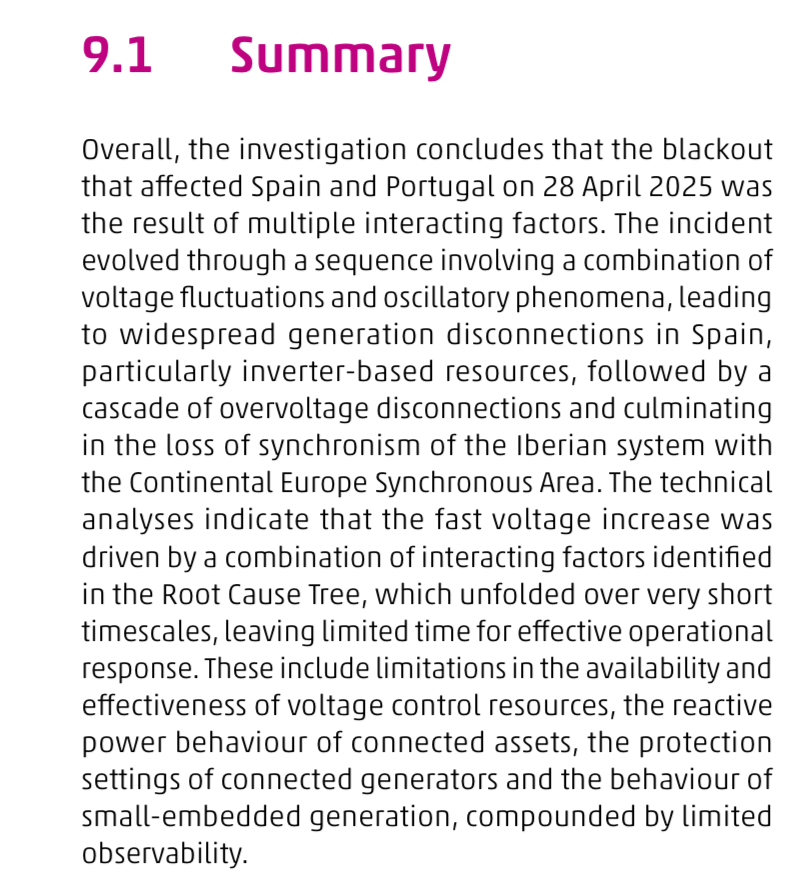
As far as I understand none of the options in the question would probably be labeled as ultimate causes (which seems to be voltage control and oscillatory phenomena) even if some of them might have been labeled proximate causes.
I’m not sure whether renewables would be fair to blame inherently as contributors since the regulations themselves on them probably seems to have contributed per:
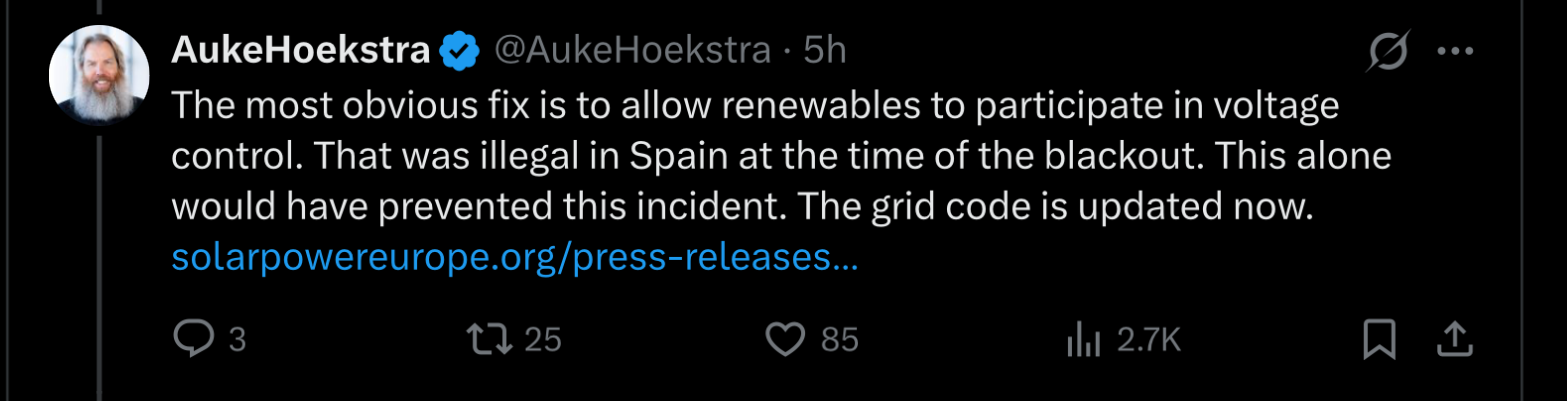
Hi @Choms
If by Dec 31st we don't have a root cause communicated:
Will you extend the closing date? Or resolve "Never found root cause" as YES?
@MiguelLM the second one (never found root cause to Yes and all the others to No) but honestly I totally forgot about this, idk if they communicated anything or it's still the same, if anyone can find any source to any official resolution (in Spanish is fine) I'm happy to resolve early
@Choms
The most serious investigation is the one by the European Network of Transmission System Operators for Electricity (ENTSO-E).
There were other public statements, but by entities with interests to present a partial version of the truth, given the reputational, economic and legal implications at stake.
The Factual Report was published October 3rd 2025 (Summary and Full Report).
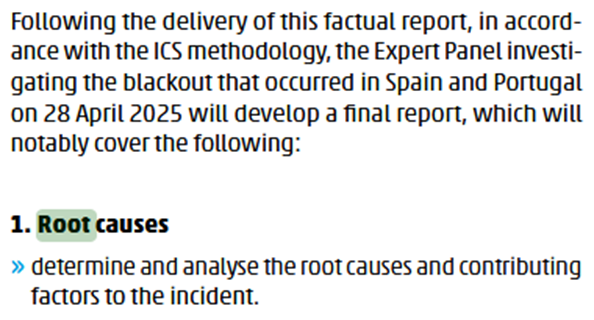
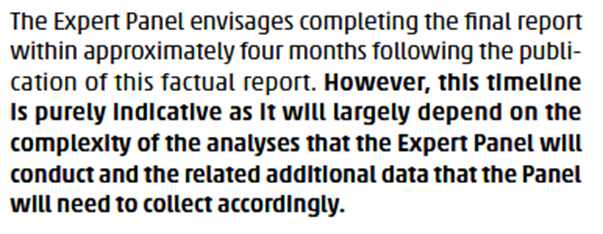
There are also investigations at Spain’s National Court and potentially legal proceedings claiming compensations. These will take years.
@MiguelLM yea I'm inclined to say if by December they are still investigating I'll resolve to that option, that's what I wrote originally:
"Never found root cause": Resolves "Yes" if, after a reasonable period (e.g., six months), no official cause for the outage is determined.
@Choms as previously communicated, the final report with root cause analysis is still expected for 2026 Q2
I checked https://www.entsoe.eu/ site today, (2nd January), and nothing new was published recently.
Based on your criteria, "Never found" should resolve YES and all others NO.
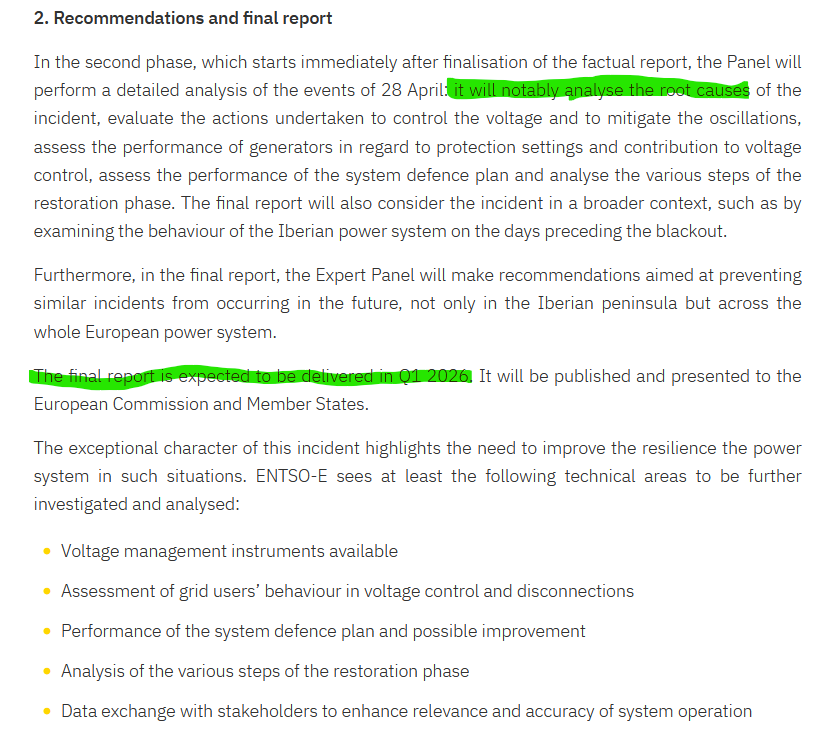
@MiguelLM I'm willing to take the publication on the Moncloa website (Spanish gov) https://www.lamoncloa.gob.es/consejodeministros/resumenes/paginas/2025/170625-rueda-de-prensa-ministros.aspx as it is an official source and aligns with your screenshot, it seems the final report is waiting on the specific details but still mentions the cause being:
- Insufficient dynamic voltage control capacity (either not programmed enough or the programmed units did not provide what the standard requires).
- Oscillations that conditioned the system: the operator’s prescribed measures were applied but these in turn led to higher tensions.
- Successive disconnections, some apparently improper, which escalated the voltage until reaching a point of no return.
As such only "cascading failure" would resolve to YES, but I'll leave @traders a couple weeks to discuss.

@Choms I'm uncertain about this but I would expect "Renewables made the grid less stable" and "Low or insufficient inertia" to also resolve true as as far as I can tell the reliance on a handful of thermal power plants for dynamic voltage control is because most of the generation is renewable, and that if there was less renewables on the grid, there would have been more thermal power generation, less/no need for dynamic voltage control, a smaller voltage spike, and less/no blackout. https://www.endesa.com/en/the-e-face/electrical-grid/voltage-control-grid-blackout aligns with this interpretation although also points out regulatory aspects preventing solar plants from contributing to voltage control so it doesn't seem as simple as "renewables bad".
@fwbt well, Endesa is not a valid source, asides of being clearly biased, is not Spanish government which was a requirement on this market
Both red electrica and the government said the problem was not related to renewables, multiple experts mentioned renewables actually made it more stable, but mainly, it is not part of the official resolution I linked above, in the resolution it says the out-of-comission center that exacerbated the control issues was thermal
I am, however, willing to accept insufficient inertia as a YES, given it's poorly defined
@Berg the report explicitly says on page 14 this was not a cause, download it here: https://www.ree.es/en/operation
@LudwigBald I agree inertia will be probably ruled out.
The recent Factual Report by ENTSO-E presents the inertia data in pages 35 to 39. They will present the root cause analysis in the next report in 2026, but the Inertia charts don't show any meaningful difference on the 28th April compared to the rest of the year.
https://eepublicdownloads.blob.core.windows.net/public-cdn-container/clean-documents/Publications/2025/entso-e_incident_report_ES-PT_April_2025_06.pdf
It's a working document, not a final resolution, but people may want to re-think their positions:
https://www.entsoe.eu/publications/blackout/9-may-2025-iberian-blackout/
More information https://archive.is/20250501081420/https://www.elmundo.es/economia/empresas/2025/04/30/6811ff00e9cf4a757b8b457e.html (Spanish).
It looks like the grid was unstable for at least a week prior to the incident and on April 22, it was on the verge of it.
@Choms It's not so crazy, that's some of the narrative in Spain and Portugal as well. The former president of electricity operator Red Eléctrica said "a sudden excess of renewable generation in the system could lead to strong voltage fluctuations in the grid, resulting in the loss of generation", and some experts in the topic sort of agree with this.
@TenShino "could" and "did" are different words :)
@vitamind I live here, I know how the grid is set up, we don't have 60% of generation in one place and nobody reported a spike, only a sudden loss of power (multi point within 5 seconds), also weather was perfect for both solar and wind generation in practically the whole peninsula (see pictures of ppl at terraces)
@Choms but renewables - particularly offshore - require pretty substantial modifications and upgrades to infrastructure. If that was not done properly, it is a reasonable cause of the black out.
@Choms True enough, but I wasn't claiming that was the reason, my point was just that it's not as crazy of a hypothesis as you may have thought since even the former president and other experts are entertaining the idea.
@TenShino it is not a crazy hipothesis but given the specific circumstances not one particularly likely, what I noticed though (and reason for my comment) is the overblown coverage to that particular hipothesis basically selling the "renewables bad" idea, like if countries in Europe (e.g. Austria) haven't been using 100% renewables for years without issues, and, as said, all the network here in EU is interconnected and they all undergo a lot of regulations and requirements, while there is ofc corruption and overspending, safety, and more in new installations, is generally enforced correctly
@Choms seems like a motte-and-bailey here. You state, "it's crazy that narrative in the US about blaming renewables but honestly at this point is fairly normal, not like I expect common sense anymore", and then go on to cede, "it is not a crazy hipothesis but given the specific circumstances not one particularly likely".
Can you provide some of the reports you seen that, according to you, baselessly suggested that renewables were to blame and thus the conclusion is "renewables bad"?
@vitamind do you realize there is a difference between the narrative and the hypothesis, right? like, the hypothesis may be reasonable, I conceded that, but the spoon-feeding with a clear focus on "renewables bad" by mainly US media (repeated by some others sure) is crazy - and if you need me to be more concise, people buying it specifically is what I would say it's crazy, if it wasn't because... well... the maniac doing maniacal things daily and people all happy about it 🤷♂️
@vitamind just what I said, multiples groups of assholes in different social networks trash talking renewables 😂 and linking at articles about this, honestly even techlinked jumped the gun on it and basically repeats the same bla bla bla than the rest of the media if you want to see their last video (and what the weather service said for sure there was no temperature variations)