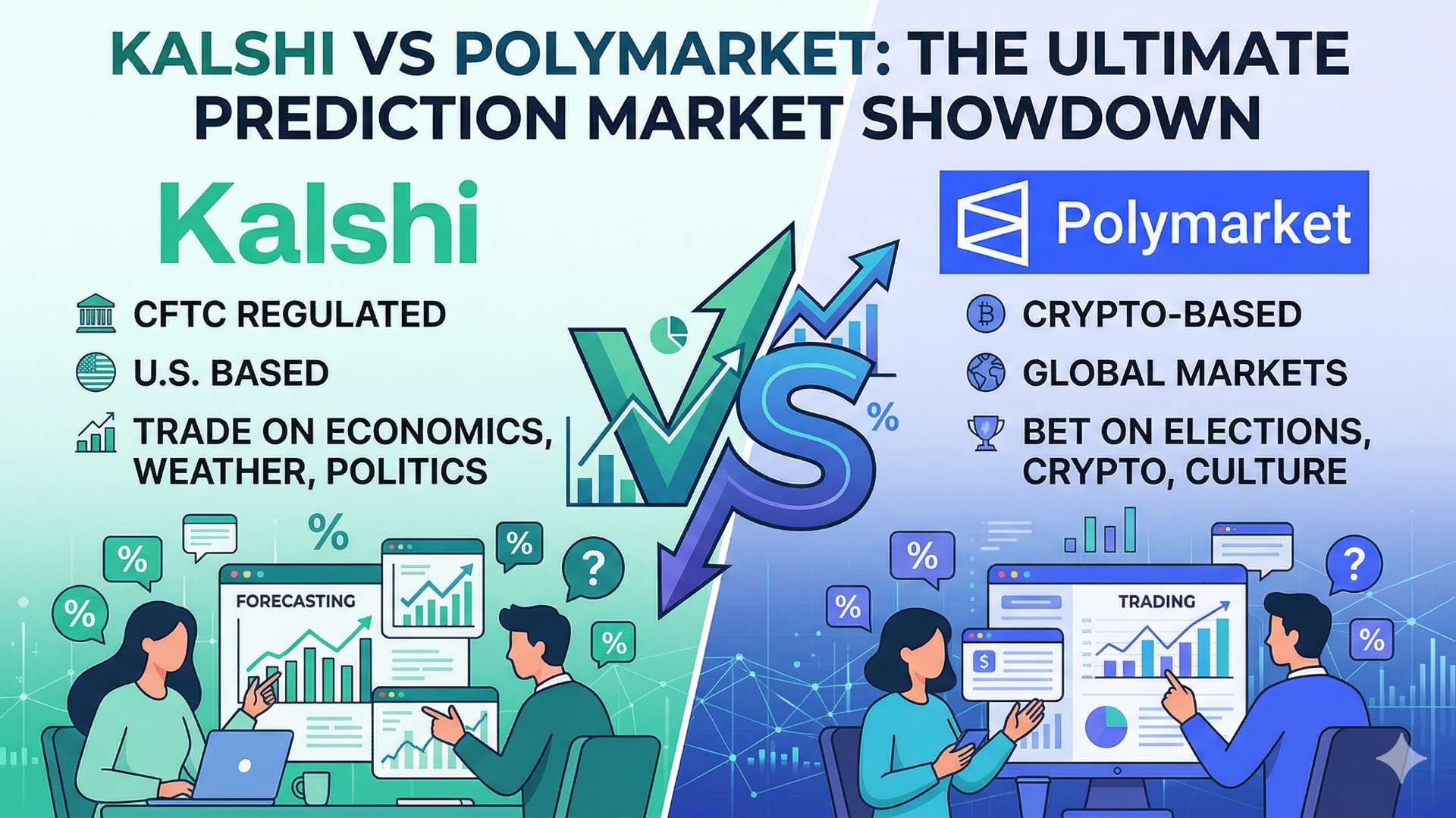
Prediction markets had a breakout year. Mainstream media covered them, traders made fortunes on election calls, and suddenly everyone had an opinion on whether markets beat polls. But as the dust settles, a quieter debate is heating up in trading communities: Kalshi or Polymarket, which platform is actually worth your time?
The answer isn't obvious. They're built on different foundations, attract different users, and make very different bets on what the future of prediction markets looks like. Here's a breakdown.
Polymarket: The Liquidity King
Polymarket is the Wild West of prediction markets - and that's not entirely an insult. Built on Polygon (a layer-2 Ethereum blockchain), it's decentralized, permissionless, and open to traders globally. At its peak during the 2024 U.S. election cycle, it was processing hundreds of millions of dollars in volume on a single market.
The platform's strength is its liquidity. High-profile markets attract serious capital, which means tighter spreads and better pricing. Bots thrive here - the open CLOB (Central Limit Order Book) API makes it straightforward to deploy automated strategies, and market makers compete aggressively to provide liquidity.
But there's a catch. Polymarket operates in a legal gray zone in the United States. U.S. residents are technically blocked from using the platform, and the company settled with the CFTC back in 2022 for $1.4 million over unregistered binary options. For traders who care about regulatory clarity - or who simply can't use a VPN - that's a hard stop.
Kalshi: The Regulated Contender
Kalshi took the harder road. Founded in 2018, it spent years working through CFTC approval before launching as the first federally regulated prediction market exchange in the U.S. in 2021. That regulatory status is its entire value proposition.
For U.S. traders, Kalshi is the only major platform where you can legally trade event contracts - on interest rate decisions, economic indicators, weather events, and more - without worrying about compliance. Institutional participation is growing because of this. Hedge funds and serious retail traders increasingly see Kalshi as a legitimate financial instrument, not a novelty.
The tradeoff is scope and liquidity. Kalshi's market selection is narrower, and volumes - while growing — don't yet match Polymarket's on equivalent events. Spreads tend to be wider, which matters if you're running tight arbitrage strategies or deploying bots at scale.
Still, Kalshi is building fast. Its 2024 legal victory against the CFTC - when a court sided with Kalshi's right to offer election markets - was a landmark moment that could reshape what's possible on regulated platforms.
The Real Question Nobody's Asking
Most comparisons stop at fees, markets, and liquidity. But the more interesting question is: what are you actually optimizing for?
If you're a developer building a prediction market bot, Polymarket's open infrastructure, deep liquidity, and active bot ecosystem make it the obvious starting point. The tooling is better, the community is larger, and the data is richer.
If you're a U.S.-based trader who wants to use prediction markets as a genuine financial hedging tool - say, to offset business risk tied to Fed rate decisions - Kalshi is the only legal path. Regulatory clarity isn't just a compliance checkbox; it's what allows institutional money to enter, which ultimately improves market quality for everyone.
And if you're watching from the outside, the Kalshi vs. Polymarket dynamic is really a proxy for a bigger debate: does the future of prediction markets belong to open, decentralized infrastructure or regulated, institutionally-backed exchanges?
Where Do You Stand?
Both platforms are making real arguments with real traction. Polymarket proved that prediction markets can move serious capital and outperform traditional forecasting. Kalshi proved that regulatory legitimacy is achievable - and potentially more durable.
The question worth sitting with: as prediction markets mature and more capital flows in, which model wins? Does decentralization and openness attract enough trust, or does regulation become the only viable path to mainstream adoption?
Drop your take below - and if you're just getting into prediction markets, marvn.ai has deep-dives on both platforms and the bot strategies being run on each.