I have posted this problem elsewhere, but I don't think anyone has seriously tried it yet.
Resolves YES if there is a solution posted in the comments to this market that I can understand and I am satisfied with being correct by market close time (one week from market creation time).
For reference, it took me about 3-4 hours of partially-focused time to solve it.
Here's the problem:
Let $S=\{1,2,\dots,n\}$ and let $B$ be a family of subsets of $S$. Let $A$ be the family of subsets of $S$ that are a (not necessarily proper) superset of some set in $B$. Suppose that $|B|\le 100n$. You are told $n$ but not $A$ or $B$.
In a \textit{query}, you may ask about one subset of $S$, and you will be told whether it belongs in $A$.
Does there exist a strategy that takes a subexponential number of queries and finds a set in $B$ with minimum size?
Since there is some amount of subjective judgment on my side for this market, I will not bet.
There will be no AI clarifications added to this market's description.
 1,000
1,000🏅 Top traders
| # | Trader | Total profit |
|---|---|---|
| 1 | Ṁ4,956 | |
| 2 | Ṁ1,685 | |
| 3 | Ṁ1,530 | |
| 4 | Ṁ196 | |
| 5 | Ṁ166 |
People are also trading
Congrats @NateWatson! I will post my original solution in the side market https://manifold.markets/Incompleteusern/will-jats-claimed-solution-to-their.
Ok, here's a better writeup of @NateWatson's solution. If nobody has any complaints before I wake up tomorrow, I will resolve the market to YES.
https://latex.artofproblemsolving.com/miscpdf/lxfmitem.pdf?t=1769998851574
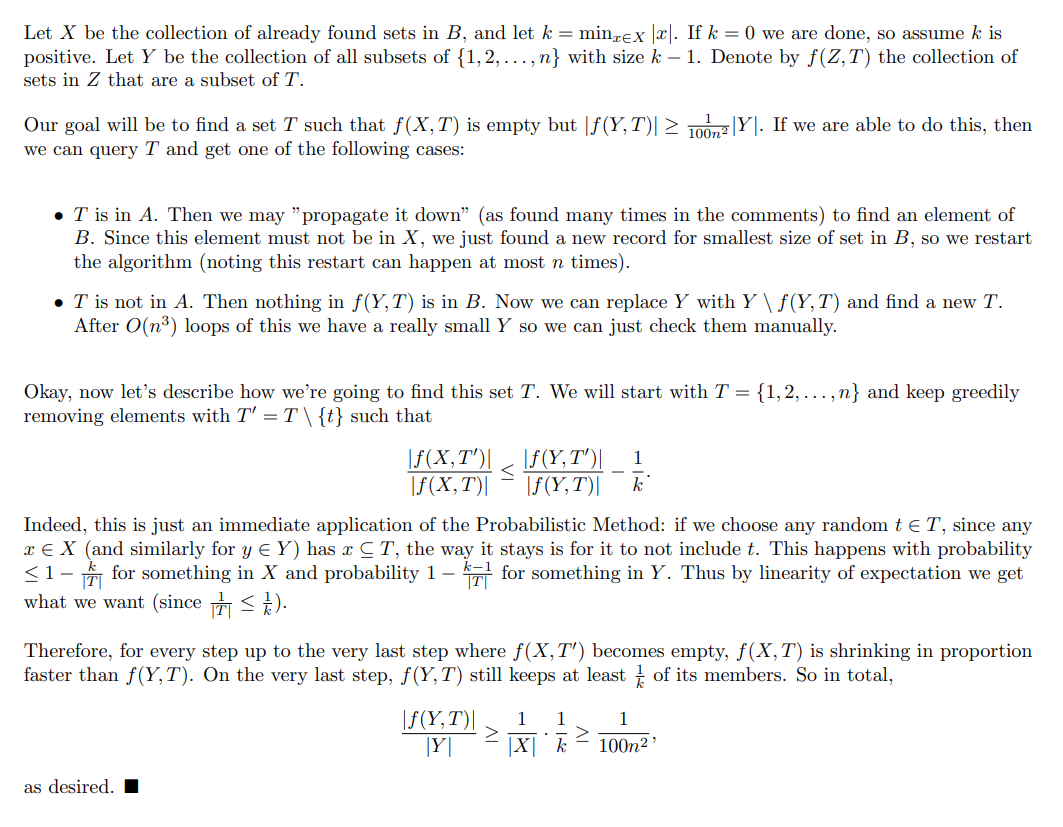
@phenomist I think you can get it as follows:
Y has at most 2^n elements solely by the virtue of there being that many elements possible.
Each step multiplies the number of elements remaining from consideration by (1 - 1/100n^2).
For large n, we have that (1 - 1/100n^2)^(100n^2) is about 1/e, so after at most 200n^3 applications we've divided by e^(2n) > 2^n.
@jatloe “T is in A…” it doesn’t follow the new set is smaller, just that it is in B minus X. The bound on the size of B is what provides the bound which is 100n loops.
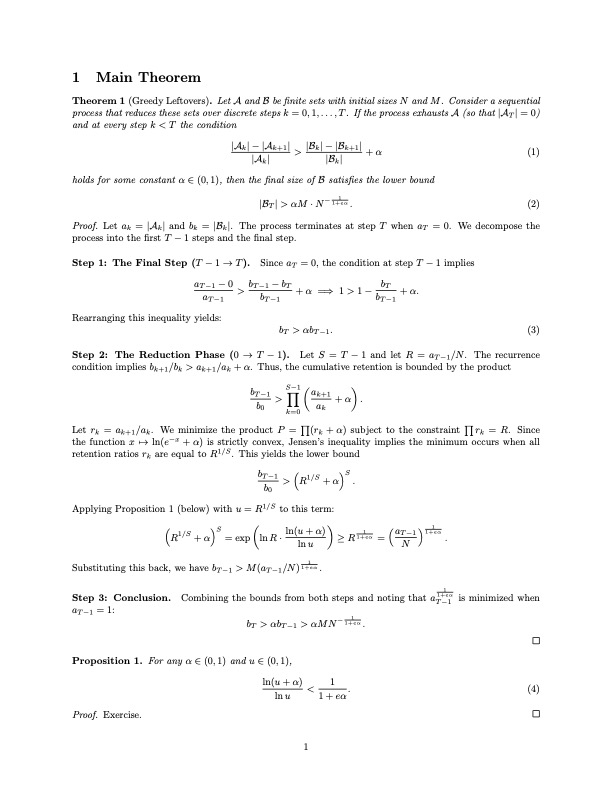
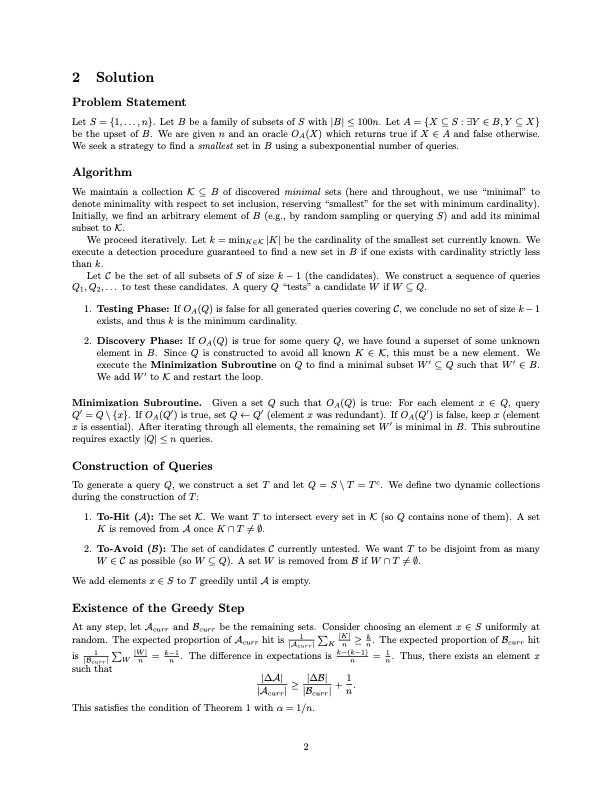
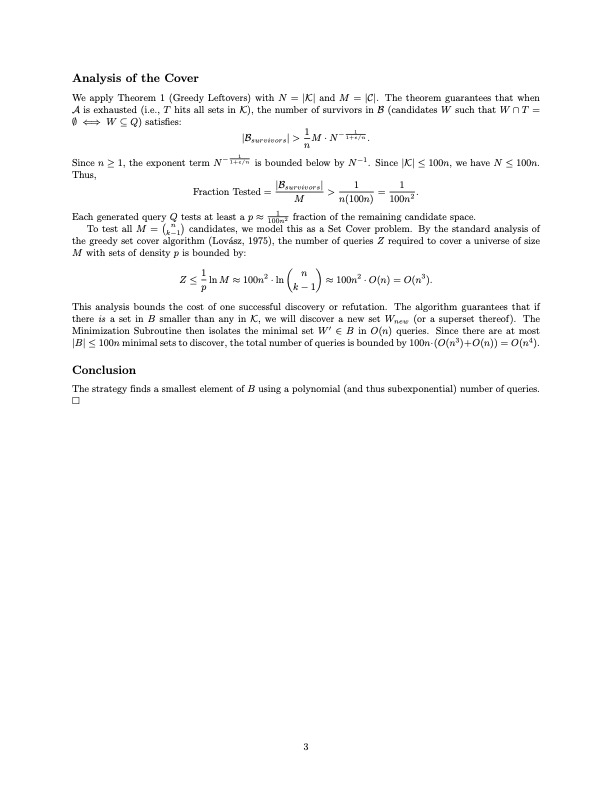
Can you (not an AI) describe how this "Lovasz analysis" works?
@DottedCalculator if you knock off a fixed proportion p each turn in a greedy algorithm, you get down to the point where there's only one left in log time for fixed p, then you can kill the last one in one more step
@NateWatson On page 3, you bounded N^(-1/(1+e/n)) below by N^-1. However, this means that on page 1, the actual bound you needed from proposition 1 was ln(u+alpha)/ln(u) < 1. Unrolling further, when you applied proposition 1, you used it to show (R^(1/S)+alpha)^S >= R^(1/(1+e alpha)). Since the bound you actually needed was just >= R, this implies alpha was useless, which of course makes no sense since the point is that A is being shrunk down faster than B is on the bottom of page 2. How are you using alpha nontrivially?
@jatloe alpha gets used twice in (2), your argument seems to be that one of these alphas is useless, but the other one could still be useful.
@harfe this seems to be the case. I will sanity check for a bit longer then provide a (much) better writeup of this solution and open it up to the NO holders to check
@harfe yeah I think the last step is really where the action is. It would be enough that I don’t decimate the to-miss set more than the to-hit set until the last step. Then we have to take a hit and chop it by a whole alpha to kill the last element.
@NateWatson Could you explain more how you select the next x in S to add to T? I am guessing you do not track $\mathcal C$ explicitly, as that would be exponential. But it somehow depends on $\mathcal C$ or previous Q's, otherwise you would just generate the same Q again and again.
@NateWatson Yes, but HOW does it use the "to avoid" collection, without tracking the "to avoid" collection explicitly (which would be exponential)? (If the answer is simple enough, maybe you can provide pseudo code for that part).
@harfe you are allowed to track the "to avoid" collection explicitly since the problem only asks for subexponential queries, not subexponential time complexity.
@jatloe Thanks, that was what I missed! (I should have read the market description more carefully). Buying YES now.