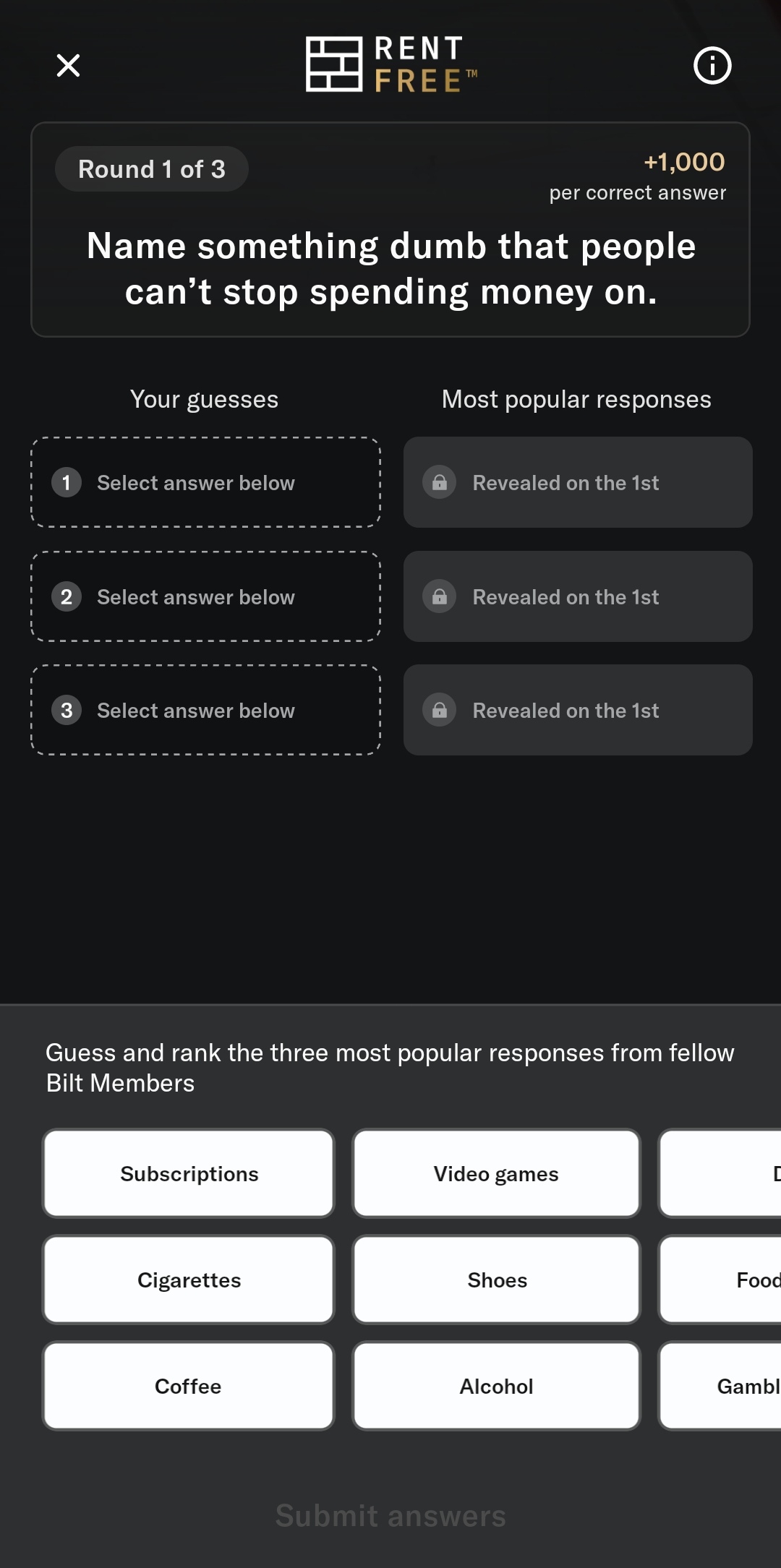
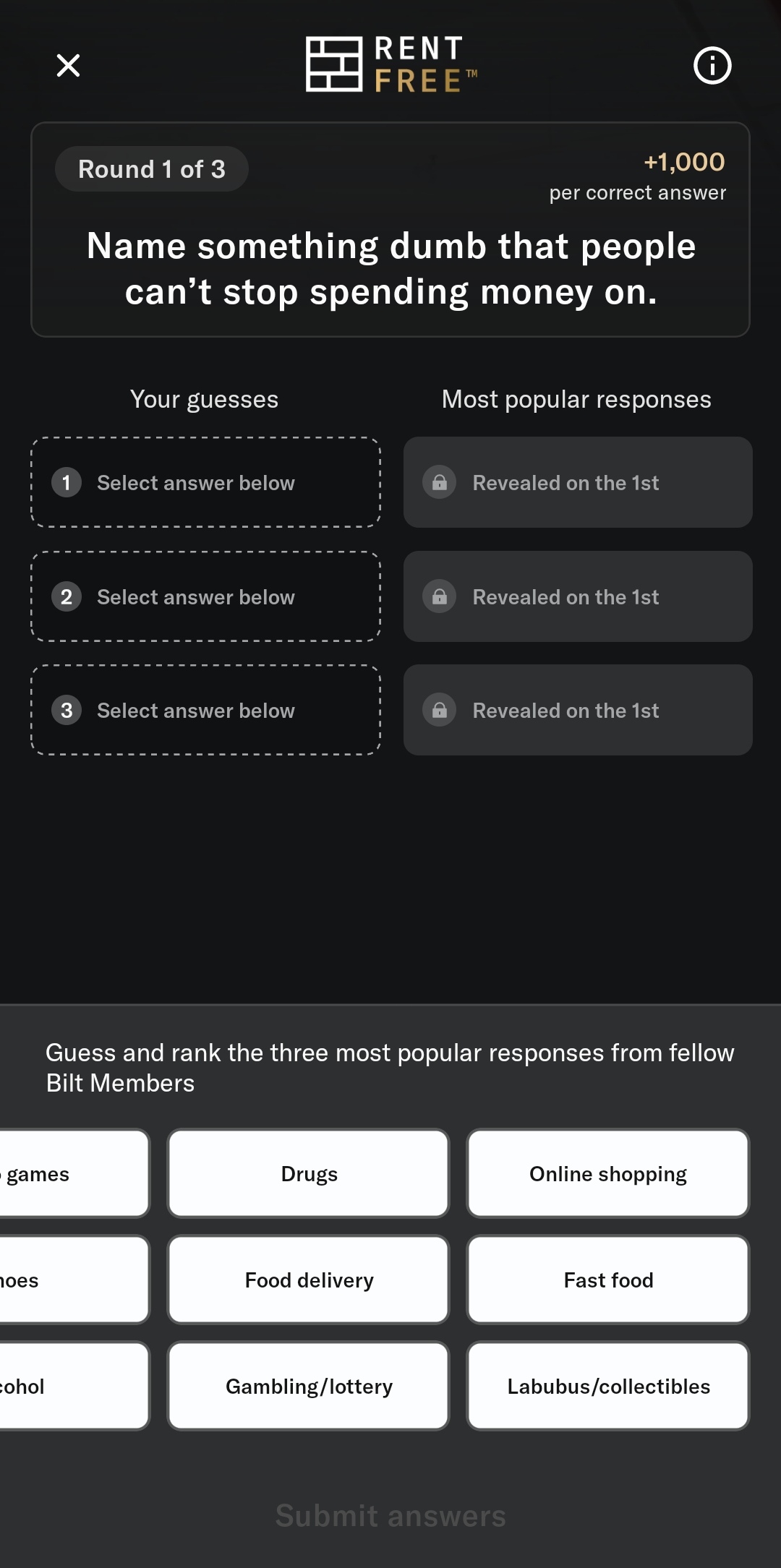
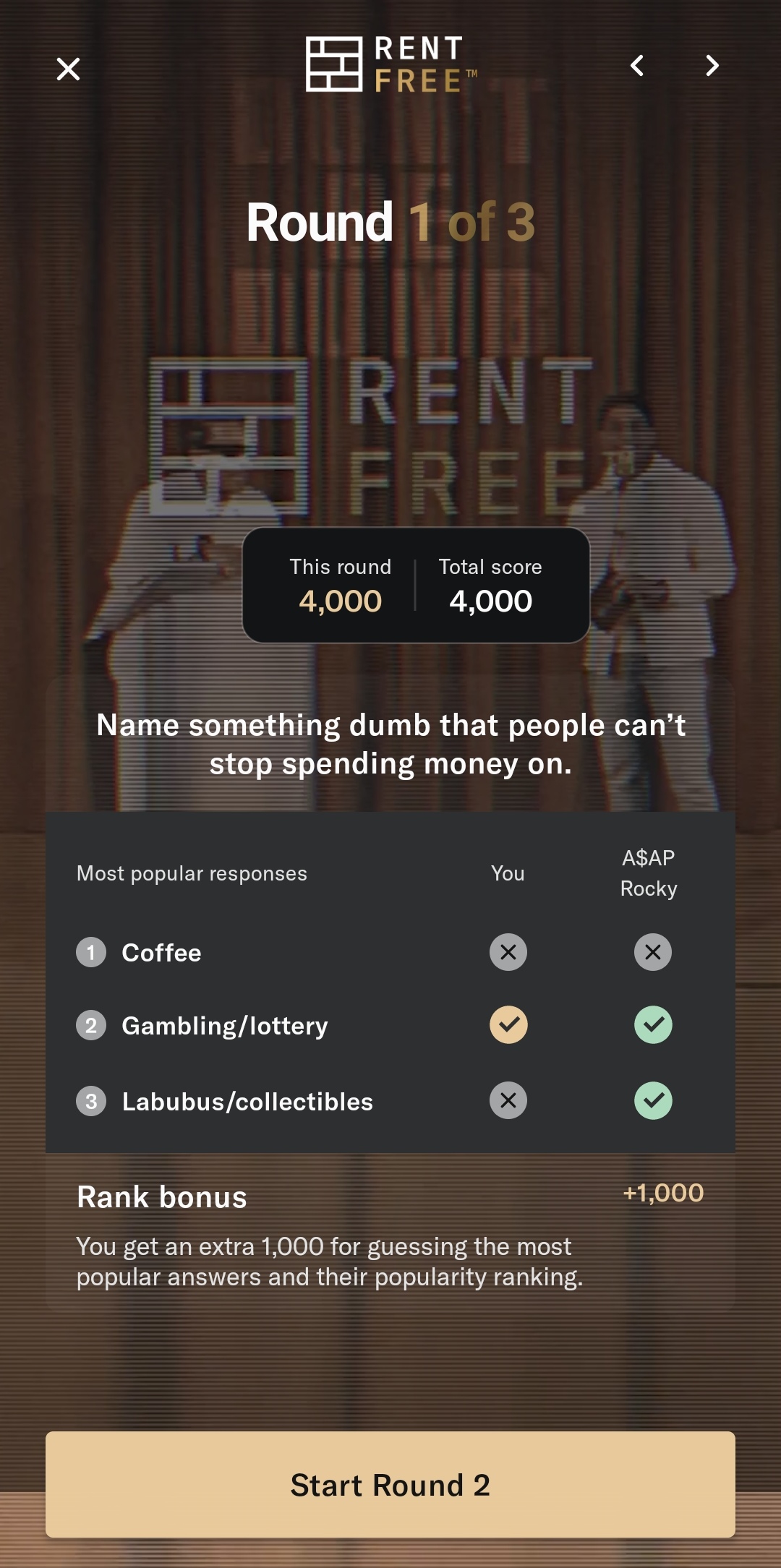
Name something dumb that people can't stop spending money on. (Bilt Rent Free Jan 1, 2026 Q1)
5
1.2kṀ461
Jan 1
59%
Gambling/lottery
36%
Subscriptions
27%
Fast food
27%
Online shopping
23%
Video games
19%
Cigarettes
19%
Shoes
19%
Food delivery
19%
Drugs
19%
Alcohol
19%
Coffee
14%
Labubus/collectibles

Bilt is a credit card company that has a monthly game show where they survey their users for their answers to various questions. Top scorers in the actual game get their next month's rent covered by Bilt.

The top 3 answers reported on the actual game (not this prediction market) will resolve YES 100%, regardless of their order. The rest resolve NO.

The results post at 4pm EST, Jan 1, 2026. I was one of the surveyed users this month. However, I do not know the correct answers, so I can trade on this market.

This is my referral link if you wish to sign up / apply and play the game yourself:

https://bilt.page/r/0ZY5-58A2

Referral code 0ZY5-58A2

Click here for a dashboard to other Jan 1, 2026 Bilt Rent Free markets.

There will be no AI clarifications added to this market's description.

Get
Ṁ1,000
to start trading!
Sort by:

For the record, this is what the survey looks like. They are write-ins, and they don't use all of the questions they ask.

sold Ṁ18 NO

You know what? I'll let you all adjust the probabilities first. Wow, you guys respond fast.

bought Ṁ10 NO

@Quroe ahahahahah, I followed you and got the notification

@prismatic @JeromeHPowell Remember, 25% of all answers here will resolve YES. Assume 25% is the base rate across the board.
I'll add a subsidy after all probabilities look like they add to about 300% across the board.

bought Ṁ10 NO

@Quroe no, dont....wait one second, i need to send you a thread

@Quroe trust me on this, if you add this right now you'll be screwed

@Quroe https://manifold.markets/post/manifold-should-do-anything-other-t?r=SmVyb21lSFBvd2VsbA see this

thread

Manifold should do anything other than throwing away excess shares when liquidity is added to Multiple Choice or Set markets
Caveat: You can prove that this breaks something or leads to 'cheating' and we can throw the entire idea away. It might not be perfect, but I argue it is better than the status quo. Background Manifold still uses the maniswap AMM for binary markets, which has a very handy solution to the "excess shares" issue when liquidity is added to an existing pool. Maniswap adjusts the p parameter to allow better use of subsidy mana without throwing away shares. This causes some changes in behavior of the AMM when betting against it, but usually it ends up better than just throwing away a lot of mana. When Multiple Choice markets were introduced in 2023, one concession made in the implementation was fixing p = 0.5 due to Math Reasons. It mostly didn't matter a ton at the time, some reasons being: Manifold was pumping liquidity into markets for every trader, so it was papered over; the actual amounts of mana used were significantly smaller, 100 mana was about what 1000 is today due to mana inflation over time. Later on, Set markets were introduced as "We took the Multiple Choice markets and just turned off the auto-balancing". These also have a fixed p = 0.5. Problem So, what's wrong? On both Multiple Choice and Set markets, significant amounts of liquidity added after market creation are totally lost. Your mana basically just goes "poof". In the case of Set markets, it's really simple. Since p = 0.5 is fixed, if you subsidize a Set market where answers are far from 50%, a significant portion of the amount you subsidize is thrown away as excess shares. You don't get them back. Manifold doesn't get them. They're just vaporized. In the case of Multiple Choice markets, it's a little more complicated, but in most cases you will be vaporizing somewhere between.....5% and "a massive amount" of your mana. Concrete Example Here's a concrete example to help you understand the issue. A market is created with 3 answers A, B, and C, with 1000 mana as the initial subsidy. Traders do some trading and the market ends up with A = 80%, B = 10%, C = 10%, like this: Total Liquidity: 1000 Option A 80.0% Pool Yes shares: 176.8 Pool No shares: 707.1 Option B 10.0% Pool Yes shares: 1060.7 Pool No shares: 117.9 Option C 10.0% Pool Yes shares: 1060.7 Pool No shares: 117.9 Pool Value: 707.11 At this point, some of the initial 1000 mana in the pool has been used up by traders who have moved the market from 33/33/33 to 80/10/10, as represented by the "pool value" of 707 mana. If you found this market and decided you wanted to add more liquidity to it at this point, perhaps you would supply an extra 1000 mana. Pause for a moment and make a guess, what will the pool value be after we apply 1000 mana of subsidy to this market? Here's the market state after the 1000 mana subsidy: Total Liquidity: 2000 Option A 80.0% Pool Yes shares: 294.6 Pool No shares: 1178.3 Option B 10.0% Pool Yes shares: 1531.9 Pool No shares: 170.2 Option C 10.0% Pool Yes shares: 1531.9 Pool No shares: 170.2 Pool Value: 1084.07 Ha, did you think that spending 1000 mana would result in more than 377 mana added to the value of the pool? In this example, 778 Yes shares in Option A (present value of 623 mana) were completely vaporized during the subsidy process. You never get it back and no one else does. (You will just have to take my word for it, the math part would take a long time to explain.) Possible Fixes The main thing I care about is doing absolutely anything other than the status quo. I often see multiple choice markets that would benefit from a lot of subsidy, but in many cases it is so inefficient that users would be crazy to do it. The best fix is to keep track of all excess shares, but choosing a method to do so might rub people the wrong way. This is a play money site, we can just try stuff. I'll present 2 options, someone else might have others...they would both work on both Multiple Choice and Set markets: Option A: just give the subsidizing user the excess shares as a "bet" straightforward implementation need to decide on the "cost basis" of this bet because it will affect profit (a safe one is one mana per share which always results in negative profit but not by too much) can be traded like any other shares Option B: keep track of the excess shares using some other method and pay them out on market resolution they could be a special "bet" that cannot be sold/redeemed and don't count as profit or they could be kept as a pool-adjacent value that just remembers how many excess shares any user owns, to pay back at resolution time Concerns Basically you can make slightly one-sided trades at the expense of funding the AMM. Maybe it is abusable but I can't see exactly how it would ruin things, especially since we cannot withdraw liquidity in the MC markets. Like you could effectively exit out of a position by funding the AMM rather than changing the market price. Would love any feedback!! Where have I messed up?

@JeromeHPowell It's fiiiiine. These markets usually get a few people to sign up to Manifold and trigger referral bonuses to counter any mathematical losses incurred. (People like to Google the answers to Bilt's Rent Free game.)

I like the new trader bonuses for making the market more liquid. I just wish I could set the starting setpoints to 25% and have the liquidity immediately present.

© Manifold Markets, Inc.TermsPrivacy