( This is a sequel to this market: https://manifold.markets/PeterSchmidtNielsen/is-the-final-bit-of-my-48bit-secret )
I have generated 41 secret bit strings, of each length from 24 to 64. This market will resolve YES iff a majority of final bits of the 41 secrets are a 1.
Encoded as ASCII strings of length 24 to 64, consisting of the characters "0" and "1", their SHA256 hashes are:
24-bit: ab84dcb317c58ad7b61dee712c0f85163be702ee877ffcc96cbb2903351ba5fe
25-bit: d6a8061c39de4a25648f5831f538e0d4f2820e046aca4f5c859ebbf121880216
26-bit: 1716c734d292a1f2fdea7e68ae4dffe319d0a6766e5ae00a63ecaf4df6f2977d
27-bit: d7a8d4f8b3a36ed1d9571533a170c2ae9c5ab34250f198ed7204a3405c65aaa3
28-bit: b53ce9689ef2423e7d96bb532c848768f14e6a353f0125717582b7f2ee02f0bf
29-bit: 8832cbea094954cc96697e7dd80379eaded2fe98e68b47008d1fa7f61c2403b7
30-bit: 7b95563f3eb45ce562995e216fdfe11cdeb690cc9077db50e9af7bae180bfd38
31-bit: eb55b39d86ee409448a6fb94aad7d5f84f0926642b3c27c3d365cdaacea2085a
32-bit: 58bc9866bcb2dcc8bb5ea63114e549a98b3f06ed69c7133925d57fa6d4a0b303
33-bit: 7343a509e32cbd145ab779fc77c4315e7d524cba7e7d4f0cd4f814e2685dfdd6
34-bit: a5e33249d33113c9f79dec58ae2c14fcc5bdf1c1c52dfbc840f8ed536c90d292
35-bit: 56517ec665f1618333238754e08e9c7beae6e2bef1a57761fc54665fb1c82df6
36-bit: 6b88becf524d4562dbe513a9b1e6e6dea85ee48098ac06ede989358e56e92ab3
37-bit: a906a914ca939b463ab2dd07c8d426903659c033128300c24a7d885afc2b50c9
38-bit: 0abd6d63cda6479d363a98f3ccb1801550a7d3d0b00335e93bcc00d9ef480a80
39-bit: d2c3bf86e5911d15cfc4294117d82b05d4f1002ef66bb3b9cf4e724a219af14e
40-bit: 40dee4ffcccc011ef09483d3794fe4c44329b0dfbd428c5aefb57b92623e6b43
41-bit: 810b8c5c8d6a32eca3ca38ca5074072cb1cf001a487444e2e64077ea1087f6f8
42-bit: 71d11e28a5f7b6393d76dca3c6e72e768189eb7199978e550d8d0d04a19942e4
43-bit: a4ca59a76d0c669871994151d159f362a01605e496aae638d20cf7a705076bdd
44-bit: c80c972d132eea8588511bd934dcd3a24ad049319ef8f8bec63612c591162828
45-bit: 9b7c1231637eb7330bded336cfd1d7b216fb6bfb98a152f8f6dab001644fc718
46-bit: 98be444ced08d7c62e3d67ed62bb806a4ebe872185c8eecf5f82928f61c5f269
47-bit: 78ee69b04b289a1b1cc13e28c343502e539326c12204392ad8619421b3acb2d9
48-bit: e74de500176dd69bf0ed5ba1d0384f3416719a4aeb25bc25904804677ae21537
49-bit: 604bca9ff8aac66eb4546ccc9a552e2cd16fc83ba2f339294db6d7356ec0d82b
50-bit: b2efce52b4fc0a5bbac046002dd859ce72a370c1e7b912b7d9bcbd10f86d6207
51-bit: e56106aad29dd6b5dd359e412003c735e10ba9bee671ec7a78fefc0f0bff3a30
52-bit: 3b55bffdc11c5b0ffac0238620b8387e4da0ae479248ad3918c6e00055ce7c7c
53-bit: ae274c0a5c813386a44caf600932193465b06e69582d411565b1f1767a49da53
54-bit: a6e3151727022416018e79b76f5e53a4e1bb880ed6d18bb02aea285ec7db1cc8
55-bit: 979dda53319fb638fec017bc749e4660d412f739d0e4fe8b9c59a403a0f9316a
56-bit: f4641a434829ea2c7382018d3ef43a7251bf3b2bd1c7b1bc08f6b6124f9fe91e
57-bit: 9c27fa6c8f083fa15efefa24ef8f6e346167456ccad1dd899465bc4d14e1f6b8
58-bit: 07255620c083425e365e53ec88bea05d9f13a27aed2e06b4b2582098dbf732af
59-bit: 7bc5fcbcccdcdfe0dcdf5b91c9c1ea998acc38d04a70b2fda7d7bda3ed2a31db
60-bit: abd417f5c5ebb5799cf341f0c90846820f6de483c97cb0541cc0e84b36807581
61-bit: 1741939a30a165137b01255766beecb4b2186d6d1c093bbe402b3194656c1d00
62-bit: 835b4fd04c1d7ef124c5509a546f6c347bb187638a839a45bca237d1be41681f
63-bit: c628c7de7d17bc02716ef144d1a7207ef59f4d2dc30021ce2622bbb5f20c7d4a
64-bit: eaae27063c0a2f063fa4b2ad6472b127d488192681a0856e7cfd7499705a4b9e
To be very explicit about the encoding, I mean that e.g. the 24-bit secret got encoded as a length 24 ASCII string containing only the characters "0" and "1", and then when hashed gave the above value.
Every day around 10 AM PDT I will reveal one more bit of each secret.
EDIT, now that it's over: For example, the final state on the 20th was that I revealed the first 20 bits of each secret:
24-bit: "00110000101011110110xxxx"
25-bit: "00011100011100000101xxxxx"
26-bit: "10000110011010100011xxxxxx"
27-bit: "10100000000010011001xxxxxxx"
28-bit: "00101001001110001010xxxxxxxx"
29-bit: "11001011000101100010xxxxxxxxx"
30-bit: "10011111101011000111xxxxxxxxxx"
31-bit: "00001110100001110101xxxxxxxxxxx"
32-bit: "10100001000000000111xxxxxxxxxxxx"
33-bit: "11000111010110111110xxxxxxxxxxxxx"
34-bit: "11000111001000100000xxxxxxxxxxxxxx"
35-bit: "11111101001110111011xxxxxxxxxxxxxxx"
36-bit: "11000100111010011110xxxxxxxxxxxxxxxx"
37-bit: "01000100001100100111xxxxxxxxxxxxxxxxx"
38-bit: "11110101001011101010xxxxxxxxxxxxxxxxxx"
39-bit: "10011000001100110101xxxxxxxxxxxxxxxxxxx"
40-bit: "10111101111010101001xxxxxxxxxxxxxxxxxxxx"
41-bit: "11000110100110101010xxxxxxxxxxxxxxxxxxxxx"
42-bit: "01000001001011111101xxxxxxxxxxxxxxxxxxxxxx"
43-bit: "00100001011101100000xxxxxxxxxxxxxxxxxxxxxxx"
44-bit: "01010001000011000100xxxxxxxxxxxxxxxxxxxxxxxx"
45-bit: "10001101010001001110xxxxxxxxxxxxxxxxxxxxxxxxx"
46-bit: "11001100100110100010xxxxxxxxxxxxxxxxxxxxxxxxxx"
47-bit: "00001111011011010101xxxxxxxxxxxxxxxxxxxxxxxxxxx"
48-bit: "00110011100110010101xxxxxxxxxxxxxxxxxxxxxxxxxxxx"
49-bit: "01100101011100000001xxxxxxxxxxxxxxxxxxxxxxxxxxxxx"
50-bit: "01010000111100100101xxxxxxxxxxxxxxxxxxxxxxxxxxxxxx"
51-bit: "11010110010010101010xxxxxxxxxxxxxxxxxxxxxxxxxxxxxxx"
52-bit: "10101101111100011010xxxxxxxxxxxxxxxxxxxxxxxxxxxxxxxx"
53-bit: "10000010100101111110xxxxxxxxxxxxxxxxxxxxxxxxxxxxxxxxx"
54-bit: "01011101011110001010xxxxxxxxxxxxxxxxxxxxxxxxxxxxxxxxxx"
55-bit: "11101001010010100000xxxxxxxxxxxxxxxxxxxxxxxxxxxxxxxxxxx"
56-bit: "00000000100111110111xxxxxxxxxxxxxxxxxxxxxxxxxxxxxxxxxxxx"
57-bit: "10001100110110010001xxxxxxxxxxxxxxxxxxxxxxxxxxxxxxxxxxxxx"
58-bit: "01101100011110111111xxxxxxxxxxxxxxxxxxxxxxxxxxxxxxxxxxxxxx"
59-bit: "00110110100011110111xxxxxxxxxxxxxxxxxxxxxxxxxxxxxxxxxxxxxxx"
60-bit: "01101011110010111100xxxxxxxxxxxxxxxxxxxxxxxxxxxxxxxxxxxxxxxx"
61-bit: "10011011110101011011xxxxxxxxxxxxxxxxxxxxxxxxxxxxxxxxxxxxxxxxx"
62-bit: "10011011100101000110xxxxxxxxxxxxxxxxxxxxxxxxxxxxxxxxxxxxxxxxxx"
63-bit: "01000111100110110001xxxxxxxxxxxxxxxxxxxxxxxxxxxxxxxxxxxxxxxxxxx"
64-bit: "00110001101110101001xxxxxxxxxxxxxxxxxxxxxxxxxxxxxxxxxxxxxxxxxxxx"
This gist by @retr0id indeed contains all the correct answers (as you can verify yourself), so I'm now resolving the market as YES: https://gist.github.com/DavidBuchanan314/cadca838cb04e07b0c47d8305059952b
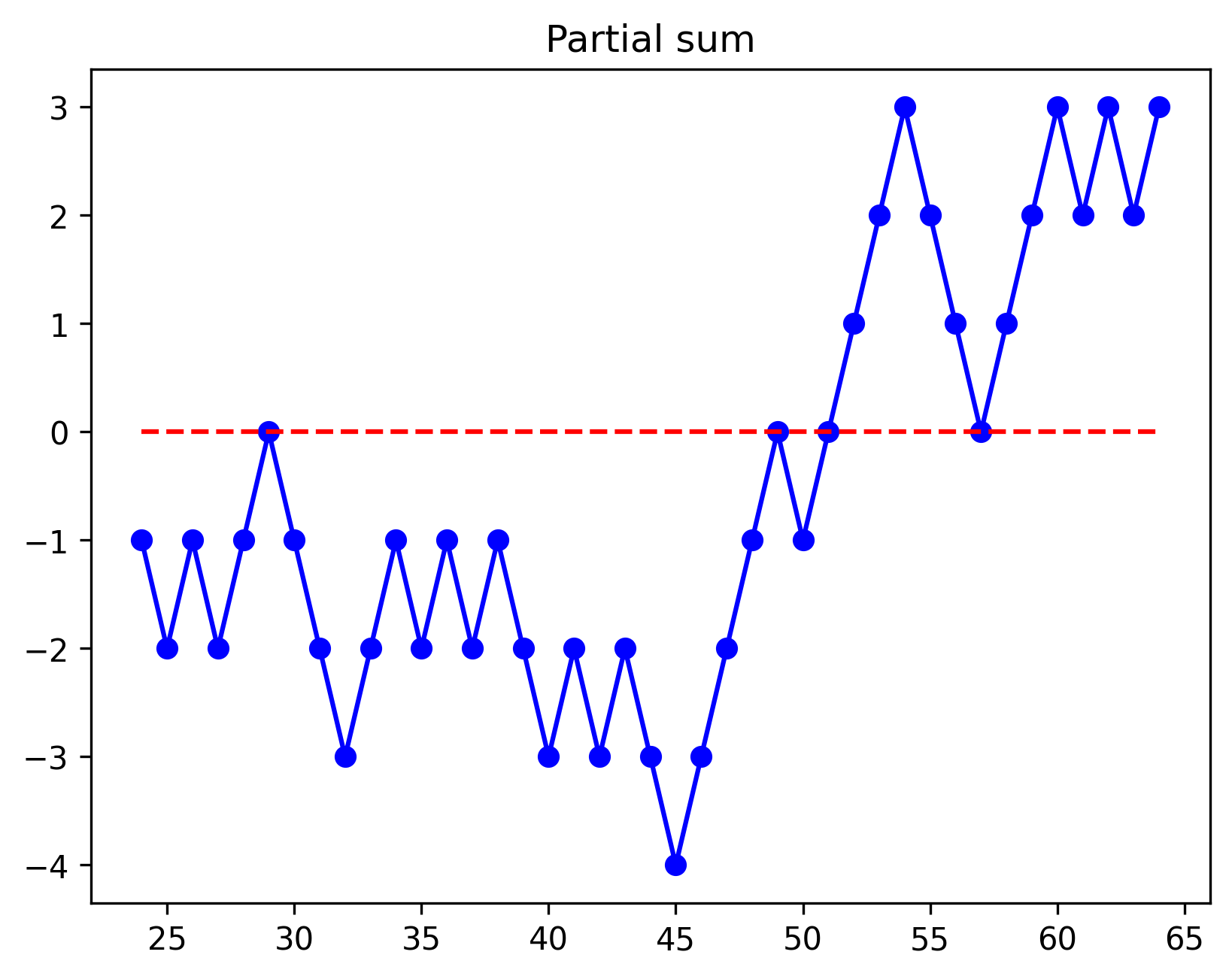
Here were the partial sums of the above secrets. That is, this plot is "count ending in 1 - count ending in 0", as you solve more:
( Also, you can bet on when this market will go <10% or >90% here: https://manifold.markets/PeterSchmidtNielsen/when-will-my-question-about-a-major )
 1,000
1,000🏅 Top traders
| # | Trader | Total profit |
|---|---|---|
| 1 | Ṁ1,816 | |
| 2 | Ṁ871 | |
| 3 | Ṁ644 | |
| 4 | Ṁ575 | |
| 5 | Ṁ400 |
Here are the partial sums (count ending in 1 - count ending in 0), now that the secrets are public:

As you can see, it's not completely dissimilar to the shape made by the market:

(However, when the market was down at 50% to 55% for a day or two several people apparently had already solved it! So it's not super clear, and the (admittedly somewhat poor) resemblance is probably partially noise.)
@PeterSchmidtNielsen This does not look like a typical series of partial sums to me. I still owe you an answer to the question what "typical" is.
The closest use related to my research is probably the typical rank of a tensor, which are all ranks that appear for a subset of tensors that are not of measure zero. This makes not much sense here, since the possible partial sums are a finite set. I think everything that occurs more often than, say, 10% of the time is a reasonable approximation for typical. I know this is not an exact definition and not the best description, but I don't know better.
Anyway nice game.
@ThomasMach Yes, thanks for playing and contributing! I will say, I think your point from before (that humans are very bad at gauging this sort of thing) was very true, and I'd say probably applies here. For example, here are 20 more uniformly random trajectories.

Would you say that the above trajectory is qualitatively that different than #3, #4, #5, or #20? I'd say qualitatively (again, where humans are a very poor judge of this) that the trajectory from this market doesn't stand out at all.
For reproducibility, and to show that nothing is up my sleeve, the above trajectories are generatated deterministically by the following Python code. I guess I could have fine-tuned how I chose to fix the seeds, or if I randomized a different way, but I'll just give you my word that I only wrote this one way of doing it, and didn't change it:
```
for i in range(20):
random.seed(i)
y = [0]
for _ in range(41):
y.append(y[-1] + random.choice((-1, +1)))
plt.plot(y[1:], marker='o', linestyle='-')
plt.plot([0]*41, color='r', linestyle='--')
plt.savefig(f'generate/{i:03}.png', dpi=300, bbox_inches='tight')
plt.close('all')
```
Regardless, I for sure appreciate you chiming in!
@PeterSchmidtNielsen I find the late crossover followed by another touching of 0 atypical. But a similar behavior indeed shows up in #3, #4, #5, and #20.
My tooling etc. I should probably do more writing on my thinking https://github.com/sundhaug92/MM-PSN
@MartinSundhaug yup, my graph agrees with yours https://gist.github.com/DavidBuchanan314/c83ed6aa5943934279949d775311370c

The rest of my code is uninteresting, just a python script to parse the challenge data and emit hashcat commands, which I manually pasted into ssh sessions into GPU-equipped boxes (at first in my living room, and then in the cloud). The vast majority of my compute budget (~$15 overall!) was blown around July 3rd (when I computed up to 51-bit), the remainder (when I remembered about this market yesterday) was comparatively cheap because of the number of revealed bits at the time.
Although I spent the money just-for-fun (I considered it a learning project for cloud GPU), I did get slightly better value-for-money than just directly purchasing mana! ($15 = M1500, but I gained M1816 in this market)
I expect efficiency could have been boosted significantly by writing custom CUDA/opencl, hashcat was hitting really low hashrates towards the end - and it really shouldn't have been. As I said earlier, it's pattern generator thingy presumably wasn't really built with this in mind.
@retr0id Looks like Peter's graph is in terms of bits to add rather than the odds of a yes. I ran the computation locally, meaning the compute-cost was the electricity I used (which I didn't measure) and the boiling apt.
I got 99 problems but the bits ain't one https://gist.github.com/DavidBuchanan314/cadca838cb04e07b0c47d8305059952b
(no point in locking my mana up until the end of the market, so here they are)
@retr0id Yeah I took a break when I had reached that, was too hot inside so waiting for the difficulty to drop was worth it
@MartinSundhaug Ahhh, so you knew for certain but didn't have enough mana balance to fully capitalize on it? I should've been paying attention to your balance!
@retr0id Yeah I've been throwing my daily (loan + share bonus + betting bonus) at this, since that's the liquidity I had. When @EstMtz DMed me asking me for the 56 bit I had some fun in them not asking me for everything I had. I actually knew the results when I pinged Peter on the 17th, but I wanted to keep up the appearances
@EstMtz As I understand what retr0id said previously, 2x the difficulty is expected so half the rate
@MartinSundhaug Yeah, although it could end up being better or worse than that depending on hashcat implementation details (would strongly recommend writing some custom mining code!)
(I am no longer trying to crack hashes but I am watching with curiosity)
@MartinSundhaug Ack, I'm so sorry, I got distracted by dealing with a logistics thing! I'll put it up right now!