Challenge Description:
I commit to completing the daily Tango puzzle on LinkedIn for 100 days. For each day, I must solve that day’s puzzle in 60 seconds, according to the official completion time recorded by the game.
LinkedIn’s streak system provide independent proof if I did not attempt a puzzle on a given day. In such a case, the streak is not failed.
If I exceed 60 seconds on any , the challenge is considered failed.
If i cant provide proof the i did it in 60 sec, teh chellenge is failled
 1,000
1,000🏅 Top traders
| # | Trader | Total profit |
|---|---|---|
| 1 | Ṁ823 | |
| 2 | Ṁ184 | |
| 3 | Ṁ115 | |
| 4 | Ṁ34 | |
| 5 | Ṁ21 |








Today I was bored, so I started digging through my performance stats..
Based on my current distribution, the chance of scoring over 60 on any given day is only: 0.57%
What are the odds that it happens at least once in the next 63 days?
Using the complement rule:
P(1−(1−0.0057)63
The result is: ≈30.2%
So there’s still roughly a 1-in-3 chance that I’ll hit another 60+ day before day 100.
But then I looked back at my actual history.
i want tracking it but over my 150-day streak, I can remember at least 4 outlier days where I went over a minute.
Historically, that means my real daily probability is closer to: ≈2.67%
If I use that probability instead for the next 63 days:
1−(1−0.0267)63≈0.821 ≈82%
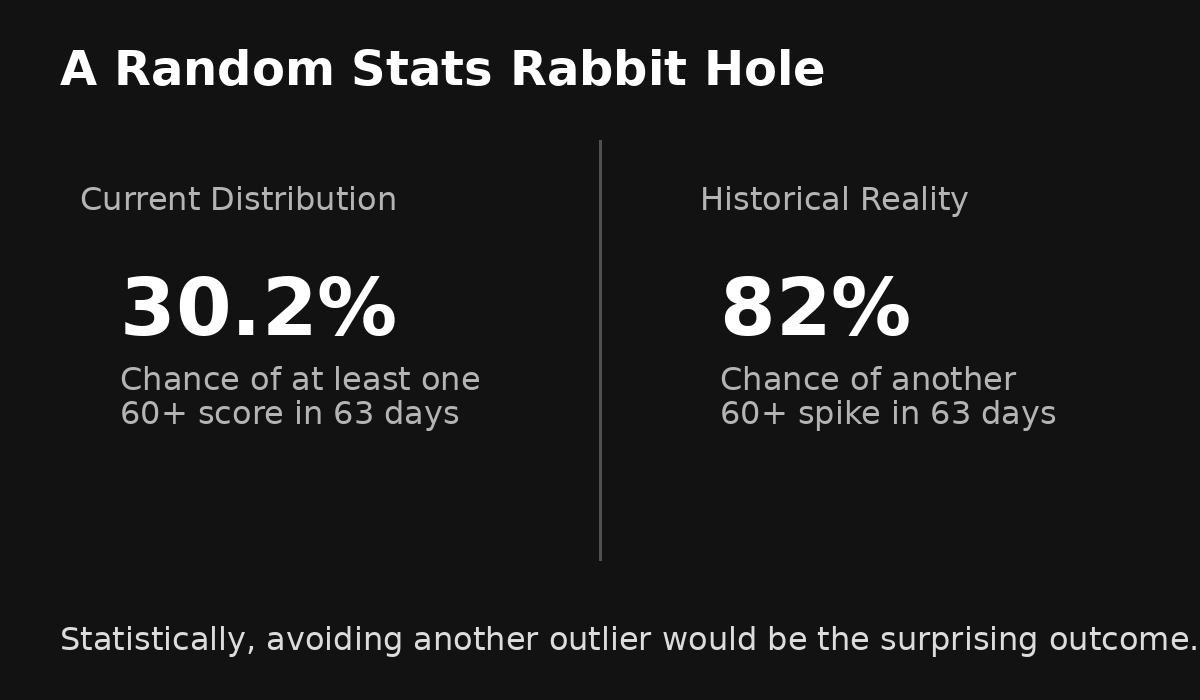
the current % is kinda in the middle of it; can i defeat the odds and win this challeng? Only time will tell
@Longtimecarp I’m aware that time measurements don't follow a perfect normal distribution since they can't be negativ, meaning the 'bell curve' should technically be truncated at zero. However, since my variance is small enough, the difference is negligible, so I decided to stick with the standard model for these calculations