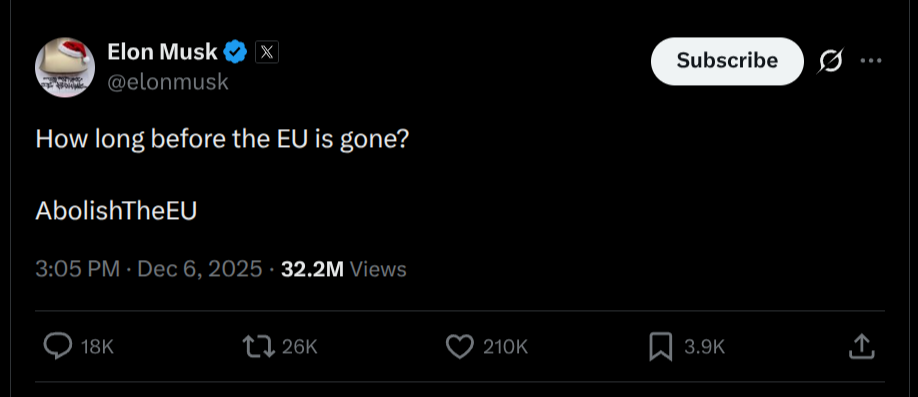
This is a long-term YES/NO market about which “lasts longer”: Elon Musk as a living person, or the European Union as an ongoing political union (including clear institutional successors that carry on its identity).
How this market resolves
YES – Resolves YES if Elon Musk ceases to exist (see definition below) before the EU (as defined below) ceases to exist.
NO – Resolves NO if the EU ceases to exist before Elon Musk ceases to exist.
N/A – Resolves N/A if:
The two events are effectively simultaneous in real-world terms (no sensible way to say which came first), or
By 1 January 2100, neither event has clearly occurred, or
The real world evolves in a way that makes the core comparison (“who lasts longer?”) genuinely undefined.
What counts as “Elon Musk ceasing to exist”?
For the purposes of this market, Elon Musk is treated as having “ceased to exist” when:
His death is clearly and credibly reported by major news sources and/or official announcements, or
There is a widely accepted legal declaration of his death (for example, after being missing for many years).
We use the ordinary, practical sense of biological death. Speculative scenarios like mind uploads, clones, AI copies, etc., do not affect resolution unless there is a clear, widely recognized legal sense in which he is still alive; in that case, the market creator will apply the spirit of the question and, if necessary, resolve N/A.
What counts as “the EU ceasing to exist”?
In this market, “the EU” means:
The current European Union and any direct institutional successor that clearly continues its legal and political identity without an actual break-up.
Concretely, the EU is considered to continue to exist if:
It changes its treaties, constitution, or internal structure;
It changes its official name (e.g., to something like “European Federation”) while explicitly inheriting the EU’s treaties, institutions, and membership;
It gains or loses members, even many of them, as long as there remains a single union that is generally recognized as the legal continuation of today’s EU.
The EU is considered to have ceased to exist if, while Elon Musk is still alive:
There is a formal legal dissolution or termination of the EU (or its continuous successor), with no single entity taking over its treaties and institutions as a direct continuation, or
The EU effectively breaks up into multiple separate unions and/or independent states, and no one surviving union is broadly recognized as the legal successor of the EU as a whole.
In other words, a scenario more like the breakup of a multinational union into distinct pieces, rather than a deepening or rebranding of the same union.
Edge cases & interpretation
Partial collapses or exits: If some member states leave, but an EU-like union remains that claims continuity and is recognized as such, the EU is still considered to exist.
Mergers into larger blocs: If the EU merges into a larger political entity, and that larger entity explicitly inherits the EU’s legal personality, treaties, and institutions (i.e., it is treated as the EU plus more), the EU is considered to continue to exist through that successor.
Extreme ambiguity: If historical and legal consensus is unclear about whether a new entity is a continuation of the EU or something entirely new, the market creator will resolve according to the most reasonable interpretation of “did the EU actually break up?” and may resolve N/A if it’s genuinely impossible to decide.
Timing and information sources
The market resolves as soon as the first of the two events clearly happens: Elon Musk’s death, or the EU’s cessation (as defined above).
If both happen close together, the resolution is based on which event clearly occurred earlier in real-world time (using UTC where needed).
Resolution will be based on widely available public information (major news outlets, official statements, and historical/academic consensus in the case of the EU).
 1,000
1,000